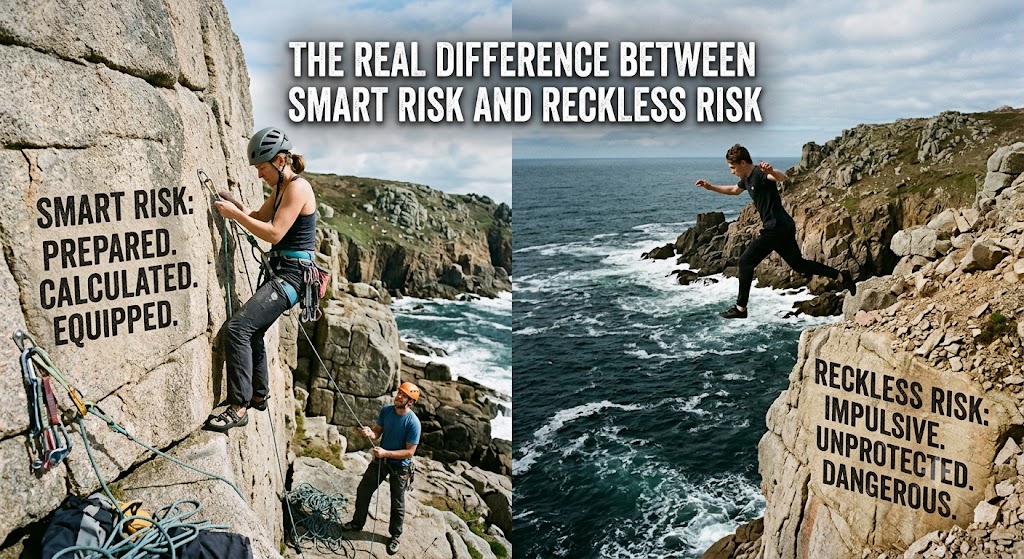
The Real Difference Between Smart Risk and Reckless Risk
Every meaningful achievement in life involves some level of risk. Starting a business, changing careers, investing money, relocating to a new city, learning a new skill, or even entering a serious relationship all require stepping into uncertainty. Yet despite this reality, many people either avoid risk completely or embrace it carelessly. One group becomes trapped by fear and misses opportunities that could have transformed their lives. The other jumps into decisions without preparation, hoping luck will compensate for poor judgment. Neither approach leads to lasting success. The real difference between smart risk and reckless risk is not the presence of uncertainty but the quality of preparation, knowledge, timing, and decision-making behind it.
One of the biggest misconceptions about successful people is that they are fearless gamblers. The truth is quite the opposite. Most financially successful entrepreneurs, investors, and business leaders spend far more time reducing risk than taking it. They research markets, gather information, test ideas, build contingency plans, seek expert advice, and calculate possible outcomes before making major decisions. What outsiders often describe as courage is usually the result of preparation. They are not betting blindly. They are making informed decisions with a clear understanding of both the potential rewards and the possible consequences.
Reckless risk follows a completely different path. It is driven by emotion rather than evidence. It often begins with excitement, greed, desperation, impatience, or the fear of missing out. Instead of asking difficult questions, people taking reckless risks search only for information that supports what they already want to believe. They ignore warning signs, dismiss experienced advice, and convince themselves that everything will somehow work out. Unfortunately, reality rarely rewards wishful thinking.
Consider someone who hears about a new investment opportunity promising extraordinary returns in a very short period. A person taking reckless risk immediately invests all their savings without understanding the business model, researching the company, or considering the possibility of loss. A person taking smart risk studies the investment, diversifies their portfolio, invests only money they can afford to lose, understands the risks involved, and prepares emotionally for different possible outcomes. Both individuals invest, but only one respects uncertainty.
Smart risk begins with education. Knowledge does not eliminate uncertainty, but it dramatically reduces unnecessary mistakes. Before successful investors buy stocks, they study financial statements, understand industries, evaluate management teams, and consider long-term economic trends. Before entrepreneurs launch businesses, they analyze competitors, identify customer needs, estimate operating costs, and test product demand. Before professionals switch careers, they assess market demand, develop new skills, and create financial safety nets. Preparation transforms uncertainty into calculated opportunity.
Reckless risk, on the other hand, often celebrates ignorance. Many people convince themselves that excessive research causes hesitation and that bold action alone creates success. While action is certainly important, action without understanding resembles driving at high speed through an unfamiliar city without looking at road signs. Movement alone does not guarantee progress. In many cases, it simply increases the speed at which mistakes happen.
One important characteristic of smart risk is proportional exposure. Intelligent decision-makers never risk everything on a single opportunity. They understand that even excellent decisions sometimes produce unfavorable results because life contains variables nobody can fully control. For this reason, they protect themselves by limiting potential damage. Investors diversify assets. Business owners maintain emergency funds. Professionals continue developing new skills even after finding stable employment. They prepare for uncertainty because they know certainty does not exist.
Reckless risk ignores proportionality. It places excessive confidence in one outcome. People sell all their possessions to invest in one business idea without market validation. They borrow large amounts of money for speculative ventures they barely understand. They leave stable employment without savings or alternative income. These decisions are not courageous. They are dangerous because they concentrate all hope into a single unpredictable event.
Another defining feature of smart risk is patience. Intelligent decision-makers understand that worthwhile opportunities rarely disappear overnight. They take sufficient time to verify information, consult trusted advisors, and evaluate alternatives. They understand that delaying a decision for better information often increases the probability of success.
Reckless risk mistakes urgency for opportunity. Scammers frequently exploit this weakness by creating artificial deadlines and claiming offers will disappear within hours. Fear of missing out pushes many people into decisions they would reject under calmer circumstances. Whenever someone pressures you into making an important financial decision immediately, caution becomes more valuable than speed.
Emotions play a powerful role in every major decision. Smart risk acknowledges emotions but refuses to let them become the primary decision-maker. Successful individuals recognize when excitement, fear, anger, pride, or desperation influence their thinking. They pause, reflect, and seek objective perspectives before acting.
Reckless risk allows emotions to dominate judgment. After suffering financial losses, some people immediately make larger investments hoping to recover quickly. Others become overconfident after experiencing early success and begin taking increasingly dangerous risks. Emotional decision-making often creates cycles of unnecessary gains followed by devastating losses.
One of the greatest differences between smart and reckless risk lies in how each approaches failure. People taking smart risks accept failure as one possible outcome and prepare accordingly. They create backup plans, maintain financial reserves, and preserve their ability to recover. If one strategy fails, they learn from the experience without destroying their future opportunities.
Those taking reckless risks rarely prepare for failure because they convince themselves failure cannot happen. They invest emergency savings, neglect insurance, ignore legal protections, or accumulate excessive debt. When unexpected setbacks occur, recovery becomes far more difficult because they eliminated every safety margin.
History provides countless examples of this distinction. Many famous entrepreneurs experienced failed businesses before building successful companies. Their willingness to take risks was balanced by continuous learning, adaptation, and careful resource management. They rarely repeated identical mistakes because each failure became valuable education.
Meanwhile, countless business failures result not from taking risks but from taking irresponsible risks. Owners overestimate demand, underestimate expenses, ignore customer feedback, expand too quickly, or rely excessively on borrowed money. These failures often reflect poor planning rather than bad luck.
Financial markets provide another excellent illustration. Long-term investors understand that market fluctuations are normal. They invest consistently, diversify holdings, and focus on decades rather than days. Short-term speculators often chase trends, follow rumors, and react emotionally to every market movement. While some experience temporary success, many eventually discover that emotional speculation creates unpredictable outcomes.
Smart risk also requires understanding probability rather than certainty. No investment, business, or career decision guarantees success. Intelligent decision-makers estimate probabilities instead of searching for guarantees. They compare possible rewards against possible losses and determine whether the expected value justifies the uncertainty.
For example, investing in education carries risk because no degree guarantees employment. However, acquiring valuable skills generally increases long-term earning potential significantly enough that many people consider the risk worthwhile. The decision becomes even smarter when students carefully choose fields with strong market demand rather than pursuing education without considering future opportunities.
Relationships also demonstrate this principle. Building trust with another person always involves emotional risk because rejection remains possible. Yet avoiding all relationships eliminates opportunities for companionship, growth, and happiness. Smart emotional risk involves choosing trustworthy people, communicating honestly, maintaining healthy boundaries, and recognizing warning signs. Reckless emotional risk ignores repeated evidence of dishonesty, manipulation, or incompatibility while hoping circumstances will magically improve.
Career development follows similar patterns. Remaining permanently in a comfortable but stagnant position may appear safe, yet it often creates invisible long-term risks. Skills become outdated. Industries change. Automation replaces routine work. Inflation reduces purchasing power. Sometimes refusing to take reasonable risks becomes the greatest risk of all.
This paradox surprises many people. Every decision carries risk, including choosing not to act. Someone who refuses to invest because markets fluctuate still faces the risk of inflation reducing purchasing power. Someone who avoids entrepreneurship may sacrifice opportunities for greater income and independence. Someone who never develops new skills risks becoming professionally irrelevant. The absence of visible action does not eliminate uncertainty. It simply changes its form.
Smart risk therefore involves comparing multiple risks rather than asking whether risk exists. Every option carries advantages and disadvantages. Intelligent decision-makers identify which uncertainties they can manage most effectively.
Successful people also distinguish between reversible and irreversible decisions. Reversible decisions allow experimentation because mistakes can be corrected relatively easily. Trying a new marketing strategy, learning software, offering a new product, or taking online courses usually involve manageable consequences. Irreversible decisions, such as guaranteeing large loans, selling major assets, or entering binding legal agreements, require much deeper analysis because reversing them becomes far more difficult.
This distinction encourages intelligent experimentation. Rather than betting everything immediately, successful entrepreneurs frequently test ideas using small-scale pilot projects. They gather customer feedback before expanding. Investors often begin with modest amounts before increasing exposure. Professionals volunteer for new responsibilities before making permanent career changes. Small experiments reduce uncertainty while preserving flexibility.
Another hallmark of smart risk is continuous learning. Markets evolve, technologies advance, consumer preferences change, and economic conditions shift constantly. Decisions that were intelligent five years ago may become outdated today. Successful individuals remain curious because they understand that yesterday’s knowledge cannot fully solve tomorrow’s problems.
Reckless risk often assumes previous success guarantees future success. This overconfidence blinds people to changing realities. Businesses fail when leaders ignore new competitors. Investors lose money when they assume markets always behave exactly as before. Professionals struggle when they stop learning after achieving initial success.
Confidence itself deserves careful examination. Healthy confidence grows from competence, preparation, and repeated experience. Dangerous confidence grows from ego, luck, or limited success. Smart risk relies upon realistic confidence supported by evidence. Reckless risk depends upon exaggerated confidence unsupported by preparation.
Many people confuse courage with recklessness because both involve uncertainty. True courage does not deny danger. It acknowledges danger while preparing responsibly. Firefighters wear protective equipment before entering burning buildings. Surgeons spend years studying before performing operations. Pilots follow detailed checklists before every flight regardless of experience. Professionals in high-risk environments understand that discipline protects lives.
Financial literacy strengthens smart risk by helping people recognize hidden consequences. Understanding compound interest, inflation, taxes, diversification, liquidity, debt management, and cash flow allows individuals to make more informed decisions. Without this knowledge, many attractive opportunities hide significant dangers beneath impressive promises.
Scams consistently target individuals seeking extraordinary returns with minimal effort. Whether involving fake investments, cryptocurrency fraud, pyramid schemes, or online business promises, these schemes usually exploit the same psychological weaknesses. They emphasize urgency, secrecy, guaranteed profits, and emotional excitement while discouraging independent verification. Recognizing these warning signs transforms potential victims into informed decision-makers.
The workplace also rewards calculated risk. Employees who volunteer for challenging assignments, present innovative ideas, develop leadership skills, and continuously improve often create greater career opportunities than those remaining permanently comfortable. However, intelligent professionals also evaluate organizational culture, available resources, and potential consequences before making significant career moves.
Parents unknowingly teach children attitudes toward risk through daily behavior. Children who observe thoughtful planning, responsible financial decisions, healthy problem-solving, and resilience after setbacks develop balanced perspectives toward uncertainty. Conversely, children exposed only to fear or recklessness may struggle to develop sound decision-making later in life.
Technology has amplified both smart and reckless risk. Information has become more accessible than ever before, allowing anyone to research industries, compare investments, learn skills, and access expert knowledge. At the same time, misinformation spreads rapidly through social media, making emotional decision-making easier than ever. The ability to distinguish credible information from persuasive marketing has become an essential life skill.
One practical framework for evaluating risk involves asking several important questions before making major decisions. What is the best possible outcome? What is the worst possible outcome? How likely is each outcome? Can I survive the worst-case scenario? What information am I missing? What assumptions am I making? Have I consulted knowledgeable people? Am I acting from excitement, fear, or evidence? What would make me change my mind? These questions slow emotional thinking and encourage rational evaluation.
Another valuable habit involves maintaining decision journals. Recording the reasoning behind major financial or business decisions allows people to evaluate their thinking later. This practice reveals patterns of judgment, highlights recurring mistakes, and improves future decision-making. Successful investors and entrepreneurs frequently analyze both successful and unsuccessful decisions because improvement comes from understanding the process, not merely celebrating outcomes.
It is equally important to recognize that smart risk evolves over time. A twenty-year-old with minimal financial responsibilities may reasonably accept greater career uncertainty than someone supporting a family. Likewise, individuals approaching retirement often prioritize capital preservation over aggressive growth. Smart risk adapts to changing circumstances rather than following rigid formulas.
Ultimately, progress belongs neither to those who avoid all uncertainty nor to those who embrace every opportunity blindly. It belongs to those who develop the wisdom to distinguish calculated opportunities from unnecessary dangers. Every meaningful goal requires courage, but courage becomes far more powerful when supported by preparation, knowledge, discipline, patience, and continuous learning.
The real difference between smart risk and reckless risk is not bravery. It is judgment. Smart risk asks questions before acting. Reckless risk acts before asking questions. Smart risk prepares for multiple outcomes. Reckless risk assumes only one outcome. Smart risk protects the future while pursuing opportunity. Reckless risk sacrifices the future for immediate excitement. Understanding this distinction can transform not only financial decisions but every important choice throughout life. Those who master calculated risk position themselves to seize opportunities with confidence while protecting themselves from avoidable disasters, creating a future built not on luck, but on thoughtful and informed decisions.

EarnSmartOnline.com.ng is dedicated to helping readers make smarter financial decisions through practical guides on online income, personal finance, technology, digital business, and wealth creation. Our goal is to provide reliable, easy-to-understand, and actionable content that empowers individuals to earn smarter, build sustainable income streams and achieve long-term financial success.
Recommended: Start Earning Online
- Ultimate Affiliate Marketing Program — learn affiliate marketing with a done-for-you sales system ($15). Check it out
- The Newbie Affiliate Guide — the beginner-friendly starter guide (~$6.68). Check it out
- Easy Dollar Maker — earn in dollars uploading AI images and videos from your phone ($17). Check it out
Disclosure: These are affiliate links. If you buy through them, I may earn a commission at no extra cost to you.