
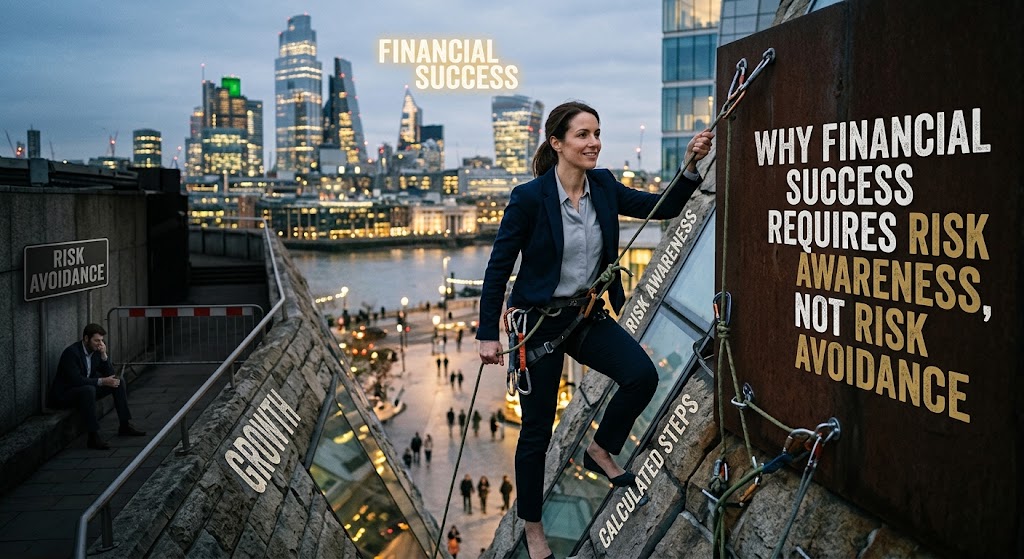
Why Financial Success Requires Risk Awareness, Not Risk Avoidance
Many people grow up believing that the safest path is always the best path. They are taught to avoid risks, play it safe, stay in familiar territory, and never make financial decisions that could lead to uncertainty. While caution is important, this mindset has quietly become one of the biggest obstacles to financial success. The truth is that financial success does not belong to people who avoid every risk. It belongs to those who understand risk, prepare for it, manage it wisely, and make informed decisions despite uncertainty. This is why financial success requires risk awareness, not risk avoidance.
One of the biggest misconceptions about money is that avoiding risk guarantees safety. In reality, avoiding risk simply means choosing a different kind of risk. Someone who refuses to invest because they fear losing money takes on the risk of inflation slowly reducing the purchasing power of their savings. Someone who avoids starting a business because they fear failure accepts the risk of remaining financially dependent on a single source of income. A person who refuses to learn new skills because they fear wasting time faces the risk of becoming irrelevant in a changing job market. Every financial decision carries risk, whether you recognize it or not.
Risk is part of everyday life. Every time you drive a car, cross a busy street, or even eat at a restaurant, there is some level of risk involved. Yet people continue doing these things because they understand that the goal is not to eliminate risk completely but to reduce unnecessary danger while enjoying the benefits. Money works exactly the same way. Wealth is built by people who understand how to evaluate risks instead of pretending they do not exist.
History repeatedly shows that nearly every successful entrepreneur, investor, inventor, or business owner faced uncertainty before achieving financial success. They did not possess magical confidence or guarantees of success. What separated them from others was their willingness to study the situation, prepare carefully, and take calculated risks instead of reckless ones. They understood that avoiding every opportunity because of fear often leads to a lifetime of missed possibilities.
Many people confuse calculated risk with gambling. These are not the same thing. Gambling depends primarily on luck, while calculated risk depends on preparation, research, probability, and decision-making. A business owner who studies customer demand before opening a store is taking a calculated risk. An investor who researches companies before buying shares is taking a calculated risk. A professional who spends months learning a valuable digital skill before changing careers is taking a calculated risk. These decisions involve uncertainty, but they are supported by information rather than blind hope.
One reason many people avoid financial risk is because they focus entirely on what they might lose instead of what they could gain. Human beings naturally dislike losses more than they enjoy equivalent gains. Psychologists call this loss aversion. Losing one thousand dollars often feels more painful than the happiness of gaining one thousand dollars. While this instinct helped humans survive dangerous environments thousands of years ago, it can become harmful in today’s financial world. Excessive fear of loss often prevents people from making decisions that could improve their lives over time.
Inflation provides one of the best examples of hidden risk. Many people believe keeping all their money in cash is the safest option. While cash provides liquidity and short-term stability, inflation gradually reduces its purchasing power. If inflation averages several percent every year, the same amount of money buys fewer goods and services over time. By trying to avoid investment risk completely, many people unknowingly expose themselves to inflation risk, which quietly erodes wealth year after year.
Career choices also demonstrate the importance of risk awareness. Someone who remains in the same position for decades simply because it feels comfortable may believe they are avoiding risk. However, industries evolve, automation replaces repetitive tasks, and economic conditions change. The greater risk may actually be refusing to develop new skills. Continuous learning, certifications, networking, and adapting to changing technologies involve effort and uncertainty, but they also reduce the long-term risk of unemployment or career stagnation.
Business owners understand that every opportunity comes with uncertainty. Launching a new product, hiring employees, expanding into another city, or entering a different market all involve financial risk. However, businesses that refuse to adapt often disappear. Companies that once dominated entire industries have vanished because they feared changing their business models while competitors embraced innovation. Sometimes the biggest risk is remaining exactly where you are while the world continues moving forward.
Successful investors rarely try to eliminate risk completely. Instead, they manage it through diversification, research, patience, and discipline. Diversification means spreading investments across different assets instead of placing everything into one opportunity. This approach recognizes that nobody can predict the future perfectly. Rather than depending on certainty, wise investors build systems that remain resilient even when unexpected events occur.
Emergency savings represent another practical example of risk awareness. Building an emergency fund does not eliminate the possibility of job loss, illness, or unexpected expenses. Instead, it prepares you to handle uncertainty without financial panic. Risk-aware individuals understand that unexpected events are part of life. Rather than pretending emergencies will never happen, they create financial buffers that allow them to recover more quickly.
Insurance exists because risk can never be completely eliminated. Health insurance, vehicle insurance, business insurance, and property insurance all acknowledge uncertainty while reducing financial consequences. Paying small premiums today protects against potentially devastating losses tomorrow. This is not risk avoidance. It is intelligent risk management.
Education itself is an investment involving risk. Spending money on training, university, professional certifications, or specialized skills requires time, effort, and financial commitment. There is never a guarantee that every educational investment will produce immediate results. However, refusing to invest in personal development carries its own long-term risk. Knowledge often creates opportunities that remain invisible to those who never acquire it.
Many people delay important financial decisions because they are waiting for certainty. Unfortunately, certainty rarely exists in business, investing, employment, or entrepreneurship. Markets change, technology evolves, consumer preferences shift, and global events influence economies in unpredictable ways. Waiting until every uncertainty disappears often means waiting forever while opportunities pass by.
Financial literacy dramatically improves risk awareness. The more people understand budgeting, investing, taxes, interest rates, business principles, and economic trends, the better they become at recognizing potential dangers before making decisions. Knowledge does not remove uncertainty, but it reduces unnecessary mistakes. Financial education transforms fear into informed judgment.
Debt also illustrates the importance of understanding risk. Debt itself is neither entirely good nor entirely bad. Productive debt used responsibly for education, business expansion, or appreciating assets can generate future income. Uncontrolled consumer debt used to finance temporary pleasures often creates long-term financial stress. The difference lies in understanding how each type of debt affects future financial stability.
Technology has introduced new forms of financial opportunity as well as new risks. Digital businesses, cryptocurrency, online investing, artificial intelligence, remote work, and e-commerce offer tremendous possibilities. They also attract scams, misinformation, and unrealistic promises of quick wealth. Risk-aware individuals research thoroughly before participating. They understand that excitement should never replace due diligence.
One common mistake is confusing courage with recklessness. Courage involves acting despite uncertainty after careful preparation. Recklessness ignores warning signs, refuses to gather information, and depends on optimism alone. Financial success rewards courage far more often than recklessness. Intelligent decision-makers ask questions, verify information, evaluate alternatives, and prepare contingency plans before acting.
Emotional control plays a major role in financial risk management. During economic booms, excitement encourages people to chase unrealistic returns. During downturns, fear convinces many to sell valuable assets at the worst possible moment. Risk-aware individuals recognize these emotional patterns and avoid making major financial decisions based solely on temporary feelings. They understand that markets, businesses, and economies naturally experience cycles.
Time is another powerful factor. Short-term uncertainty often discourages people from making long-term investments. However, many successful financial strategies depend on patience. Compound growth rewards consistency over many years rather than immediate gratification. Those who constantly react to daily market fluctuations frequently undermine their own long-term success.
Entrepreneurs often experience multiple failures before building profitable businesses. These failures should not automatically be viewed as evidence that taking risks is wrong. Instead, they often represent valuable learning experiences that improve future decision-making. Every mistake provides information about customers, operations, marketing, pricing, or management. Individuals who remain willing to learn often become stronger after setbacks than they were before.
Family financial planning also benefits from risk awareness. Parents who create wills, purchase insurance, save for education, and prepare retirement plans acknowledge uncertainty without becoming fearful. They recognize that responsible planning protects loved ones regardless of future circumstances. Ignoring these responsibilities because uncomfortable topics are unpleasant creates greater financial vulnerability later.
Another overlooked aspect of risk awareness involves recognizing fraudulent opportunities. Scammers frequently promise guaranteed returns, effortless wealth, secret investment strategies, or unbelievable profits. Risk-aware individuals understand that unusually high returns usually involve unusually high risks. They ask difficult questions, verify credentials, and remain skeptical of promises that appear too good to be true.
Networking reduces financial risk in surprising ways. Relationships with experienced professionals, mentors, accountants, lawyers, investors, and business owners provide valuable advice before important decisions are made. Learning from other people’s experiences often prevents expensive mistakes that books alone cannot teach.
Risk tolerance varies from person to person. Someone nearing retirement may prefer lower-risk investments than a young professional beginning a career. There is no universal formula suitable for everyone. Financial success requires understanding your own goals, responsibilities, income stability, and comfort level while making decisions appropriate for your unique circumstances.
Preparation transforms uncertainty into manageable challenges. Successful business owners create backup plans. Investors maintain diversified portfolios. Families establish emergency savings. Professionals continuously update their skills. These actions do not eliminate risk, but they dramatically improve resilience when unexpected events occur.
The world rewards individuals who solve problems, create value, and embrace intelligent uncertainty. Every major innovation, successful company, breakthrough technology, or life-changing investment began with someone willing to move forward despite incomplete information. Progress has never belonged to people who waited for perfect safety. It has belonged to those who prepared thoroughly, acted wisely, learned continuously, and adjusted when necessary.
Financial success is not about eliminating every possibility of failure because that goal is impossible. Every investment carries uncertainty. Every business faces competition. Every career encounters change. Every economy experiences cycles. The objective is to understand these realities and make decisions that maximize opportunity while minimizing unnecessary exposure.
Building wealth requires balancing caution with confidence. Too much caution prevents growth, while excessive confidence invites disaster. Financial wisdom exists between these extremes. It involves gathering accurate information, evaluating probabilities, protecting against worst-case scenarios, and taking calculated action when opportunities align with your goals.
Ultimately, the greatest financial danger is often not the risks you choose to take but the opportunities you never pursue because fear convinced you to remain still. Every year spent avoiding intelligent financial decisions represents time that can never be recovered. Wealth rarely belongs to those who spend their lives hiding from uncertainty. It belongs to people who respect risk, understand it, prepare for it, and move forward with wisdom instead of fear.
The most successful people are not fearless. They simply refuse to let fear become their financial strategy. They recognize that every worthwhile opportunity contains uncertainty, every meaningful achievement requires courage, and every prosperous future is built through informed decisions rather than perfect guarantees. Financial success is therefore not the reward for avoiding risk. It is the reward for becoming aware of risk, managing it responsibly, and using knowledge, discipline, and preparation to turn uncertainty into opportunity.

EarnSmartOnline.com.ng is dedicated to helping readers make smarter financial decisions through practical guides on online income, personal finance, technology, digital business, and wealth creation. Our goal is to provide reliable, easy-to-understand, and actionable content that empowers individuals to earn smarter, build sustainable income streams and achieve long-term financial success.
Recommended: Start Earning Online
- Ultimate Affiliate Marketing Program — learn affiliate marketing with a done-for-you sales system ($15). Check it out
- The Newbie Affiliate Guide — the beginner-friendly starter guide (~$6.68). Check it out
- Easy Dollar Maker — earn in dollars uploading AI images and videos from your phone ($17). Check it out
Disclosure: These are affiliate links. If you buy through them, I may earn a commission at no extra cost to you.



