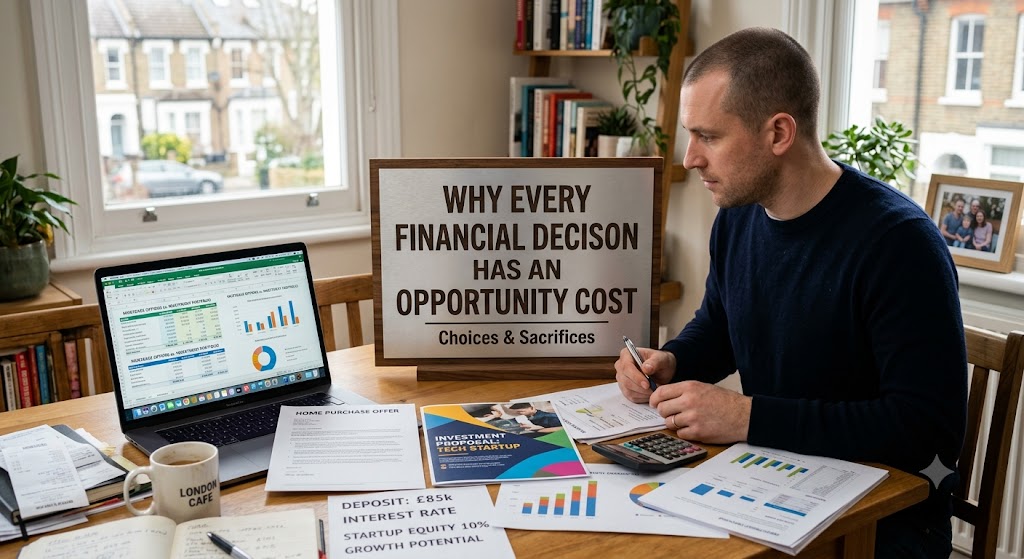
Why Every Financial Decision Has an Opportunity Cost
Money is one of the most powerful tools people use every day, yet very few stop to think about the hidden price attached to every financial decision they make. Most people believe the cost of buying something is simply the amount printed on the price tag, but economics teaches a much deeper truth. Every financial decision has an opportunity cost. Whether you are buying a new smartphone, investing in a business, saving money in a bank account, purchasing a house, or deciding to spend an evening at a restaurant, you are also giving up something else that your money, time, and resources could have achieved.
Understanding this principle is one of the biggest differences between people who consistently build wealth and those who remain trapped in financial struggle. Wealthy individuals rarely look only at what they are buying. They also consider what they are sacrificing by making that purchase. They understand that every pound, dollar, euro, or naira spent today cannot be spent elsewhere tomorrow. Every financial decision closes one door while opening another. Learning to evaluate those trade-offs is one of the most valuable financial skills anyone can develop.
Opportunity cost is not about avoiding spending altogether. Instead, it is about making intentional choices that maximise value over the long term. Life will always require spending money, but intelligent financial decisions involve understanding what must be sacrificed before committing available resources. Every choice carries consequences, whether those consequences are obvious or hidden.
Many people mistakenly believe that financial success depends entirely on earning more money. While increasing income certainly helps, poor decision-making can quickly erase even a high salary. There are countless examples of professional athletes, entertainers, executives, and entrepreneurs who earned millions yet eventually faced financial ruin. At the same time, many individuals with average incomes quietly accumulate wealth because they consistently choose the option with the better long-term reward.
The difference often comes down to opportunity cost. Imagine someone receives a yearly bonus from work. One person immediately spends it on luxury items that lose value over time. Another invests the same amount into learning a valuable skill, purchasing productive equipment, or investing in appreciating assets. Both spent exactly the same amount of money, but the future outcomes are completely different because of the opportunity costs attached to each decision.
Money is limited for everyone. Even billionaires have finite resources. Since no one can buy everything they want, every financial decision involves choosing one possibility over another. Every purchase silently says no to hundreds of other possibilities. That reality exists whether people acknowledge it or not.
One of the easiest examples involves dining out. Suppose someone spends a significant amount eating at expensive restaurants several times each week. While each meal provides temporary satisfaction, the cumulative amount spent over months or years could have been invested into a business, retirement account, emergency fund, education, or property. The true cost of those meals is not merely the restaurant bill. It also includes everything the same money could have accomplished elsewhere.
This idea becomes even more powerful when combined with time. Money has the ability to grow when invested wisely. A small amount invested today may become several times larger years later because of compound growth.
When money is spent on unnecessary consumption instead of productive assets, the opportunity cost includes not only the original amount but also all the future growth that money could have generated. This hidden cost is often invisible because people naturally focus on what they gained today instead of what they lost tomorrow.
Consider two friends who both receive the same monthly salary. One spends nearly everything immediately after payday, constantly upgrading gadgets, buying fashionable clothing, and financing expensive lifestyles. The other carefully budgets expenses, invests consistently, and purchases only what genuinely improves quality of life. After ten or fifteen years, the difference between their financial positions may become enormous despite earning identical incomes. The gap was created not simply by income but by thousands of financial decisions, each carrying its own opportunity cost.
The concept also applies to borrowing money. Many people focus only on monthly repayments without considering the opportunities they sacrifice. Large debts reduce financial flexibility. Every future payment made towards unnecessary debt is money that cannot be invested, saved, donated, or used to pursue new opportunities. Interest payments especially represent opportunity costs because they transfer wealth away from the borrower instead of building personal assets.
Impulse buying provides another excellent example. Retail stores, online marketplaces, and advertisers spend billions studying consumer psychology. Their goal is to encourage immediate purchases before customers fully evaluate alternatives. Flash sales, limited-time discounts, countdown timers, and promotional offers often create emotional urgency rather than rational decision-making.
A discounted item may appear to save money, but if the purchase was unnecessary, no real savings occurred. Instead, money that could have remained invested or available for future priorities disappeared. The opportunity cost becomes the productive use that money never received.
Subscriptions illustrate another hidden financial drain. Modern consumers often subscribe to streaming platforms, fitness services, software, premium memberships, online tools, cloud storage, music services, gaming platforms, and digital applications. Individually, each subscription may seem affordable. Together, they quietly consume significant monthly income. Those recurring payments represent ongoing opportunity costs because they reduce the amount available for investments, emergency savings, business capital, or debt reduction.
Education also involves opportunity cost. Pursuing higher education often requires tuition, books, transportation, and years away from full-time employment. However, if the education develops valuable skills that substantially increase future earnings, the long-term benefits may outweigh the immediate sacrifices. The key question becomes whether the expected return justifies what must be given up.
Business owners constantly evaluate opportunity costs. Every investment decision requires comparing alternatives. Should profits be reinvested into marketing, new equipment, additional employees, product development, inventory expansion, or debt repayment? Choosing one option inevitably means postponing another. Successful entrepreneurs understand that wise allocation of limited resources determines long-term business success.
Even governments face opportunity costs. Public budgets cannot fund every desired programme simultaneously. Increased spending on infrastructure may reduce funds available for healthcare, education, defence, or public transportation. Economic policy often involves choosing between competing priorities because resources remain finite.
Opportunity cost also affects career decisions. Accepting one job frequently means declining another opportunity. Starting a business may require giving up a stable salary. Pursuing entrepreneurship carries risks, but remaining in an unfulfilling career may also carry hidden costs through lost earning potential and unrealised opportunities. Financial decisions extend far beyond simple purchases.
Time itself possesses enormous economic value. Every hour devoted to one activity cannot simultaneously be used elsewhere. Spending countless hours consuming entertainment may feel enjoyable, but the opportunity cost could include acquiring valuable skills, building relationships, exercising, reading educational material, or developing additional income sources. Although time cannot be deposited into a bank account, it remains one of the most valuable financial assets every individual possesses.
Many people underestimate how small financial decisions accumulate over decades. Buying expensive coffee each morning may appear insignificant. However, repeated thousands of times over many years, those purchases represent substantial opportunity costs. This does not necessarily mean people should eliminate every enjoyable expense. Rather, they should understand the true long-term implications before deciding whether the temporary pleasure justifies the sacrifice.
Saving money also involves opportunity costs. Keeping excessive amounts of cash in low-interest accounts may feel safe, but inflation gradually reduces purchasing power. While security is important, money that never earns meaningful returns sacrifices potential growth. Wise financial planning balances liquidity, safety, and investment opportunities rather than focusing exclusively on one objective.
The housing market provides another practical example. Purchasing an expensive home may offer prestige and comfort, but higher mortgage payments, maintenance costs, insurance, taxes, and utilities reduce financial flexibility for years. A more modest home may free substantial income for investing, business development, travel, retirement planning, or children’s education. The true comparison extends beyond property size to everything those monthly savings can accomplish elsewhere.
Financial freedom often depends less on earning extraordinary income than on consistently recognising opportunity costs before making decisions. Every pound, dollar, euro, or naira has multiple possible destinations. People who carefully compare those alternatives generally make stronger financial choices over time. Wealth is rarely built through one spectacular decision. More often, it grows through thousands of thoughtful choices made consistently across many years.
Perhaps the greatest lesson opportunity cost teaches is intentional living. Instead of allowing emotions, advertising, peer pressure, or temporary desires to dictate spending habits, financially successful individuals pause to ask one powerful question before making important purchases. They ask themselves what else this money could accomplish if used differently. That simple question often changes everything because it shifts attention from immediate gratification toward long-term value.
Every financial decision writes part of your future. Whether you realise it or not, every purchase, every investment, every loan, every subscription, every luxury, every sacrifice, and every saving decision shapes the life you will experience years from now. Understanding opportunity cost does not remove difficult choices, but it ensures those choices are made with greater awareness, wisdom, and purpose. In the end, the people who consistently build lasting wealth are usually not those who have unlimited money. They are the ones who understand that every financial decision has an opportunity cost and choose accordingly.

EarnSmartOnline.com.ng is dedicated to helping readers make smarter financial decisions through practical guides on online income, personal finance, technology, digital business, and wealth creation. Our goal is to provide reliable, easy-to-understand, and actionable content that empowers individuals to earn smarter, build sustainable income streams and achieve long-term financial success.
Recommended: Start Earning Online
- Ultimate Affiliate Marketing Program — learn affiliate marketing with a done-for-you sales system ($15). Check it out
- The Newbie Affiliate Guide — the beginner-friendly starter guide (~$6.68). Check it out
- Easy Dollar Maker — earn in dollars uploading AI images and videos from your phone ($17). Check it out
Disclosure: These are affiliate links. If you buy through them, I may earn a commission at no extra cost to you.