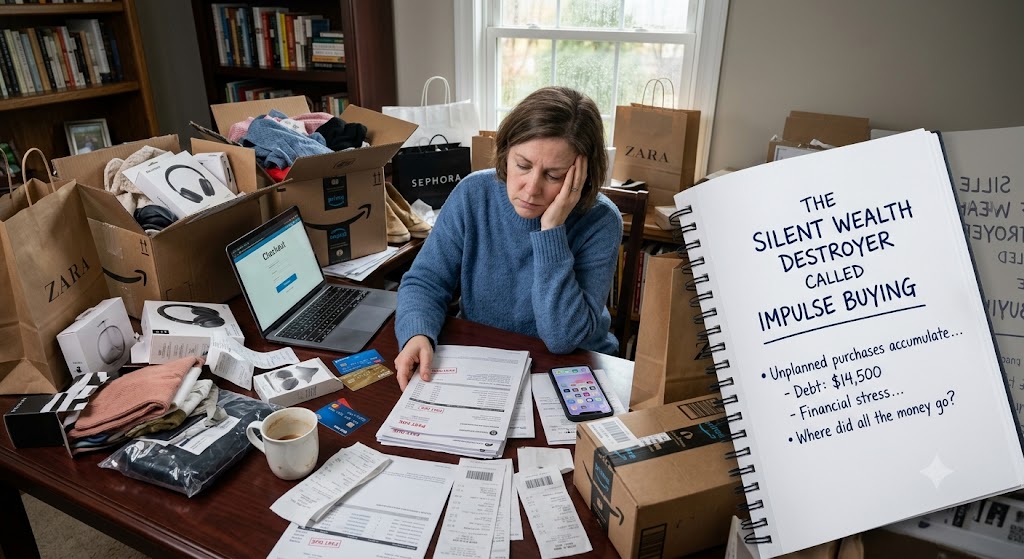
The Silent Wealth Destroyer Called Impulse Buying
Impulse buying is one of the most underestimated financial problems in modern society. Unlike unemployment, debt, or inflation, it rarely announces itself as a major threat. It doesn’t usually arrive with alarming headlines or obvious financial disasters. Instead, it quietly slips into everyday life through small, seemingly harmless purchases that gradually consume money that could have been invested, saved, or used to create lasting wealth. This is why impulse buying deserves far more attention than it receives. It is a silent wealth destroyer because its damage accumulates slowly, often without the buyer noticing until years have passed.
Many people believe financial struggles are caused mainly by low income. While income certainly plays an important role, the truth is that countless people earning respectable salaries still struggle financially because they spend without intention. Every unplanned purchase represents money that has been redirected away from future opportunities. The issue is rarely about a single expensive item. Instead, it is the hundreds or even thousands of spontaneous purchases made over months and years that quietly reshape a person’s financial future.
The rise of online shopping has made impulse buying easier than at any other time in history. A smartphone is now a shopping mall that fits inside a pocket. Social media platforms constantly expose users to products they never intended to buy. Advertisements are carefully designed using sophisticated algorithms that learn individual preferences, habits, interests, and even emotional states. This means consumers are no longer searching for products. Products are searching for consumers.
Many purchases begin with a sentence people have repeated countless times: “I wasn’t planning to buy this, but…” That short statement often marks the beginning of unnecessary spending. The item may appear affordable. It may even be discounted. The buyer feels they are saving money because of a promotion, yet they forget one simple truth. You never save money by buying something you never intended to purchase in the first place.
Impulse buying is driven more by emotion than logic. People often shop when they are excited, stressed, bored, lonely, frustrated, or even celebrating success. Retailers understand this human behaviour extremely well. Their marketing strategies are designed to encourage emotional decisions before rational thinking has time to intervene. Bright colours, limited-time offers, countdown timers, exclusive deals, free shipping thresholds, flash sales, and persuasive product descriptions all work together to create urgency.
Scarcity is another powerful psychological trigger. When shoppers see messages such as “Only three left,” “Sale ends tonight,” or “Limited stock available,” they begin worrying about missing an opportunity rather than evaluating whether they actually need the product. Fear of missing out often overrides financial discipline.
One of the greatest misconceptions about impulse buying is believing only expensive purchases matter. In reality, small daily purchases often cause greater long-term damage. A coffee purchased every workday, unnecessary snacks during fuel stops, subscriptions forgotten after free trials, repeated online food deliveries, frequent fashion purchases, and random gadgets all seem insignificant individually. Together, however, they create a substantial financial drain.
Imagine someone spends only the equivalent of ten dollars each day on unnecessary purchases. That equals approximately three hundred dollars every month. Over one year, that becomes three thousand six hundred dollars. Over ten years, without considering investment returns, that reaches thirty-six thousand dollars. If that money had instead been invested consistently, the long-term financial difference could be life changing.
Impulse buying doesn’t only reduce savings. It also delays wealth creation. Money can only perform one job at a time. Every currency note spent impulsively loses the opportunity to earn future returns. Financial experts often describe this as opportunity cost. When money is used to satisfy temporary emotions, it cannot simultaneously build investments, reduce debt, fund education, start businesses, or generate passive income.
Social media has dramatically intensified impulse buying behaviour. Influencers showcase luxury lifestyles, fashionable clothing, expensive gadgets, luxury vacations, premium vehicles, and designer accessories. Followers begin comparing their own lives with carefully edited online content. They often forget that many online personalities earn money promoting products or receive those products free of charge. Viewers attempt to imitate lifestyles that may not even reflect reality.
Comparison is one of the most dangerous financial habits because it encourages spending for appearance rather than usefulness. Many purchases are not motivated by personal need but by social pressure. People buy larger homes than necessary, newer phones before the old ones become obsolete, fashionable clothes they rarely wear, or luxury brands simply because others appear to own them.
Modern payment systems also contribute significantly to impulse buying. Cash creates psychological resistance because people physically see money leaving their hands. Digital payments remove much of that emotional discomfort. Credit cards, mobile wallets, one-click purchasing, buy-now-pay-later services, and automatic payment systems reduce the feeling of spending. As a result, consumers often purchase far more than they would if required to pay entirely with cash.
Buy-now-pay-later services deserve particular attention. They create the illusion that products are affordable simply because payments are divided into smaller instalments. Unfortunately, many consumers accumulate multiple payment plans simultaneously until large portions of future income become committed before salaries even arrive.
Retail stores are carefully engineered environments. Every shelf placement, background song, lighting arrangement, fragrance, product display, and checkout layout has been tested to encourage spending. Supermarkets intentionally place sweets, drinks, magazines, batteries, and other inexpensive products near checkout counters because shoppers waiting in queues become more likely to purchase items they never intended to buy.
Online stores use similar strategies. Product recommendations, personalised suggestions, customers-also-bought sections, abandoned cart reminders, email discounts, loyalty rewards, and push notifications all encourage additional purchases. Many consumers believe they are making independent buying decisions when in reality sophisticated marketing systems are heavily influencing those decisions.
Impulse buying also affects relationships. Couples frequently argue about money because one partner spends impulsively while the other prioritises saving. Financial disagreements remain among the leading causes of relationship conflict worldwide. Often, the argument is not about a single purchase but about repeated spending patterns that gradually undermine shared financial goals.
Parents also unintentionally pass impulse buying habits to children. Young people observe adults making emotional purchases and begin believing spending equals happiness. Without proper financial education, children may grow into adults who repeat identical behaviours.
Another overlooked consequence of impulse buying is household clutter. Many homes contain wardrobes full of unworn clothes, kitchens filled with unused appliances, garages packed with forgotten equipment, and shelves crowded with products purchased during moments of excitement but rarely used afterwards. Clutter represents money trapped inside depreciating possessions instead of productive assets.
Financial stress frequently follows impulsive spending. After the excitement of purchasing disappears, reality returns. Credit card balances increase. Savings decline. Bills become more difficult to pay. Emergency funds remain inadequate. Investment opportunities are postponed. The emotional satisfaction lasts only briefly while the financial consequences can persist for months or years.
Advertising constantly encourages immediate gratification. Society celebrates consumption far more visibly than saving. New product launches receive enormous publicity while disciplined financial behaviour rarely attracts similar attention. As a result, many people unconsciously associate spending with success and saving with deprivation.
True wealth, however, is rarely built through constant consumption. Wealth grows when people consistently spend less than they earn and invest the difference wisely. Every financially successful individual eventually masters delayed gratification. They understand that refusing today’s unnecessary purchase may create tomorrow’s financial freedom.
Breaking the impulse buying habit begins with awareness. People cannot change behaviours they refuse to acknowledge. Reviewing bank statements often reveals surprising spending patterns. Many consumers are shocked when they calculate how much money disappears each month on non-essential purchases.
Creating a shopping list before entering stores significantly reduces spontaneous purchases. Lists create intentionality. Buyers focus on necessities rather than distractions. Similarly, avoiding recreational shopping helps eliminate unnecessary temptation. Shopping should solve problems, not relieve boredom.
Waiting before purchasing expensive items is another highly effective strategy. Many financial experts recommend a twenty-four-hour or even thirty-day waiting period for non-essential purchases. During this time, emotional excitement usually fades, allowing logical thinking to replace impulsive decision-making. Surprisingly, many people discover they no longer want the item after waiting.
Budgeting also provides powerful protection. A well-designed budget assigns every unit of income a purpose before spending begins. When people know exactly where their money should go, impulsive purchases become easier to identify and resist.
Removing stored payment information from online shopping websites introduces valuable friction. Having to manually enter payment details creates extra time for reconsideration. Even small inconveniences can dramatically reduce unnecessary purchases.
Turning off promotional emails and shopping notifications also decreases temptation. Many impulse purchases occur simply because consumers were reminded about products they had completely forgotten. Reducing exposure naturally reduces desire.
Understanding emotional triggers is equally important. Some people shop when anxious. Others spend after receiving salaries. Some buy excessively during celebrations while others use shopping to escape loneliness. Identifying personal triggers allows individuals to develop healthier coping mechanisms that do not involve unnecessary spending.
Saving should become automatic rather than optional. Automatic transfers into investment or savings accounts reduce the amount of money available for impulsive purchases. People generally adapt their spending to whatever remains accessible.
Financial goals provide powerful motivation against impulse buying. Someone saving for a home deposit, business investment, retirement, education, or emergency fund finds it easier to reject unnecessary purchases because every spending decision is measured against a meaningful objective.
One useful question before every purchase is remarkably simple: “Will this item improve my life enough to justify delaying my financial goals?” Many purchases immediately fail this test.
Minimalism has also gained popularity because it encourages intentional ownership rather than endless accumulation. Owning fewer but higher-quality possessions often increases satisfaction while reducing unnecessary spending.
Impulse buying is ultimately a battle between immediate pleasure and future freedom. Every purchase represents a choice between present comfort and long-term opportunity. While there is nothing wrong with occasionally enjoying life’s pleasures, repeated emotional spending gradually weakens financial stability.
The world’s wealthiest individuals rarely become wealthy because they purchased everything they wanted. They became wealthy because they consistently distinguished between wants and needs, opportunities and distractions, assets and liabilities. They recognised that every financial decision shapes future possibilities.
One overlooked truth is that financial independence is built through thousands of ordinary decisions rather than a few extraordinary ones. Saying no to unnecessary spending today may seem insignificant. Repeating that decision hundreds of times over many years creates extraordinary financial results.
Consumers should also remember that companies spend billions studying human psychology. Marketing professionals continuously test advertisements, colours, pricing structures, product placements, and promotional techniques to maximise purchasing behaviour. There is nothing accidental about modern retail environments. They are designed to encourage spending. Recognising this makes it easier to approach purchasing decisions with caution instead of emotion.
Financial discipline should never be confused with deprivation. The goal is not to eliminate enjoyment but to ensure spending aligns with personal values and long-term objectives. Buying intentionally is entirely different from buying impulsively. One creates satisfaction while the other often creates regret.
At its core, impulse buying is dangerous because it hides behind harmless appearances. Few people become financially unstable because of one dramatic purchase. Most become financially vulnerable through countless small decisions that seemed unimportant at the time. Those decisions quietly accumulate until opportunities disappear, debt increases, savings remain inadequate, and financial dreams are postponed indefinitely.
The silent wealth destroyer called impulse buying rarely announces its arrival. It quietly enters through convenience, emotional marketing, social comparison, digital advertising, instant payments, and temporary desires. Yet it can be defeated through awareness, discipline, patience, planning, and intentional financial habits.
The next time you feel the urge to purchase something unexpectedly, pause for a moment. Ask yourself whether you are buying because you genuinely need the item or because your emotions have temporarily taken control. That brief moment of reflection may seem insignificant, but repeated consistently over months and years, it can become one of the most profitable financial habits you ever develop. Every avoided impulse purchase is more than money saved. It is another step towards financial freedom, long-term security, and the kind of wealth that is built quietly through wise decisions rather than destroyed silently through unnecessary spending.

EarnSmartOnline.com.ng is dedicated to helping readers make smarter financial decisions through practical guides on online income, personal finance, technology, digital business, and wealth creation. Our goal is to provide reliable, easy-to-understand, and actionable content that empowers individuals to earn smarter, build sustainable income streams and achieve long-term financial success.
Recommended: Start Earning Online
- Ultimate Affiliate Marketing Program — learn affiliate marketing with a done-for-you sales system ($15). Check it out
- The Newbie Affiliate Guide — the beginner-friendly starter guide (~$6.68). Check it out
- Easy Dollar Maker — earn in dollars uploading AI images and videos from your phone ($17). Check it out
Disclosure: These are affiliate links. If you buy through them, I may earn a commission at no extra cost to you.