
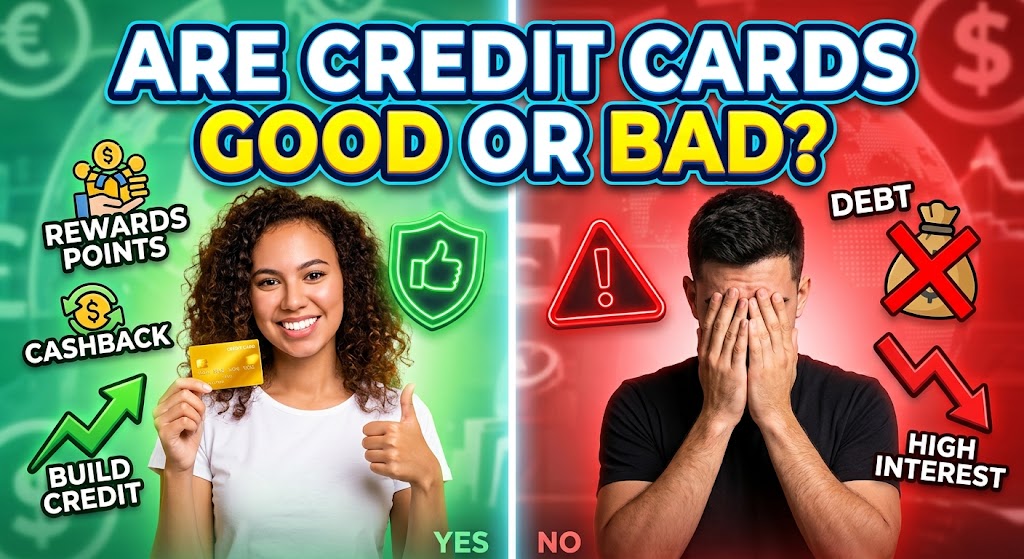
Are Credit Cards Good or Bad?
Are credit cards good or bad? This is a common personal finance question because credit cards can be both useful financial tools and sources of serious financial problems. The answer depends less on the card itself and more on how, why and when it is used. A credit card can help a financially disciplined person manage cash flow, build a positive credit history and access certain benefits. The same credit card can also encourage overspending, create expensive debt and make it easier for someone to spend money they do not actually have.
Understanding whether credit cards are good or bad therefore requires looking beyond the convenience of making payments. A credit card is essentially a borrowing facility. When you use it, the card provider pays the merchant on your behalf and you are expected to repay the amount according to the terms of the account. If you repay what you owe within the applicable interest free period, you may avoid interest on purchases depending on the card terms. If you carry a balance, however, interest and other charges can make the original purchase significantly more expensive.
This distinction is extremely important because many people think of a credit card as extra income. It is not. A credit limit is not the same thing as money you have earned. If your credit card gives you a limit of ₦1,000,000, that does not mean you have an additional ₦1,000,000 available to spend without consequences. It means you have potentially been given permission to borrow up to that amount under specific conditions.
This is one of the biggest reasons the question “Are credit cards good or bad?” cannot have a simple yes or no answer. The same financial product can produce completely different outcomes depending on the behaviour of the person using it.
For a disciplined consumer, a credit card can provide convenience. It can reduce the need to carry cash, make online purchases easier and provide a payment method that can be useful when travelling or dealing with businesses that accept cards. Some cards may also provide rewards, discounts, cashback or other benefits. However, these benefits should never be allowed to distract from the fundamental purpose of the card. You are still responsible for repaying what you borrow.
One of the strongest arguments in favour of responsible credit card use is the opportunity to establish a positive credit history. Credit providers may consider how reliably you manage borrowed money when assessing future applications. A record of making payments on time and managing credit responsibly can be valuable when applying for certain forms of borrowing.
However, credit history systems differ between countries and financial institutions, so consumers should understand how credit reporting works in their own market. Having a credit card does not automatically create a strong financial profile. Missing payments, accumulating excessive debt or using a large proportion of your available credit can create problems instead.
Another potential advantage is financial flexibility. Imagine an unexpected expense arrives shortly before payday and you have sufficient income to repay the amount soon. A credit card may provide temporary access to funds that allows you to handle the expense without immediately disrupting your other essential financial commitments.
But this advantage comes with an important warning. Credit should not become a substitute for emergency savings. If every unexpected expense is placed on a credit card, temporary borrowing can gradually become permanent debt. Once interest begins accumulating, the cost of solving one emergency can continue long after the emergency itself has disappeared.
This is why having an emergency fund remains an important part of personal financial planning. Savings provide a source of money that belongs to you. Credit provides access to money that you must repay.
The psychological difference between the two is significant. Spending your own money can create a natural sense of limitation because your available balance decreases. Spending borrowed money can feel less painful initially because the money leaving your account is not necessarily visible at the moment of purchase.
This can encourage people to spend more than they would normally spend with cash or a debit card.
Credit cards can therefore influence consumer psychology. When you have access to a credit limit, the immediate financial barrier to purchasing something becomes weaker. A person who would hesitate to spend ₦100,000 from their savings might be more comfortable putting the same purchase on a credit card because repayment happens later.
That delay can make borrowing feel less painful than it actually is.
This is where responsible credit card use becomes extremely important. Before making a purchase with borrowed money, ask yourself whether you could afford the purchase without the credit card. If the answer is no, ask whether the purchase is genuinely necessary and whether you have a realistic plan for repayment.
If you cannot comfortably repay the balance, the purchase may not actually be affordable.
Another major issue is interest. Credit card interest can be expensive, and the exact rates, fees and repayment rules vary considerably between cards and financial institutions. Consumers should read the terms and conditions carefully instead of assuming that every card works in exactly the same way.
A purchase that initially appears affordable can become considerably more expensive when interest is charged over an extended period.
For example, imagine someone buys an expensive electronic device using credit and then makes only small repayments for many months. The person may eventually discover that the total amount paid is much higher than the original purchase price.
This is one reason minimum payments can be dangerous when misunderstood. A minimum payment is generally designed to keep an account in good standing under the applicable terms. It does not necessarily mean that paying only that amount is an efficient way to eliminate the debt.
Paying only the minimum can allow a balance to remain outstanding for a long time, potentially resulting in substantial interest costs.
People sometimes make another mistake by focusing entirely on the monthly repayment rather than the total cost. A purchase may seem affordable because the required monthly payment is small, but the overall financial commitment could still be significant.
Good personal finance requires looking beyond the immediate payment.
Another danger is accumulating multiple credit card balances. One card may appear manageable. A second card may seem useful for another purpose. A third card may provide additional flexibility. Eventually, however, the consumer may have several repayment obligations with different interest rates, fees and payment dates.
Managing multiple debts can become complicated and stressful.
This does not mean that having multiple credit cards is automatically bad. Some financially disciplined people use different accounts for legitimate reasons. The problem occurs when the number of accounts increases the person’s borrowing capacity faster than their ability to repay.
A larger credit limit can create the illusion that someone is financially stronger than they really are.
For example, someone earning ₦300,000 per month may have access to several hundred thousand naira or more in credit. The available credit can create a false sense of purchasing power. But the person’s salary has not increased simply because their borrowing capacity has increased.
This distinction is essential.
Your income determines what you earn. Your credit limit determines how much you may be allowed to borrow. These are completely different things.
Another reason credit cards can become dangerous is emotional spending. People do not always spend money because they need something. They may spend because they are bored, stressed, unhappy, excited or influenced by social pressure.
Credit makes emotional spending easier because the financial consequences can be delayed.
Someone may have a difficult day and decide to purchase something expensive online. The excitement of the purchase happens immediately. The financial pain arrives later when the bill becomes due.
This delayed consequence can reinforce unhealthy spending behaviour.
Social media can make the problem even worse. People are constantly exposed to images of expensive holidays, cars, restaurants, clothing, gadgets and lifestyles. A credit card can make it possible to imitate those lifestyles temporarily, even when the underlying income does not support them.
This can create a dangerous cycle of borrowing to maintain appearances.
Financial success, however, is not measured by how expensive your lifestyle looks. It is measured by how sustainable your financial position is.
Someone driving an expensive car while carrying substantial high interest debt may be financially weaker than someone living modestly with savings and investments.
This is why the question “Are credit cards good or bad?” should also be connected to the larger question of financial behaviour.
A credit card is a tool. Tools are not automatically good or bad. A hammer can build a house or cause damage depending on how it is used. Credit works similarly.
Used carefully, it can provide convenience and financial flexibility. Used carelessly, it can create years of financial stress.
One practical strategy is to treat your credit card as a payment method rather than as a source of income. If you receive your salary and have enough money to cover your planned purchases, you may use the credit card for convenience and then repay the balance according to the card’s terms.
The psychological rule should be simple: do not spend more simply because the card allows you to.
Another useful approach is to set your own spending limit below the official credit limit. If your bank gives you a ₦2,000,000 credit limit, you do not have to behave as though ₦2,000,000 is available for spending.
You can establish a personal rule that keeps your borrowing capacity far below the maximum.
This creates a psychological barrier against excessive spending.
Consumers should also monitor their statements regularly. Do not wait until the end of the month to discover what you have spent. Review transactions frequently so that mistakes, unauthorised transactions and unnecessary purchases can be identified early.
Financial awareness becomes much easier when spending is visible.
It is also important to understand fees. Depending on the card and provider, there may be annual fees, transaction fees, foreign exchange charges, late payment fees, cash advance fees or other costs. The specific charges depend on the product, so consumers should read the agreement and fee schedule before using a card.
Cash advances deserve particular caution because they may have different terms from ordinary purchases and can involve additional costs.
Anyone considering a credit card should also understand the difference between using credit for productive purposes and using it for lifestyle consumption. Borrowing to purchase something that immediately loses value can create a particularly difficult financial situation.
That does not mean every purchase that loses value is automatically wrong. Many necessary expenses are not investments. The key issue is whether the debt is affordable and whether the purchase fits within your broader financial plan.
Credit can also be dangerous when used to cover recurring expenses that income cannot support. If someone regularly uses a credit card to pay for food, rent, transport or other essential expenses because their income is insufficient, the underlying problem is not the credit card. The person has a cash flow problem that borrowing may temporarily hide.
Eventually, the borrowed money must be repaid.
This is why credit should not be used to create the illusion of affordability.
If your income cannot support your lifestyle, increasing your credit limit does not solve the problem. It simply increases the amount of time before the problem becomes impossible to ignore.
For people already carrying significant credit card debt, the priority should generally be understanding exactly how much is owed, the applicable interest rates, minimum payments, fees and repayment dates. Creating a realistic repayment strategy can help bring the situation under control.
It may also be useful to stop adding new debt while existing balances are being addressed.
The goal should not simply be to make the minimum payment every month. The goal should be to reduce the outstanding balance in a sustainable way while avoiding unnecessary new borrowing.
Another important lesson is that credit cards should not be treated as emergency savings. A credit card can provide access to borrowed money during an emergency, but an emergency fund gives you access to your own money.
Building savings can therefore reduce the need to rely on credit when unexpected expenses occur.
People also need to recognise that financial discipline is more important than financial products. Someone with an excellent credit card but poor spending habits can still experience financial problems. Someone with a simple card and strong financial discipline may use credit responsibly for years without allowing it to control their finances.
This means that before asking whether credit cards are good or bad, you should ask whether your financial habits are strong enough to handle borrowing.
If you regularly overspend, struggle to control impulse purchases, ignore bills or have difficulty tracking your expenses, adding more available credit may make your situation worse.
If you budget carefully, understand the terms, pay on time, avoid unnecessary borrowing and treat credit as a tool rather than extra income, a credit card may be useful.
The answer to “Are credit cards good or bad?” therefore depends on the user.
Credit cards are not free money. They are not a replacement for income. They are not a shortcut to wealth. They are not automatically harmful either.
The most important question is whether the benefits you receive are worth the financial risks and costs associated with using the card.
Before applying for a credit card, consider your income, spending habits, existing debts, emergency savings and ability to repay what you borrow. Compare the terms carefully and understand the interest rates and fees that apply.
Once you have a credit card, create rules for yourself. Never assume that because you have a large credit limit you should spend up to it. Never use borrowing simply to impress other people. Never ignore a growing balance because the minimum payment appears manageable. Never assume a small monthly payment means a purchase is cheap.
Instead, focus on affordability, repayment and long term financial health.
The healthiest relationship with credit is one where you remain in control. You know what you owe, why you borrowed it, when you will repay it and how the borrowing fits into your overall financial plan.
Ultimately, are credit cards good or bad? They can be either.
For a disciplined person who pays attention to costs and repayment, a credit card can be a convenient financial tool. For someone who uses borrowed money to support an unaffordable lifestyle, it can become a financial trap.
The card itself is not the final problem. The problem is losing control over the relationship between spending, borrowing and repayment.
The smartest approach is therefore not to blindly love credit cards or automatically hate them. Understand them. Read the terms. Know the costs. Track your spending. Protect your income. Build savings. Borrow only what you can realistically repay and never confuse a credit limit with wealth.
When used with discipline, credit can serve you. When used without discipline, you can end up serving the debt.
That is the real answer to the question, “Are credit cards good or bad?”

EarnSmartOnline.com.ng is dedicated to helping readers make smarter financial decisions through practical guides on online income, personal finance, technology, digital business, and wealth creation. Our goal is to provide reliable, easy-to-understand, and actionable content that empowers individuals to earn smarter, build sustainable income streams and achieve long-term financial success.
Recommended: Start Earning Online
- Ultimate Affiliate Marketing Program — learn affiliate marketing with a done-for-you sales system ($15). Check it out
- The Newbie Affiliate Guide — the beginner-friendly starter guide (~$6.68). Check it out
- Easy Dollar Maker — earn in dollars uploading AI images and videos from your phone ($17). Check it out
Disclosure: These are affiliate links. If you buy through them, I may earn a commission at no extra cost to you.



