
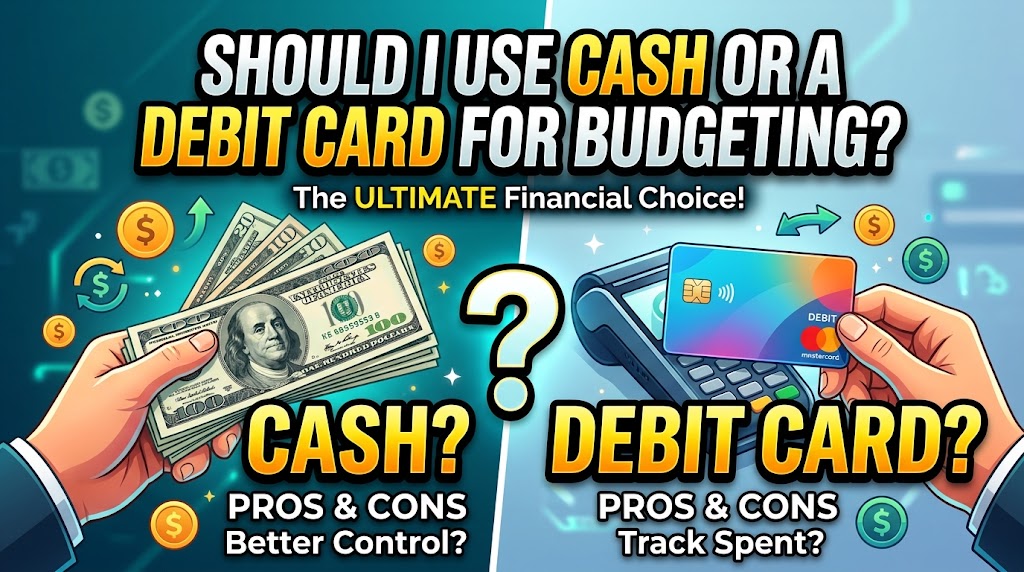
Should I use cash or a debit card for budgeting?
Should I use cash or a debit card for budgeting? It is a simple question, but the answer can have a significant impact on how effectively you manage your money. Both cash and debit cards can help you control spending, but they influence your behaviour in very different ways. Cash gives you a physical limit that can make spending feel more real, while a debit card offers convenience, flexibility and easier transaction tracking. The better option depends on your spending habits, financial goals, income pattern and ability to monitor your transactions.
Budgeting is not simply about writing down how much money you earn and how much you plan to spend. A successful budget should influence what you actually do with your money. You can create the most beautiful spreadsheet in the world, but if you continue spending beyond your limits, the budget is not doing its job. This is why the question, Should I use cash or a debit card for budgeting?, is really a question about behaviour. Which payment method makes it easier for you to follow the financial boundaries you have already created?
Cash has one major psychological advantage. You can physically see it leaving your possession. If you have ₦50,000 available for groceries and decide to use cash, you can physically separate that money from the rest of your finances. Every purchase reduces what remains in your wallet or envelope. When the money is finished, the spending limit becomes obvious.
This physical experience can make budgeting more powerful for people who struggle with impulse spending. Paying with cash creates a moment of awareness before money disappears. You have to physically hand over the money and receive change. That process can make the cost of a purchase feel more significant.
A debit card works differently. You can pay for something without physically seeing the money leave your hand. The transaction may take only a few seconds. In many situations, this convenience is useful. However, convenience can also make spending feel less painful. If you are someone who frequently makes small purchases without thinking about their combined cost, using a debit card without a clear budgeting system can make overspending easier.
This does not mean debit cards are bad for budgeting. In fact, they can be extremely useful when used deliberately. One of their biggest advantages is transaction visibility. Many banks provide transaction histories that allow you to see where your money went. This can make it easier to analyse spending patterns, identify unnecessary expenses and understand how much you actually spend in different categories.
A debit card can also reduce the need to carry large amounts of cash. If you are making a significant purchase, paying bills or buying something online, a debit card can be much more convenient than cash. For people who manage most of their finances digitally, using a debit card can make budgeting easier because spending information is automatically recorded.
The real issue is therefore not whether cash is good and debit cards are bad, or whether debit cards are modern and cash is outdated. The real issue is whether your chosen payment method helps you remain conscious of your spending.
If you regularly ask yourself, “Where did all my money go?” at the end of the month, cash may be worth experimenting with for certain categories. You do not necessarily have to use cash for everything. You could use cash for areas where you frequently overspend, such as eating out, entertainment, shopping or miscellaneous expenses.
For example, suppose you decide that you can afford ₦30,000 for entertainment during the month. You could withdraw exactly ₦30,000 and use that money only for entertainment. Once the money is gone, you know that you have reached your limit.
This approach can be particularly effective because it creates a physical boundary around discretionary spending. Instead of relying entirely on willpower, you create a system that makes overspending more difficult.
This is one reason envelope budgeting has remained popular. The idea is straightforward. Money is divided into different categories, and each category receives a specific amount. You might have an envelope for food, transport, entertainment, personal spending and other variable expenses. The money available in each category represents the spending limit.
The same principle can be recreated digitally using separate bank accounts, subaccounts or budgeting tools. This means you do not necessarily need physical cash to benefit from the psychology of a spending limit.
Debit cards can work extremely well when they are connected to this kind of structure. Instead of having one large balance that makes you feel wealthy enough to spend, you can assign specific amounts to specific purposes.
For instance, if you have ₦200,000 available for monthly discretionary and variable expenses, you might allocate specific amounts to groceries, transport, entertainment and personal spending. The goal is to make the available amount for each category clear before you begin spending.
This approach solves one of the biggest problems with debit card budgeting. A debit card gives you access to your account balance, but your total account balance is not necessarily the same as the amount you can afford to spend.
Imagine that you have ₦500,000 in your bank account. Seeing that balance may create the feeling that you have substantial spending power. But perhaps ₦250,000 is already needed for rent, ₦80,000 for school fees, ₦50,000 for bills and ₦40,000 for savings. Your genuinely available spending money may be much smaller than ₦500,000. Should I use cash or a debit card for budgeting?
This is why looking only at your bank balance can be misleading.
A budget should tell you what your money is already committed to before you start spending it. Otherwise, a large bank balance can create a false sense of financial security.
This is also why cash can sometimes be psychologically powerful. If you withdraw only the amount you have deliberately allocated for discretionary spending, you cannot easily convince yourself that all the money in your bank account is available for immediate consumption.
However, cash also has disadvantages. Carrying cash can be inconvenient and potentially risky. If it is lost or stolen, recovering it may be difficult or impossible. Cash also makes some transactions more difficult, especially online purchases, subscriptions, digital services and certain forms of bill payment.
For someone who travels frequently, shops online or manages a business, relying entirely on cash may become impractical.
Debit cards offer convenience that cash simply cannot match. They can be used for online transactions, recurring payments, point of sale purchases and many everyday expenses. They also create electronic records that can be useful when reviewing your budget.
Another advantage is that you can often identify exactly where money was spent. If you use cash frequently, you may remember buying something but forget the precise amount. Small cash purchases can disappear from your memory surprisingly quickly.
Suppose you spend ₦1,500 on snacks, ₦2,000 on transport, ₦3,000 on lunch and ₦2,500 on another small purchase. None of those expenses may feel significant individually. But repeated throughout the month, they can become a substantial amount.
Digital transaction records can make these patterns easier to discover.
This brings us to one of the most important principles of budgeting: awareness is more important than the payment method.
If you use cash but never track your spending, cash will not automatically make you financially responsible. You can still overspend by repeatedly withdrawing more money.
Likewise, using a debit card does not automatically mean you are irresponsible. If you maintain clear spending categories, monitor transactions and respect your limits, a debit card can be an excellent budgeting tool.
The question Should I use cash or a debit card for budgeting? therefore has a personalised answer.
If you tend to overspend because electronic payments feel effortless, cash could help you become more conscious of your spending. If you are disciplined, comfortable tracking transactions and frequently need electronic payments, a debit card may be more practical.
You can also combine both methods.
A hybrid approach may be the most realistic solution for many people. Use a debit card for fixed expenses, bills, online purchases and transactions that require electronic payment. Use cash for categories where you have difficulty controlling yourself.
For example, you could pay your electricity bill, internet bill and other regular expenses electronically while using cash for entertainment, eating out and personal shopping.
This creates a useful distinction between predictable expenses and behaviourally risky expenses.
Another strategy is to use a debit card but impose a self created spending limit. You might transfer only the amount you have budgeted for discretionary spending into a separate account and use the debit card connected to that account.
This can provide some of the psychological benefits of cash while maintaining the convenience of electronic payments.
The key is separation.
When all your money sits in one account and your debit card provides access to everything, it can become difficult to distinguish between money that is available and money that is already assigned to future obligations.
Separating money can make your budget much easier to follow.
It is also important to consider your income pattern. Someone receiving a regular monthly salary may find it relatively easy to establish a monthly spending plan. Someone with irregular income may need a more flexible approach.
If your income changes from month to month, your budgeting system should focus heavily on essential expenses, cash flow management, emergency savings and clearly defined spending limits.
In such situations, either cash or a debit card can work. The important thing is knowing exactly how much money is available for each category.
Your personality also matters.
Some people love spreadsheets, banking apps and digital records. They naturally monitor transactions and analyse their spending. For these people, debit cards can be highly effective.
Other people become overwhelmed by digital transactions and find it easier to understand their finances when they physically divide money into envelopes. For these people, cash may provide greater clarity.
Neither approach is inherently superior.
The best budgeting system is the one you can consistently follow.
Another consideration is security. Debit cards can provide useful protections and transaction records, but users need to protect their cards, PINs, banking credentials and accounts. Cash does not expose you to card related fraud in the same way, but physical cash can be lost or stolen.
Therefore, the decision should also take into account your environment, spending habits and personal circumstances.
There is also an important difference between spending money and spending credit. A debit card generally draws money from your existing bank balance, whereas a credit card involves borrowing. This distinction matters because budgeting becomes much harder when spending is disconnected from the money you currently possess.
With a debit card, the money is generally deducted from your account when you make the transaction, subject to the bank’s processing arrangements. This can help maintain a stronger connection between spending and available funds.
However, that connection is only useful if you pay attention to your account.
One of the most effective budgeting habits is checking your transactions regularly. You do not have to obsess over every transaction, but you should know where your money is going.
A weekly money review can be enough for many people. Look at your recent transactions, compare them with your budget and identify anything unusual. If you are already exceeding a category, adjust your behaviour before the end of the month instead of waiting until your money has disappeared.
This is much better than discovering the problem after the fact.
Another useful habit is to establish a spending threshold. For example, you might decide that any unplanned purchase above a certain amount requires a waiting period. This gives you time to determine whether you actually need the item.
The method works whether you pay with cash or a debit card.
The purpose is to interrupt automatic spending behaviour.
Budgeting is ultimately about making intentional decisions before money is spent. Your payment method should support that intention.
If cash helps you slow down, use cash. If a debit card helps you track spending and maintain convenience, use a debit card. If both have advantages, combine them.
You should not choose a payment method because someone online claims that it is universally better. Choose it based on what helps you control your own financial behaviour.
There is also nothing wrong with changing your approach. If you try cash for three months and discover that it works brilliantly, continue. If you find yourself constantly running out of cash or losing track of transactions, reconsider the system.
A budgeting system is not a permanent contract. It is a tool.
The most important question is not simply, Should I use cash or a debit card for budgeting? The deeper question is, “Which method makes me more intentional with my money?”
For some people, the answer will be cash. For others, it will be a debit card. For many people, it will be a combination of both.
The strongest financial system is not necessarily the most sophisticated one. Sometimes the best system is simply the one that makes your spending limits obvious and helps you respect them.
If you frequently overspend with a debit card, try using cash for one or two problematic categories. If cash feels inconvenient, recreate the same limits digitally using separate accounts or spending categories.
If you already use a debit card successfully, there may be no reason to switch.
The goal is not to make budgeting complicated. The goal is to make your money work according to a plan rather than disappear according to impulse.
Ultimately, cash and debit cards are only tools. Neither one can create financial discipline on its own. Your habits, awareness and willingness to follow your budget matter much more.
A person can carry cash and still waste money. Another person can use a debit card every day and build substantial savings. The difference is not necessarily the payment method. The difference is whether the person knows what they can afford, understands where their money is going and has the discipline to stop when they reach their limit.
So, should I use cash or a debit card for budgeting?
Use cash if its physical nature helps you control spending and makes your limits easier to see. Use a debit card if you value convenience, electronic records and digital money management and can consistently stay within your budget. If you need the advantages of both, use a combination.
The best payment method for budgeting is the one that helps you spend intentionally, save consistently and avoid financial surprises.
Your wallet, bank account and debit card are simply tools. The real budget is the behaviour behind them.

EarnSmartOnline.com.ng is dedicated to helping readers make smarter financial decisions through practical guides on online income, personal finance, technology, digital business, and wealth creation. Our goal is to provide reliable, easy-to-understand, and actionable content that empowers individuals to earn smarter, build sustainable income streams and achieve long-term financial success.
Recommended: Start Earning Online
- Ultimate Affiliate Marketing Program — learn affiliate marketing with a done-for-you sales system ($15). Check it out
- The Newbie Affiliate Guide — the beginner-friendly starter guide (~$6.68). Check it out
- Easy Dollar Maker — earn in dollars uploading AI images and videos from your phone ($17). Check it out
Disclosure: These are affiliate links. If you buy through them, I may earn a commission at no extra cost to you.



