
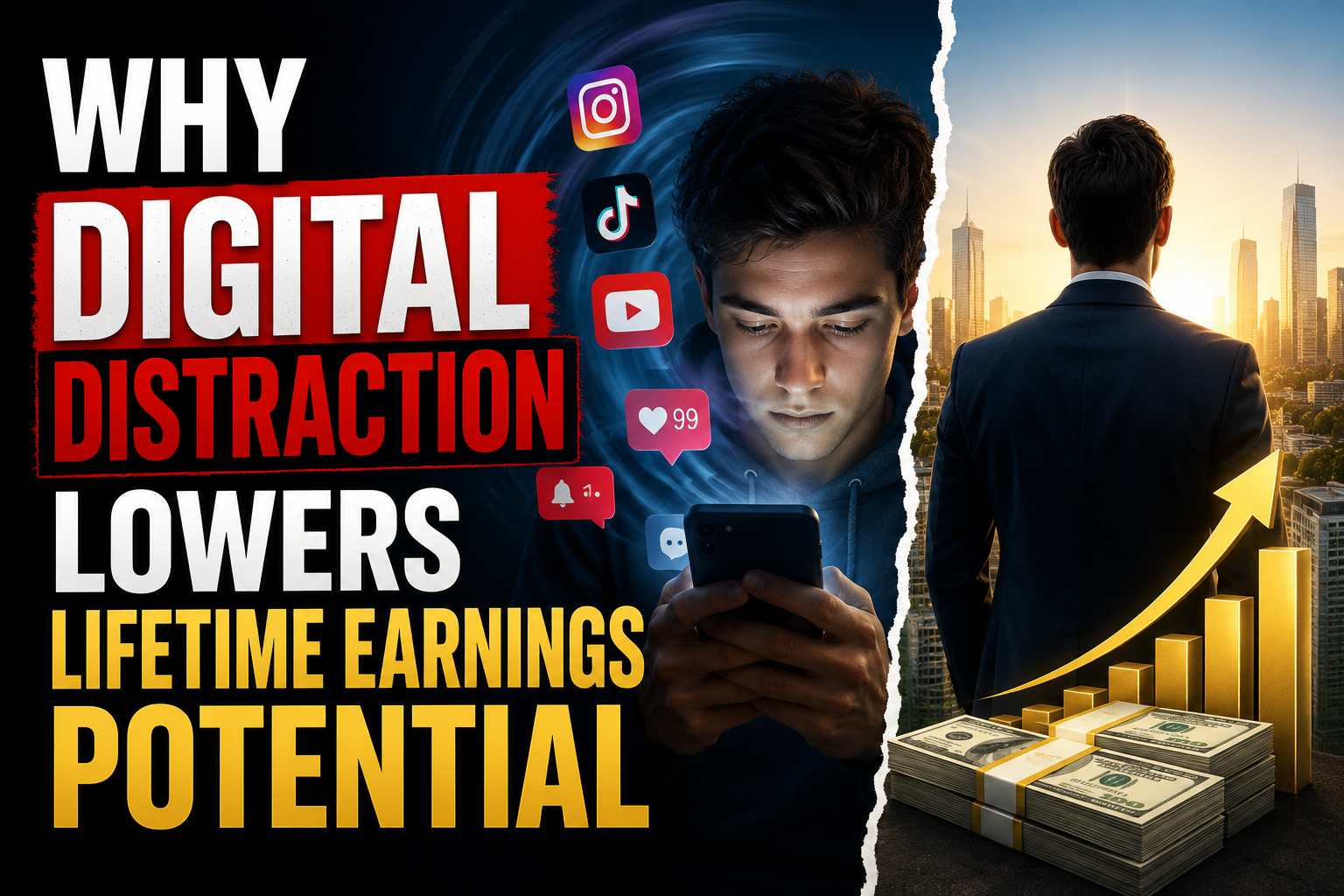
Why Digital Distraction Lowers Lifetime Earnings Potential
Why Digital Distraction Lowers Lifetime Earnings Potential is not just a motivational idea, it is a practical economic reality shaping how much people earn across their entire lives. In today’s world, attention has become one of the most competed for resources. Every notification, video, message, and endless scroll is designed to capture time that could have been used for skill building, problem solving, or deep work. While it may feel harmless in the moment, the long term financial impact of fragmented attention accumulates quietly and powerfully.
To understand this properly, it helps to recognize that income growth is rarely a sudden event. Earnings increase when skills improve, when expertise deepens, and when people become more valuable in the market. All of these require focused effort over extended periods. Digital distraction interrupts this process by breaking concentration into small pieces, making it harder for the brain to stay in the state required for deep learning. Over time, this reduces the rate at which a person develops rare and valuable abilities.
Most high income skills are not built through surface level exposure. They require repetition, practice, and sustained attention. Whether it is programming, design, writing, marketing, or business strategy, the ability to stay focused for long periods determines how quickly someone progresses. When attention is constantly pulled away by social media or entertainment platforms, learning becomes shallow. Instead of mastering one skill deeply, people often end up with fragmented knowledge across many areas without real expertise in any.
This fragmentation has a direct effect on earning potential. The labor market rewards depth more than scattered ability. Employers and clients pay premium value for people who can solve complex problems efficiently. However, complexity cannot be mastered in short bursts of attention. It requires uninterrupted thinking time. Digital distraction reduces this uninterrupted time, which slows down mastery and delays entry into higher earning brackets.
Another important factor is productivity consistency. People often underestimate how much financial success depends on what is done daily, not occasionally. Someone who spends focused hours improving their craft every day will outperform someone who studies or works irregularly due to distraction. Digital habits that seem minor, such as constantly checking messages or switching between apps, create invisible breaks in workflow. These breaks reduce output quality and increase the time needed to complete tasks.
Over a lifetime, these small inefficiencies compound. Just as compound interest grows wealth, compound distraction reduces it. When attention is repeatedly scattered, fewer meaningful projects are completed. Fewer completed projects mean fewer opportunities for promotion, fewer portfolio achievements, and fewer chances to demonstrate capability. This leads to slower income growth compared to individuals who maintain consistent focus.
There is also a psychological dimension to consider. Digital platforms are designed to reward instant gratification. Every like, comment, or short video provides quick dopamine feedback. This rewires the brain to prefer short bursts of stimulation rather than long periods of effort. Unfortunately, financial success is the opposite of instant gratification. It requires delayed rewards, patience, and sustained discipline. When the brain becomes conditioned to constant stimulation, it becomes harder to engage in work that does not provide immediate feedback, even when that work is more valuable.
This shift in attention preference affects career decisions as well. People influenced by constant digital stimulation may gravitate toward tasks that feel easier or more entertaining, even if those tasks do not contribute to long term growth. Over time, this leads to career stagnation. Instead of progressing into higher skill roles, individuals remain in positions that offer limited financial advancement.
Another hidden effect of digital distraction is reduced creative thinking. High earning opportunities often come from the ability to think differently, solve problems in new ways, or identify gaps in the market. Creativity requires mental space. When the mind is constantly occupied with external input, it loses the ability to reflect deeply. Without reflection, innovation becomes limited, and opportunities for financial advancement become fewer.
Attention fragmentation also weakens memory retention. Learning is not just about exposure to information but about storing and applying it effectively. When information is consumed in short bursts and immediately replaced with new stimuli, the brain does not fully consolidate knowledge. This results in poor long term retention, which means skills are not fully developed and can easily fade. In contrast, focused learning strengthens memory pathways and builds durable expertise that supports higher earnings.
The impact extends beyond individual performance into communication skills. People who are frequently distracted often struggle with clear thinking and articulation. This affects their ability to negotiate salaries, present ideas, or lead teams effectively. In many careers, income growth is closely tied to communication strength. If attention habits weaken the ability to think clearly under pressure, earning potential is indirectly reduced.
Time perception is also affected by digital distraction. Many individuals feel busy throughout the day but achieve very little meaningful progress. This illusion of activity creates a false sense of productivity. When time is spent switching between apps, responding to messages, and consuming content, it feels like engagement, but it does not produce long term value. Over years, this misalignment between effort and output leads to financial disappointment.
In contrast, individuals who protect their attention tend to accumulate advantages faster. They learn skills more deeply, complete more valuable projects, and build stronger professional reputations. These factors compound into higher income opportunities over time. The difference is not always intelligence or talent, but the ability to sustain focus long enough to produce meaningful results.
Ultimately, digital distraction lowers lifetime earnings potential because it attacks the foundation of all economic growth, which is attention. Without controlled attention, there is no deep learning. Without deep learning, there is no mastery. Without mastery, there is limited financial growth. The modern economy rewards those who can focus in a world full of noise, and it silently penalizes those who cannot.
The solution is not necessarily to abandon digital tools but to control their influence. The ability to direct attention intentionally rather than re-actively is becoming one of the most valuable skills in the modern world. Those who master it will find themselves progressing faster, earning more, and building stronger financial futures. Those who do not will continue to lose small fragments of time that eventually become large gaps in lifetime earnings.

EarnSmartOnline.com.ng is dedicated to helping readers make smarter financial decisions through practical guides on online income, personal finance, technology, digital business, and wealth creation. Our goal is to provide reliable, easy-to-understand, and actionable content that empowers individuals to earn smarter, build sustainable income streams and achieve long-term financial success.
Recommended: Start Earning Online
- Ultimate Affiliate Marketing Program — learn affiliate marketing with a done-for-you sales system ($15). Check it out
- The Newbie Affiliate Guide — the beginner-friendly starter guide (~$6.68). Check it out
- Easy Dollar Maker — earn in dollars uploading AI images and videos from your phone ($17). Check it out
Disclosure: These are affiliate links. If you buy through them, I may earn a commission at no extra cost to you.



