
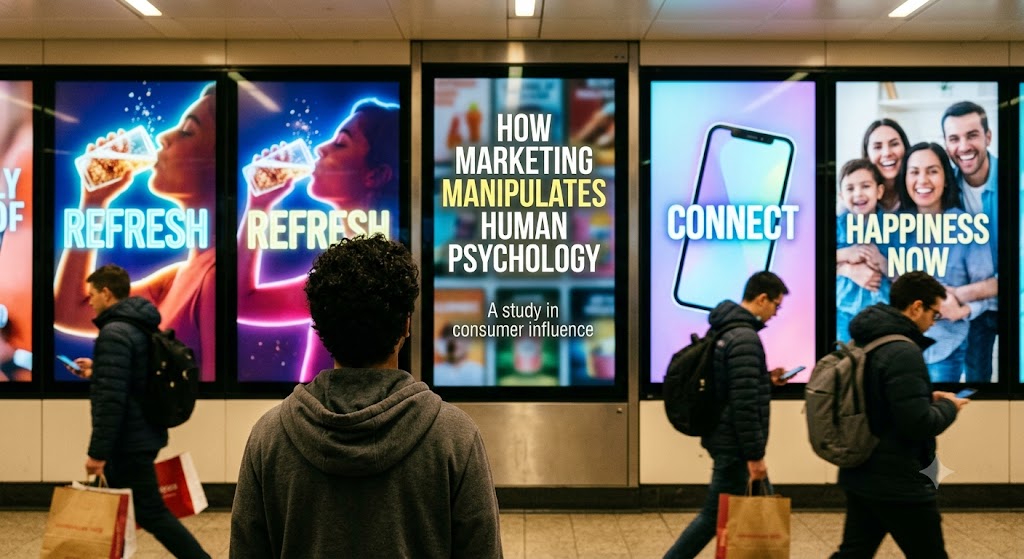
How Marketing Manipulates Human Psychology is a question that becomes more important every time we open our phones, walk into a supermarket, watch television, browse a website or even receive an email. Marketing is everywhere, but its influence goes far beyond simply telling people that a product exists. Modern marketing is deeply connected to human psychology. It studies what people desire, fear, notice, remember, trust and ultimately act upon. The more marketers understand human behaviour, the better they can design messages that influence purchasing decisions.
This does not necessarily mean that every marketer is trying to deceive people. Marketing is fundamentally about connecting products, services and ideas with people who may find them useful. However, some marketing techniques deliberately take advantage of predictable psychological patterns. These techniques can make people feel that they need something they never planned to buy, create urgency where none existed, or associate a product with happiness, status, security or success.
Understanding how marketing manipulates human psychology is therefore not just useful for business owners and marketers. It is equally important for ordinary consumers. When you understand the psychological techniques behind advertising, you become less likely to make impulsive decisions simply because an advertisement has been carefully designed to trigger an emotional response.
One of the most powerful psychological forces used in marketing is emotion. Human beings like to believe that they make decisions based on logic, but emotions often influence decisions before conscious reasoning catches up. A person may purchase an expensive phone because it makes them feel successful, buy a particular car because it represents status, choose a restaurant because it creates a feeling of luxury, or purchase insurance because an advertisement has successfully made them think about the consequences of being unprotected. How Marketing Manipulates Human Psychology
Marketers understand this very well. Instead of simply explaining what a product does, they often sell the feeling associated with owning it. A perfume advertisement may barely discuss the perfume itself. Instead, it may show romance, confidence, attractiveness and sophistication. A sports brand may not spend most of its advertising explaining the technical details of its shoes. It may show determination, achievement, confidence and people overcoming obstacles.
The product becomes connected to an emotional experience. Eventually, consumers are not simply buying an object. They believe they are buying confidence, happiness, beauty, freedom, security or recognition.
Fear is another powerful psychological tool. Fear based marketing works because humans naturally pay attention to threats. When people believe something could go wrong, they become more motivated to take action. Insurance companies, cybersecurity companies, health related businesses and security services frequently use fear to communicate the consequences of remaining unprotected.
A person who would normally ignore a security product may suddenly become interested after seeing a story about someone losing valuable information. Someone who has never considered insurance may become more concerned after seeing an advertisement showing the financial consequences of an unexpected emergency.
Fear can be legitimate when it helps people recognise genuine risks. The problem begins when marketers exaggerate those risks simply to create anxiety and push consumers towards a purchase.
Scarcity is another psychological principle that appears everywhere in modern marketing. When people believe something is limited, they often perceive it as more valuable. This is why phrases such as “limited stock”, “only a few remaining”, “offer ends tonight” and “last chance” are so effective.
Scarcity creates pressure because nobody wants to miss an opportunity. A consumer may not even be particularly interested in a product until they believe it might disappear. Suddenly, the decision changes from “Do I want this?” to “What if I never get another chance?”
This psychological shift is extremely important. Instead of evaluating whether the product is actually useful, the consumer starts evaluating the possibility of losing the opportunity. Fear of missing out becomes stronger than rational consideration.
This is known as FOMO, or fear of missing out. Social media has made this psychological principle even more powerful. People constantly see others travelling, buying new products, attending events, upgrading their lifestyles and experiencing things that appear exciting.
Marketing can amplify this feeling by suggesting that everyone else is already enjoying something. When an advertisement communicates that thousands of people have already purchased a product, the consumer may subconsciously interpret popularity as evidence of value.
This connects to another powerful psychological principle known as social proof. Humans are social creatures, and we often look at the behaviour of other people when deciding what to do.
Reviews, testimonials, ratings, customer numbers, celebrity endorsements, influencer recommendations and social media comments all provide forms of social proof. When people see that many others appear to trust a product, they may become more willing to trust it themselves.
This explains why businesses proudly display customer testimonials and ratings. A product with thousands of positive reviews can appear safer than an identical product with no reviews at all.
The interesting thing is that social proof does not always need to be highly convincing. Sometimes simply seeing other people using a product can influence perception. When a restaurant appears crowded, people may assume that the food must be good. When a website displays thousands of customers, visitors may assume the company is trustworthy. When a social media post has thousands of likes, people may assume its message is important.
Marketing also manipulates human psychology through repetition. The human brain becomes more comfortable with things it encounters repeatedly. A person may see the same company name, logo or slogan dozens of times without consciously paying attention.
Then one day, when that person needs a particular product, the familiar brand may immediately come to mind.
How Marketing Manipulates Human Psychology
This is one reason major companies spend enormous amounts of money on brand awareness. They are not necessarily expecting every advertisement to produce an immediate sale. Sometimes the goal is simply to make the brand familiar enough that consumers remember it when the purchasing opportunity eventually appears.
Repetition can create familiarity, and familiarity can create trust. However, familiarity should never automatically be confused with quality. A product can be heavily advertised and still be inferior to a less famous alternative.
Colour psychology also plays a role in marketing. Colours can influence how people perceive brands and environments. Certain colours may communicate energy, urgency, luxury, calmness, freshness, reliability or excitement depending on the context and culture.
A fast food company may use bright colours to create an energetic and stimulating environment. A financial institution may prefer colours associated with trust and stability. A luxury brand may use minimalist designs, restrained colours and large amounts of empty space to communicate exclusivity.
Even the shape, font, photography and layout of an advertisement can influence perception. Consumers may never consciously analyse these details, but their brains process them.
Another important psychological technique is anchoring. Anchoring occurs when people use an initial number or reference point to judge subsequent information.
Imagine seeing a product originally priced at ₦100,000 and then seeing it offered for ₦65,000. The second price may suddenly appear attractive because the first number has become the psychological reference point.
The consumer may think, “I am saving ₦35,000.”
But the important question is whether the product is actually worth ₦65,000. The original price may have little relevance to the product’s true value. Yet the first number can influence how the second number feels.
This is why discount marketing can be so powerful. People do not always evaluate prices independently. They compare them against reference points created by the seller.
Marketing also uses the psychology of rewards. Humans naturally respond to incentives. Discounts, bonuses, loyalty points, free gifts, cashback offers and promotional rewards can encourage people to purchase more than they originally intended.
The word “free” is particularly powerful. Something described as free can attract enormous attention even when the consumer ends up spending money elsewhere to qualify for it.
For example, a business might offer a free item when customers spend above a particular amount. A consumer who originally planned to spend ₦10,000 may increase the purchase to ₦15,000 because the additional reward feels valuable.
The customer may believe they have received a bargain while the business has successfully increased the average transaction value.
Another psychological principle is the commitment effect. Once people invest time, money or effort into something, they may become more likely to continue.
This is why many online platforms make the initial process extremely easy. A person may sign up for a free trial, customise a profile, complete several steps and become emotionally invested in the service. Cancelling later may feel like abandoning something they have already built.
Marketing can also take advantage of the human desire for consistency. Once people publicly identify themselves with something, they may feel pressure to behave consistently with that identity.
This can be seen in branding communities. A person may not simply say, “I use this phone.” They may say, “I am an Apple person,” “I am a Nike person,” or “I only use this particular brand.”
The product has become part of their identity.
Identity based marketing is extremely powerful because people do not only buy products to solve practical problems. They also buy products to communicate something about themselves.
People purchase clothing to express personality. Cars can communicate status. Technology can communicate lifestyle. Food choices can communicate values. Even financial products can become associated with identity and ambition.
Marketers understand that if they can connect a product to someone’s identity, the relationship with the customer can become much stronger than a simple transaction.
Another psychological technique is storytelling. Humans naturally respond to stories because stories give information emotional meaning.
A company could say, “Our product has excellent battery life.”
Or it could tell the story of a student who used the product throughout a long day without needing to recharge it.
The second approach creates a mental picture.
Consumers remember experiences and stories more easily than lists of technical specifications. This is why effective advertising often focuses on people rather than products.
Marketing also uses aspiration. Instead of showing consumers who they currently are, advertisements often show them who they could become.
The message may be subtle. Buy this car and become successful. Use this product and become attractive. Wear this clothing and become confident. Take this course and become financially independent.
The product becomes a bridge between the consumer’s current identity and their desired identity.
This can be extremely motivating, but it can also create dissatisfaction. If people constantly compare their real lives with carefully manufactured images of perfection, they may begin to believe that something is wrong with them.
Social media has intensified this problem because advertising is no longer limited to obvious advertisements. Influencers, creators and ordinary users can incorporate products into lifestyle content.
A consumer may feel that they are simply watching someone’s daily routine when they are actually being exposed to sophisticated promotional psychology.
Marketing also exploits convenience. Humans naturally prefer options that require less effort. If two products appear similar, consumers may choose the one that is easier to understand, easier to purchase or easier to access.
This is why successful businesses invest heavily in user experience. Removing friction can dramatically increase conversions.
The checkout process, website design, payment options, product descriptions and customer service can all influence purchasing behaviour.
The easier it is to buy something, the less time the consumer may have to reconsider the decision.
Digital marketing has taken psychological manipulation to an even more sophisticated level because technology allows businesses to observe consumer behaviour.
Online platforms can collect information about searches, clicks, browsing behaviour, purchases and interactions. This information can be used to personalise advertisements.
A person searching repeatedly for laptops may begin seeing laptop advertisements. Someone researching holidays may start seeing hotel promotions. Someone reading about fitness may suddenly encounter advertisements for fitness products.
Personalisation can make advertising more useful, but it can also make it more persuasive because the message is targeted towards an existing interest.
The modern consumer therefore faces a marketing environment that is far more personalised than the traditional billboard or television advertisement.
Another psychological principle used in marketing is loss aversion. People generally dislike losing something more than they enjoy gaining something of equal value.
This explains why marketers often frame offers around what consumers might lose rather than what they might gain.
“You will save ₦20,000” is attractive.
“You will lose your ₦20,000 discount if you wait” can create even greater urgency.
The difference may appear small, but psychologically the second message creates a sense of potential loss.
Marketing also uses contrast. A product can appear cheaper, better or more valuable depending on what it is placed next to.
A restaurant might place an extremely expensive meal beside moderately expensive meals. Suddenly, the middle option may appear reasonable.
A technology company may display a premium model beside a cheaper model so that the premium version appears more advanced.
Consumers rarely evaluate products in complete isolation. Context influences perception.
Perhaps the most important lesson is that marketing does not control the human mind like a remote control. Psychological marketing techniques influence probabilities rather than guaranteeing behaviour.
You still have the ability to say no.
The purpose of understanding marketing psychology should not be to become suspicious of every advertisement. It should be to become more conscious of why you are making a particular decision.
When you feel an overwhelming urge to buy something, pause and ask yourself a few questions.
Do I actually need this?
Would I still buy it if there were no discount?
Would I want it if nobody else knew I owned it?
Am I buying the product or the feeling attached to it?
Am I responding to genuine urgency or manufactured urgency?
Would I make the same decision tomorrow?
These questions create distance between emotional stimulation and action.
The greatest advantage a consumer can have is not knowing every marketing trick. It is developing the habit of slowing down before making important decisions.
Marketing is unlikely to disappear. In fact, it will probably become more sophisticated as technology, artificial intelligence, behavioural data and personalised advertising continue to develop.
The future of marketing may become increasingly capable of predicting what people are likely to want before they consciously recognise that desire themselves.
That creates enormous opportunities for businesses, but it also creates enormous responsibility.
Consumers need psychological awareness. Businesses need ethical boundaries. Marketers need to understand that persuasion and deception are not the same thing.
Good marketing helps people discover products and services that genuinely improve their lives. Manipulative marketing attempts to exploit weaknesses, create unnecessary insecurity or pressure people into decisions that primarily benefit the seller.
Understanding how marketing manipulates human psychology ultimately gives consumers more freedom, not less. Once you recognise the emotional triggers behind advertisements, you can separate desire from necessity, urgency from pressure and genuine value from clever presentation. How Marketing Manipulates Human Psychology
The next time an advertisement makes you desperately want something, do not immediately ask, “How can I get it?”
Ask a more powerful question first.
“Why do I suddenly want this?”
That single question can expose the psychology behind the sale and give you something marketing does not want you to have too much of: time to think.
And sometimes, the smartest purchase decision is not buying the thing you were persuaded to want.

EarnSmartOnline.com.ng is dedicated to helping readers make smarter financial decisions through practical guides on online income, personal finance, technology, digital business, and wealth creation. Our goal is to provide reliable, easy-to-understand, and actionable content that empowers individuals to earn smarter, build sustainable income streams and achieve long-term financial success.
Recommended: Start Earning Online
- Ultimate Affiliate Marketing Program — learn affiliate marketing with a done-for-you sales system ($15). Check it out
- The Newbie Affiliate Guide — the beginner-friendly starter guide (~$6.68). Check it out
- Easy Dollar Maker — earn in dollars uploading AI images and videos from your phone ($17). Check it out
Disclosure: These are affiliate links. If you buy through them, I may earn a commission at no extra cost to you.



