
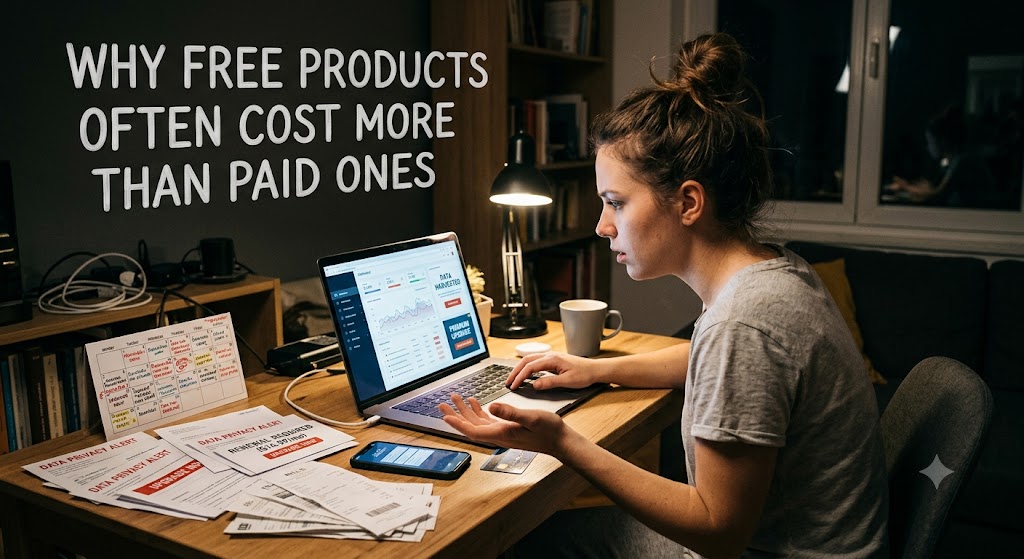
The word “free” has a powerful effect on the human mind. Put the word beside a product, service, course, application, subscription, consultation, or even a simple sample, and people immediately become interested. We naturally want to get something without giving anything in return. It feels like a bargain. It feels like winning. It feels like an opportunity that would be foolish to reject. Why Free Products Often Cost More Than Paid Ones.
But there is a question many people fail to ask when they see something advertised as free: if I am not paying for this with money, what am I paying with?
That question can completely change the way you look at free products.
Free products often cost more than paid ones, not because every free product is secretly a scam, but because the real cost of a product is not always measured in money. Sometimes you pay with your time. Sometimes you pay with your attention. Sometimes you pay with your personal information. Sometimes you pay with advertisements, inconvenience, limited features, poor support, or repeated attempts to convince you to upgrade. In some situations, you pay with opportunities you could have pursued elsewhere. Why Free Products Often Cost More Than Paid Ones
This is one of the most important lessons consumers, entrepreneurs, students, creators, and online users can learn in today’s economy. A product can have a price tag of zero and still be extremely expensive.
Think about how many free applications people use every day. You download an app without paying anything. You create an account. You begin using it. Everything appears generous. But soon you notice advertisements appearing between actions. You receive notifications designed to bring you back. You are encouraged to invite friends. You are offered premium features. Your behaviour may be tracked to understand what you like, what you click, how long you stay, and what you are likely to purchase.
You did not hand over cash at the beginning, but the business still needs to make money somehow.
That is where the economics of “free” become interesting.
Businesses do not normally operate because they enjoy giving away valuable resources indefinitely. They need revenue to pay employees, maintain infrastructure, develop products, market their services, and remain profitable. When customers are not paying directly, the company may have another business model supporting the free product.
Sometimes advertisers are paying. Sometimes paying customers are subsidising free users. Sometimes the company is collecting data that helps improve advertising or commercial decision making. Sometimes the free product is simply an introduction to a more expensive service.
None of these models is automatically bad. In fact, many free products provide enormous value. Search engines, educational resources, communication tools, software, financial information, entertainment platforms, and other digital services have made valuable resources accessible to millions of people.
Why Free Products Often Cost More Than Paid Ones
The problem begins when consumers confuse “free” with “costless”.
They are not the same thing.
A free product can be particularly expensive when it consumes large amounts of your time. Imagine downloading a free application because you want to learn a new skill. The application contains hundreds of lessons, videos, notifications, quizzes, advertisements, and recommendations. You spend months using it, but because the learning experience is poorly structured, you make very little progress.
Eventually, you discover a paid programme that could have taught you the same skill in a fraction of the time.
The first option cost nothing financially.
The second option cost money.
But which one was actually more expensive?
If the free option consumed 200 hours and produced little progress while the paid option cost ₦50,000 and required 30 hours to produce a meaningful result, the “free” option may have been far more expensive.
Time is a currency.
Most people understand the value of money because they see it leaving their bank accounts. They are much less conscious of the value of their time because there is no visible transaction when time disappears.
But every hour you spend is an hour you can never recover.
This is why free products can become expensive when they encourage endless consumption rather than meaningful progress. Social media platforms are a powerful example. You can open many of them without paying a subscription fee. You can scroll for hours without spending a naira. Why Free Products Often Cost More Than Paid Ones
But if you spend three hours every day consuming content that does not improve your life, your skills, relationships, finances, health, or understanding, the opportunity cost can become enormous.
Those three hours could have been used to learn a profitable skill, build a business, read, exercise, create content, study, rest properly, spend time with family, or solve a problem.
The platform may be free.
Your lost opportunities are not.
Another hidden cost of free products is attention.
Attention has become one of the most valuable resources in the modern economy. Companies compete aggressively for it because attention can eventually be converted into advertising revenue, sales, subscriptions, influence, or behavioural data.
This is why many free digital products are designed to keep you engaged for as long as possible.
Notifications bring you back.
Recommendations give you another video.
Autoplay removes the need to make a decision.
Endless scrolling removes the natural stopping point.
Personalised content makes the experience feel increasingly relevant.
The longer you stay, the more opportunities there are to show advertisements, collect behavioural information, promote products, or influence purchasing decisions.
Again, the service may cost nothing financially.
But your attention is being monetised.
There is another hidden cost that people often overlook: quality.
Free products can sometimes be excellent, but when a product costs nothing, there may be fewer resources available for customer support, maintenance, customisation, reliability, and development.
Imagine a business using a free software tool because it wants to save money. The software works reasonably well, but it occasionally crashes. Customer support is limited. Important features are missing. Employees spend hours finding workarounds.
The company may proudly say, “We are using free software.”
But if employees waste 10 hours every month dealing with limitations, the company is still paying.
It is simply paying indirectly.
This is why businesses should calculate total cost rather than simply looking at the purchase price.
A ₦0 product can have a total cost of ₦500,000 if it creates enough inefficiency.
A ₦200,000 product can actually be cheaper if it saves the business time, reduces mistakes, improves productivity, and generates additional revenue. Why Free Products Often Cost More Than Paid Ones
The same principle applies to individuals.
Consider free education.
The internet contains an enormous amount of free educational material. You can find tutorials, articles, videos, podcasts, lectures, books, communities, and courses covering almost every imaginable subject.
That access is extraordinary.
But free information can create another problem: information overload.
Instead of learning, people collect information.
They save videos.
They bookmark articles.
They join groups.
They download courses.
They subscribe to newsletters.
They create folders filled with resources they intend to study later.
Months later, the resources are still sitting there.
The problem was not lack of information.
The problem was lack of structure.
Sometimes paying for a good course, mentor, book, consultant, or training programme is not simply paying for information. You are paying for organisation, experience, accountability, direction, feedback, and speed.
That distinction is extremely important.
Information can be free.
Transformation often is not.
A paid product may also create commitment. When people spend money on something, they are psychologically more likely to take it seriously. This is not always true, but it happens frequently.
Someone can download a free fitness programme and never follow it.
Another person pays for a personal trainer and suddenly starts showing up consistently.
Someone can download ten free books about business and never read them.
Another person pays for one business book and carefully studies every chapter.
Someone can watch free tutorials about website development for months without building anything.
Another person pays for structured training and completes a project within weeks.
The money did not magically create discipline.
The financial commitment created psychological weight.
When something costs you something, you may value it differently.
There is also the issue of hidden upselling.
Many free products are intentionally designed as gateways to paid products. This is known as a freemium model in many digital businesses. You receive basic access for free, but important features are placed behind a payment barrier.
Again, there is nothing inherently wrong with this model. It can be an excellent way for people to test a product before committing financially. Why Free Products Often Cost More Than Paid Ones
The danger is when people become trapped in a cycle of constantly trying to work around limitations.
You might spend hours trying to make a free tool perform a task it was never designed to handle. Eventually, you either upgrade or continue wasting time.
Sometimes the sensible decision is simply to pay.
This does not mean people should start paying for everything.
Quite the opposite.
The lesson is to stop treating free as automatically better.
A wise consumer asks what they are actually receiving and what they are actually giving.
Before accepting a free product, ask what the company gains from providing it.
Ask whether your data is being collected.
Ask whether advertisements are involved.
Ask whether your time is being consumed.
Ask whether the product is genuinely useful or simply designed to keep you engaged.
Ask whether the free version is sufficient for your needs.
Ask what happens when you need support.
Ask whether upgrading later will become necessary.
Ask whether there is a cheaper paid alternative that could save you significant time.
These questions can protect you from many hidden costs.
There is also a deeper lesson here about human psychology.
People tend to focus heavily on immediate costs and ignore future costs.
If someone says, “This will cost you ₦100,000,” the brain immediately reacts.
But if someone says, “This is free, just spend two hours every day using it,” many people do not calculate the value of those hours.
The immediate financial cost is zero.
The future cost is invisible.
This is why businesses understand the psychology of free so well.
Free lowers resistance.
Free encourages trial.
Free attracts attention.
Free reduces the fear of making a bad purchase.
Free makes people feel like they have nothing to lose.
But sometimes you have plenty to lose.
You can lose time.
You can lose privacy.
You can lose focus.
You can lose productivity.
You can lose opportunities.
You can lose money later through unnecessary upgrades or purchases.
And sometimes you can lose something even more valuable: the ability to recognise what your attention is worth.
This principle is particularly important for entrepreneurs.
Many business owners make the mistake of giving away too much simply because they believe customers love free things.
Customers do love free things.
But free does not always create loyal customers.
Sometimes it creates people who only want free things.
There is a difference.
If you constantly give away your expertise, time, products, consultations, designs, strategies, or services without a clear business model, you can accidentally train people to undervalue what you provide. Why Free Products Often Cost More Than Paid Ones
Your audience may begin asking why they should pay when you have always given everything away.
Free can be a powerful marketing strategy when used intentionally.
But free should have a purpose.
A free sample can introduce people to a product.
A free article can demonstrate expertise.
A free trial can reduce purchasing risk.
A free consultation can identify customer needs.
A free resource can build trust.
But the free offer should lead somewhere meaningful.
The goal should not simply be giving things away.
The goal should be creating value and building a sustainable relationship.
Consumers also need to understand that paying for something does not automatically make it better.
There are expensive products that provide terrible value.
There are cheap products that provide extraordinary value.
There are free products that are genuinely excellent.
The real question is not whether something is free or paid.
The real question is whether the value you receive is greater than the total cost you bear.
That total cost includes more than money.
It includes time, attention, energy, risk, inconvenience, privacy, learning curve, maintenance, and opportunity cost.
Once you begin thinking this way, your purchasing decisions become much smarter.
You may still choose free products.
But you will choose them deliberately rather than emotionally.
You may still pay for products.
But you will ask whether the price is justified.
You may even discover that paying more upfront can sometimes save you considerably more later.
This is especially true when the product helps you save time.
If a paid software subscription saves you five hours every week, the subscription might be cheap compared with the value of your time.
If a professional service prevents an expensive mistake, the fee might be insignificant compared with the cost of correcting the mistake.
If a good course helps you avoid months of confusion, the price may be small compared with the opportunity cost of learning without direction.
The smartest people are not necessarily those who spend the least money.
They are often those who understand value.
They know when to save.
They know when to spend.
They know when free is enough.
They know when free is becoming expensive.
And most importantly, they understand that money is not the only currency they possess.
Your time is currency.
Your attention is currency.
Your energy is currency.
Your privacy is currency.
Your focus is currency.
Your opportunities are currency.
Every product you use makes a transaction with some combination of these resources.
Sometimes the transaction is obvious.
Sometimes it is hidden.
The price tag simply does not tell the whole story.
The next time you see something advertised as “100% free,” do not immediately celebrate.
Pause for a moment.
Ask yourself what makes the product financially sustainable.
Ask what you are giving in exchange.
Ask what the product is doing with your attention.
Ask how much time it will consume.
Ask whether it will genuinely move you forward.
And ask the question that many consumers never ask: “What will this free thing cost me if I choose it?”
Because sometimes the cheapest product is the one you pay nothing for.
And sometimes the most expensive product is the one that says “FREE” in the biggest letters.
The goal is not to become suspicious of everything free. The goal is to become conscious of the real price.
Free can be a gift.
Free can be an opportunity.
Free can be incredibly valuable.
But free can also be a business model.
And once you understand that, you stop asking only, “How much does this cost?”
You start asking the much more powerful question:
“What is this really costing me?”

EarnSmartOnline.com.ng is dedicated to helping readers make smarter financial decisions through practical guides on online income, personal finance, technology, digital business, and wealth creation. Our goal is to provide reliable, easy-to-understand, and actionable content that empowers individuals to earn smarter, build sustainable income streams and achieve long-term financial success.
Recommended: Start Earning Online
- Ultimate Affiliate Marketing Program — learn affiliate marketing with a done-for-you sales system ($15). Check it out
- The Newbie Affiliate Guide — the beginner-friendly starter guide (~$6.68). Check it out
- Easy Dollar Maker — earn in dollars uploading AI images and videos from your phone ($17). Check it out
Disclosure: These are affiliate links. If you buy through them, I may earn a commission at no extra cost to you.



