
Is investing better than keeping money in a savings account?
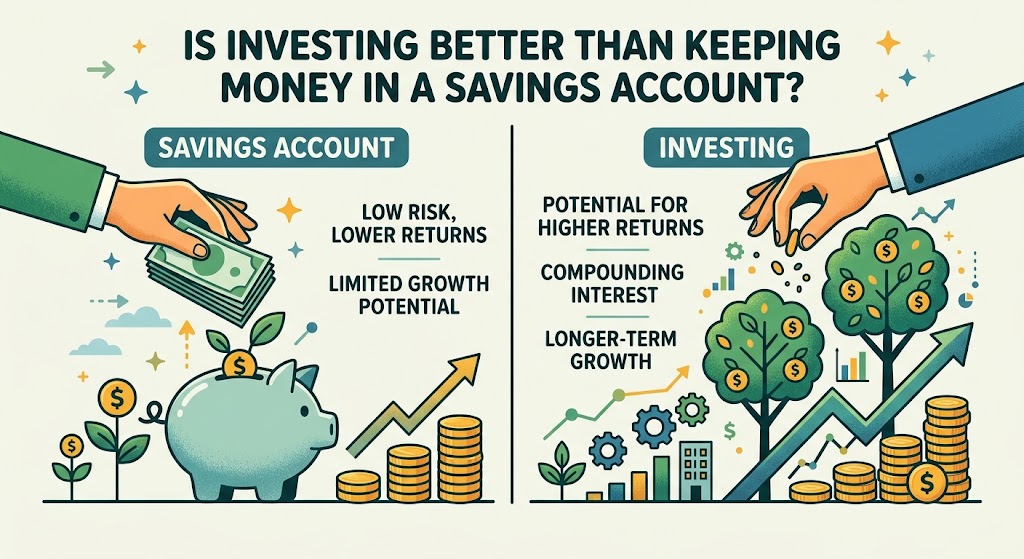
Is investing better than keeping money in a savings account? This is one of the most important questions anyone trying to improve their personal finances eventually has to ask. Saving and investing are often discussed as though they are competing strategies, but they actually serve different purposes. A savings account is generally designed to protect money, keep it accessible and provide some interest, while investing is designed to put money to work with the possibility of achieving higher returns over time. The right choice therefore depends less on which option is universally better and more on what the money is intended to do, when you will need it and how much risk you can comfortably accept.
The question becomes especially important because leaving all your money in cash can create a different kind of financial risk. Money sitting safely in an account may appear stable because the amount does not fluctuate significantly, but its purchasing power can decline when prices rise faster than the interest earned. At the same time, investing money that you may need very soon can expose you to unnecessary market risk. Understanding this difference is the foundation for making a sensible decision.
A savings account can be extremely useful because it provides liquidity. If you need money to pay rent, handle an unexpected repair, cover medical expenses, replace a broken device or deal with an emergency, you generally do not want to depend on an investment that could have fallen in value at exactly the wrong time. The purpose of emergency savings is not necessarily to generate the highest possible return. Its purpose is to be available when life becomes unpredictable.
This is why asking whether investing is better than keeping money in a savings account without considering the purpose of the money can lead to a misleading answer. Imagine someone has saved enough money to cover several months of essential expenses. That money has a job. It is there to provide financial stability. Moving the entire amount into investments simply because investments might produce higher returns could undermine the very purpose of having an emergency fund.
On the other hand, keeping every pound, dollar or naira you have in cash for decades may also be inefficient. Long term financial goals such as retirement, buying property, building wealth or achieving financial independence may require your money to grow substantially. If your money earns a return that consistently fails to keep pace with inflation, your balance might increase while your purchasing power does not increase by the same amount.
This is where investing becomes important. Investing allows your money to participate in assets that may appreciate or generate income over time. Depending on the investment, this can include shares, bonds, funds, property and other assets. However, investment returns are not guaranteed. The possibility of earning more comes with the possibility of losing some or all of the money invested, depending on the asset and circumstances.
The major difference between saving and investing is therefore not simply interest versus profit. It is accessibility, risk, time horizon and purpose. Savings generally prioritise stability and accessibility. Investing generally prioritises long term growth while accepting a greater degree of uncertainty.
Time is one of the most important factors in answering the question, “Is investing better than keeping money in a savings account?” If you need the money within a few months, keeping it accessible may be more appropriate. If you are investing money that you do not expect to need for many years, investments may have a stronger role in your financial plan.
Consider two people with the same amount of money. One person needs the money in six months to pay for a planned major expense. The other person is saving for retirement several decades away. It would make little sense for both people to use exactly the same strategy. The first person needs to protect the money from short term losses. The second person has more time to withstand market fluctuations and potentially benefit from long term growth.
This distinction is often overlooked by people who hear that investing is the best way to build wealth. Investing can indeed be a powerful wealth building tool, but that does not mean every naira or pound should immediately be invested.
There is also the issue of risk tolerance. Every investor has a different psychological relationship with uncertainty. Some people can watch their investments fall temporarily without panicking. Others may become extremely anxious when they see the value of their portfolio decline.
This matters because an investment strategy is only useful if you can stick with it. Someone who invests aggressively and then sells everything in panic during a market downturn may end up performing worse than someone with a more conservative strategy that they can maintain consistently.
A savings account can therefore provide something investments cannot always provide in the short term: psychological stability. Knowing that money is readily available and not exposed to daily market fluctuations can be valuable.
However, safety should not be confused with guaranteed wealth. A savings account may protect the nominal amount of money from market volatility, but inflation can reduce what that money can buy. If your account earns 3 percent while prices rise by 8 percent, your money has not kept pace with the cost of living in real terms.
This is why people need to think about real returns rather than simply looking at the number displayed on their bank statement. A balance that grows from £10,000 to £10,300 might appear positive, but if the cost of goods and services has increased significantly during the same period, the purchasing power of that £10,300 may actually be weaker.
The same principle applies to other currencies and economies. Inflation rates, interest rates and banking products vary by country, so consumers should evaluate the actual savings rate available to them rather than relying on generic assumptions.
Another important consideration is compound growth. Investing over a long period can allow returns to generate additional returns. This is one reason starting early can be powerful. A person who invests consistently for decades may benefit from the combination of regular contributions, investment growth and compounding.
Savings accounts can also compound interest, but the growth rate may be considerably lower depending on the account and prevailing interest rates. This does not make savings useless. It simply means that different financial tools have different jobs.
For someone building wealth, the question should therefore become more specific. How much money should remain accessible? How much should be invested? What are the financial goals? When will the money be needed? What risks can be tolerated? What investment options are available?
These questions are much more useful than asking whether one financial product is always superior to another.
One common mistake is investing before establishing an emergency fund. If an unexpected expense occurs and there is no accessible cash, the person may be forced to sell investments at an inconvenient time. If markets happen to be down, this could turn a temporary decline into a permanent loss.
An emergency fund can act as a financial buffer that prevents ordinary emergencies from becoming investment emergencies.
Another mistake is keeping far too much cash for long term goals. Some people become so uncomfortable with investment risk that they keep almost everything in savings indefinitely. While this may feel safe, it can expose them to inflation risk and the opportunity cost of not allowing some of their money to participate in long term economic growth.
The solution is not to eliminate risk. The solution is to understand and manage different types of risk.
There is market risk, which is the possibility that an investment will decline in value. There is inflation risk, which is the possibility that money loses purchasing power. There is liquidity risk, which concerns how easily an asset can be converted into cash. There is also behavioural risk, which occurs when investors make emotional decisions because of fear, greed or impatience.
A sensible personal finance strategy considers all of these.
Diversification can also play an important role in investing. Rather than putting all your investment money into one company, asset or sector, diversification can spread exposure across different investments. This does not eliminate risk, but it can reduce the damage caused by poor performance in a single investment.
The appropriate investment strategy will depend on factors such as goals, time horizon, income, financial obligations, knowledge and risk tolerance. There is no single investment portfolio that is automatically correct for everyone.
Another factor people sometimes overlook is debt. Someone with expensive high interest debt may need to prioritise paying it down before aggressively investing. If the interest charged on debt is substantially higher than the realistic return expected from an investment, paying down that debt can be financially compelling.
For example, earning a modest investment return while simultaneously paying a very high interest rate on outstanding debt may not be an efficient strategy. The exact decision depends on the type of debt, interest rate, tax considerations, emergency savings and other personal circumstances, but the principle is important: building wealth is not only about investing. It is also about controlling financial leakage.
Fees also matter. An investment with high fees can reduce long term returns. Likewise, a savings account with poor terms or excessive charges may not be as attractive as a better alternative. Consumers should look beyond marketing language and understand interest rates, fees, withdrawal conditions, penalties, taxes and other relevant terms.
It is also important to distinguish between a savings account and other forms of cash management. Depending on where you live, there may be different types of savings products, fixed term deposits, money market products or government backed savings options. Their risks, accessibility and returns can vary considerably.
People should also understand that investments are not simply a way to make quick money. The idea that investing is an easy path to becoming rich can encourage dangerous behaviour. Chasing rapidly rising assets, following social media investment trends or investing money without understanding what is being purchased can expose people to significant losses.
Good investing generally requires patience, diversification, reasonable expectations and an understanding of risk.
The psychological side of money is equally important. People often make financial decisions based on emotions rather than mathematics. Fear can cause someone to keep too much money in cash. Greed can encourage excessive risk. FOMO can lead people to buy investments after prices have already risen dramatically. Panic can cause investors to sell after a decline.
A strong financial plan creates rules that reduce the influence of temporary emotions.
This does not mean ignoring your emotions. It means recognising them and designing your financial system so that one bad day does not destroy years of progress.
For many people, the most sensible approach is not an either or decision. It is a combination of saving and investing. Money needed for immediate expenses and emergencies can remain accessible, while money intended for longer term goals can potentially be invested according to an appropriate strategy.
Think of your money as having different jobs. Some money is for today. Some is for emergencies. Some is for medium term goals. Some is for long term wealth creation. Once you assign each portion a purpose, deciding where it belongs becomes easier.
This approach also helps eliminate the idea that money in a savings account is somehow “doing nothing”. If that money is protecting you from financial emergencies, it is performing an important function. Likewise, money invested for long term growth is performing a different function.
The question “Is investing better than keeping money in a savings account?” therefore has no universal yes or no answer. Investing may be more appropriate for money that can remain untouched for a long period and whose owner can tolerate fluctuations. Savings may be more appropriate for money needed for emergencies, short term goals and financial stability.
The strongest personal finance strategy is often one that combines both rather than treating them as enemies.
If you are just beginning your financial journey, start by understanding your cash flow. Know how much you earn, how much you spend and where your money goes. Build a realistic emergency reserve. Deal with problematic high interest debt. Establish clear financial goals. Then consider how much of your surplus can be allocated towards long term investments.
Your strategy should also evolve as your circumstances change. A person in their twenties may have a different balance between savings and investments than someone approaching retirement. Someone with unstable income may need a larger cash reserve than someone with highly predictable income. Someone saving for a house deposit in two years may require a different strategy from someone saving for retirement thirty years from now.
Personal finance is personal precisely because there is no single formula that works perfectly for everyone.
The biggest mistake is not choosing the wrong side of the savings versus investing debate. The biggest mistake is failing to give your money a purpose.
Money without a purpose tends to disappear through ordinary spending, lifestyle inflation and unnecessary purchases. Money with a clear purpose can be organised deliberately.
So, is investing better than keeping money in a savings account? Investing can be better for long term growth, but savings can be better for accessibility, stability and short term financial needs. Neither should automatically replace the other.
Instead of asking which one is better, ask which one is better for this particular amount of money, for this particular goal, over this particular period.
That change in thinking can completely transform your approach to personal finance.
The objective is not simply to have money sitting somewhere. The objective is to build a financial system where your money is protected when you need protection, accessible when you need access and given an opportunity to grow when you can afford to take appropriate long term risk.
Once you understand that distinction, saving and investing stop being competing choices and become complementary tools for building financial security and, ultimately, wealth.

EarnSmartOnline.com.ng is dedicated to helping readers make smarter financial decisions through practical guides on online income, personal finance, technology, digital business, and wealth creation. Our goal is to provide reliable, easy-to-understand, and actionable content that empowers individuals to earn smarter, build sustainable income streams and achieve long-term financial success.
Recommended: Start Earning Online
- Ultimate Affiliate Marketing Program — learn affiliate marketing with a done-for-you sales system ($15). Check it out
- The Newbie Affiliate Guide — the beginner-friendly starter guide (~$6.68). Check it out
- Easy Dollar Maker — earn in dollars uploading AI images and videos from your phone ($17). Check it out
Disclosure: These are affiliate links. If you buy through them, I may earn a commission at no extra cost to you.



