
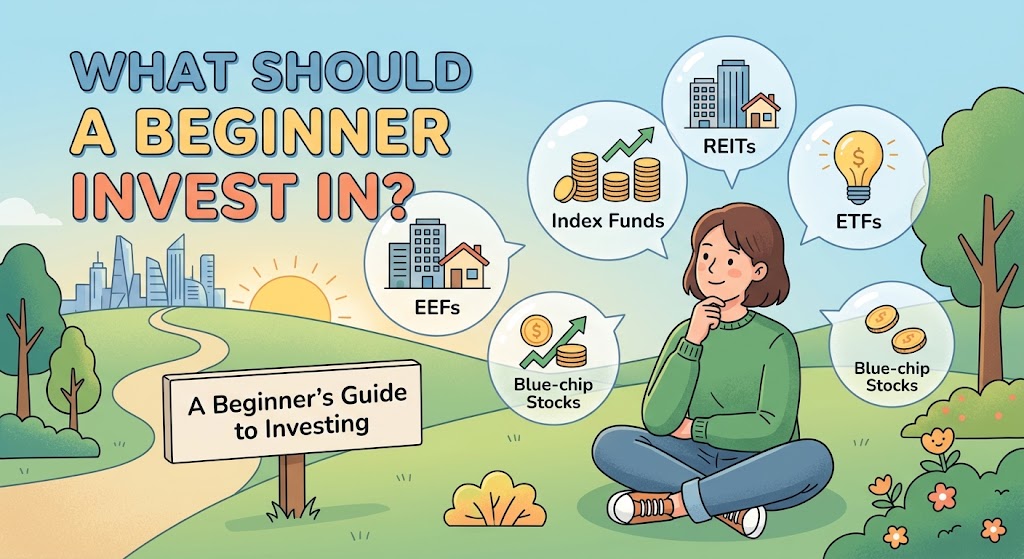
What should a beginner invest in?
What should a beginner invest in? This is one of the most important questions anyone can ask before putting their hard earned money into the financial markets. Investing can create opportunities for your money to grow over time, but starting without understanding what you are buying can turn an exciting financial journey into an expensive lesson. For a beginner, the goal should not be to find the investment that promises the biggest return overnight. The goal should be to understand how different investments work, determine how much risk you can comfortably take and choose investments that match your financial goals and time frame.
Many people approach investing with the wrong question. They ask, “What investment will make me rich quickly?” instead of asking, “What investment can I understand, hold comfortably and allow to grow over time?” The second question is much more useful because successful investing is generally about making sensible decisions consistently rather than constantly searching for the next opportunity that could suddenly multiply your money.
Before deciding what a beginner should invest in, it is important to understand that investing is different from saving. Saving usually involves putting money somewhere relatively accessible and focusing on preserving it for future needs. Investing involves putting money into assets with the expectation that they may increase in value or generate income over time, while accepting that the value can also fall. This difference matters because money needed for an emergency next month should not normally be treated in the same way as money intended for a long term investment.
A beginner should therefore start by looking at their financial foundation. If you have expensive debt, unstable income or no emergency savings, investing every available naira may not be the smartest first move. Building financial stability can be more important than immediately chasing investment returns. An emergency fund can help prevent you from being forced to sell investments at an inconvenient time when an unexpected expense arrives.
Once your basic financial foundation is reasonably strong, the next question becomes what should a beginner invest in? There is no single answer that applies to everyone because the right investment depends on factors such as your financial goals, income, age, risk tolerance, investment period and knowledge of the market.
For many beginners, diversified investments can be a sensible starting point because diversification reduces dependence on a single company or asset. Instead of putting all your money into one investment and hoping it performs well, diversification spreads your exposure across multiple investments. This does not eliminate risk, but it can reduce the damage caused by one investment performing badly.
One investment category beginners often encounter is stocks. When you buy shares of a company, you are purchasing an ownership interest in that business. If the company performs well and the market values it more highly, the share price may rise. Some companies also distribute part of their profits to shareholders through dividends. What should a beginner invest in?
Stocks can provide significant long term growth potential, but they can also experience substantial short term price movements. A beginner who invests in individual companies needs to understand that a famous or popular company is not automatically a good investment at every price. A strong business can still become a poor investment if purchased at an unreasonable valuation.
This is why beginners should be careful about buying individual stocks simply because everyone is talking about them. Investing based on social media excitement, rumours or the fear of missing out can lead to decisions that have little connection with fundamental analysis.
For someone who does not want to research individual companies, diversified funds can offer another approach. A fund can hold a collection of investments, allowing an investor to gain exposure to many companies or assets through a single investment. Depending on the type of fund, it may track a broad market index or follow a particular investment strategy.
Index funds are particularly important to understand when asking what should a beginner invest in? An index fund generally aims to track the performance of a particular market index rather than attempting to constantly select individual winners. Because it provides exposure to multiple companies, it can offer diversification without requiring the investor to research every company individually.
Exchange traded funds, commonly known as ETFs, are another investment vehicle beginners may encounter. ETFs can hold collections of assets and are traded on an exchange. Some ETFs provide exposure to broad stock markets, while others focus on particular sectors, countries, industries, bonds or other asset classes.
The important lesson is that beginners should understand what an ETF actually owns before investing in it. The word “fund” does not automatically mean low risk. A highly concentrated fund can still experience significant losses.
Bonds are another investment category worth understanding. A bond generally represents lending money to a government, company or other issuer in exchange for interest payments and the return of the principal according to the terms of the bond. Bonds can play an important role in a diversified portfolio, particularly for investors who want exposure to assets that may behave differently from stocks.
However, bonds are not completely risk free. Their risks can include the possibility that the issuer fails to meet its obligations, changes in interest rates and changes in the market value of the bond. Government backed securities may have different risk characteristics from corporate bonds, so beginners should understand the specific instrument rather than assuming every bond is equally safe.
Cash and cash equivalents can also have an important place in a financial plan. Although keeping money in a savings account is not usually considered investing in the same way as buying stocks or bonds, having accessible cash is essential for financial stability. A person who invests everything and has no readily available money may be forced to sell investments when an emergency occurs.
Real estate is another investment that attracts beginners because property feels tangible. Unlike a stock that exists as a digital financial asset, property is something people can physically see and use. Real estate can potentially generate rental income and appreciate over time, but it also comes with costs and responsibilities.
Buying property requires much more than considering whether the price might increase. Investors need to think about maintenance, taxes, insurance, vacancies, financing costs, legal expenses, location, tenant demand and the possibility that the property may take time to sell. Real estate can be valuable, but it should not be treated as automatically profitable.
Some beginners also consider investing in their own education and skills. This is often overlooked when people discuss investment opportunities. Developing a valuable skill can potentially increase earning power for many years. Learning technology, sales, communication, programming, digital marketing, financial analysis, a professional trade or another commercially valuable skill can sometimes produce returns that are difficult to achieve through a small financial portfolio.
For example, someone with a limited amount of money might be tempted to search for an investment capable of doubling a small amount quickly. A better use of that money might sometimes be learning a skill that increases their monthly income. Higher income can create greater capacity to save and invest later.
This is an important principle for beginners because the size of your investment portfolio is influenced not only by investment returns but also by how much money you are able to contribute. Someone who earns more and consistently invests a reasonable percentage of that income can potentially build wealth faster than someone constantly searching for extraordinary investment returns on a very small amount of capital.
Another important consideration is time. A beginner investing for twenty years has a very different situation from someone who needs the money in twelve months. Long term investors may have more ability to tolerate temporary market declines because they have more time for their investments to potentially recover and grow.
Short term goals require greater caution because a market decline shortly before the money is needed can create a serious problem. This is why asking what should a beginner invest in? without first asking when the money will be needed can produce a misleading answer.
Risk tolerance also matters. Some people can watch their investment fall significantly without panicking. Others become extremely anxious when their portfolio declines even modestly. Neither reaction automatically makes someone a good or bad investor, but understanding your emotional response to risk can help you choose investments you can realistically hold.
An investment strategy is only useful if you can stick with it. If an investment falls and you immediately sell because you cannot tolerate the decline, you may turn a temporary market loss into a permanent one. Beginners should therefore avoid selecting investments solely because they have historically produced impressive returns. The investment also needs to be psychologically manageable for the person holding it.
Fees deserve serious attention as well. An investment can generate a positive return while still leaving the investor with less money than expected because of management fees, transaction costs, commissions, account charges and other expenses. Small fees can become significant over long periods because they reduce the amount of money that remains invested and capable of compounding.
Beginners should therefore learn to ask how an investment provider makes money. What fees are charged? Are there transaction costs? Is there a management fee? Are there withdrawal charges? Are there currency conversion costs? Are there taxes that apply? Understanding these details can prevent unpleasant surprises.
Another common mistake is investing money simply because someone promises high returns. High potential returns generally come with higher risk, and unusually high guaranteed returns should immediately make a beginner suspicious. Legitimate investments can lose money. Anyone presenting an investment as completely risk free while promising extraordinary returns deserves careful scrutiny.
Scams often exploit beginners by using urgency, social proof and promises of easy money. A person may be told that hundreds of people are already making money from an opportunity and that they must invest immediately before the chance disappears. This creates emotional pressure that discourages careful investigation.
A beginner should never feel embarrassed about taking time to understand an investment. In fact, refusing to invest until you understand what you are buying can be one of the strongest financial habits you develop.
The same principle applies to cryptocurrency and other highly volatile assets. Digital assets can provide opportunities, but their prices can change dramatically and the risks can be substantially different from traditional investments. Beginners should not assume that something is a good investment simply because its price has increased rapidly in the past.
If someone decides to gain exposure to a highly volatile asset, they should understand the possibility of losing a substantial portion of their investment. They should also be particularly careful about scams, fake platforms, fraudulent investment schemes and people promising guaranteed returns.
Another useful principle for beginners is gradual investing. Instead of trying to predict the perfect day to invest, some investors choose to invest consistently over time. This approach can reduce the pressure of trying to determine exactly when markets will rise or fall.
Consistent investing can also encourage discipline. Rather than constantly checking prices and making emotional decisions, the investor follows a predetermined strategy. The exact approach should depend on personal circumstances, investment options available and financial goals.
Beginners should also understand the power of compound growth. When an investment generates returns and those returns remain invested, future returns can potentially be earned on both the original money and previous gains. Over long periods, this can become a powerful wealth building mechanism.
The important part is time. Compounding needs time to work. This is why starting with a modest amount and remaining consistent can sometimes be more powerful than waiting years until you have a large amount of money before beginning.
However, compounding does not mean investments grow at a guaranteed fixed rate. Real markets fluctuate, and actual returns can vary considerably from year to year. Beginners should avoid financial content that presents investment growth as if it were a straight line.
When considering what should a beginner invest in? it is also important to consider diversification across different asset classes where appropriate. A portfolio might contain a combination of investments rather than relying entirely on one type of asset. The appropriate combination depends on the investor’s goals, risk tolerance and circumstances.
The biggest mistake a beginner can make is believing that investing is primarily about finding a secret investment. In reality, successful investing is often much less exciting. It can involve choosing sensible assets, diversifying, keeping costs under control, investing consistently, avoiding emotional decisions and allowing time to work.
Beginners should also avoid investing money they cannot afford to lose without first understanding the risks. Investing is not a replacement for an emergency fund, and it should not be confused with gambling or speculation. Every investment decision involves some level of uncertainty.
The right starting point is education. Before investing, learn the basic terminology, understand how the investment works, research the provider, examine the fees, understand the risks and determine how the investment fits into your wider financial plan.
It is also worth remembering that financial advice should be personal. An investment that makes sense for one person may be inappropriate for another. Someone saving for a long term goal may have a different strategy from someone who needs their money within a few years. Someone with a stable income may have different financial priorities from someone whose income changes dramatically from month to month.
Ultimately, what should a beginner invest in? The answer is not necessarily the investment with the highest possible return. A beginner should consider investments they understand, can afford, can hold for an appropriate period and can tolerate emotionally when markets move against them. Diversified funds, broad market investments, bonds, cash savings and even investment in valuable skills can all play different roles depending on the individual’s circumstances.
The most important investment for a beginner may actually be knowledge. Understanding how money works gives you the ability to make better decisions long after your first investment has been made. It helps you recognise unrealistic promises, understand risk, evaluate fees and distinguish investing from speculation.
You do not need to become a financial expert before you begin learning about investing. You simply need to become curious enough to ask questions and disciplined enough not to put your money into something you do not understand.
Investing is not a race. There is no prize for making the most complicated investment decision or taking the greatest amount of risk. The objective is to build financial assets in a way that fits your life and gives your money an opportunity to grow over time.
For a beginner, the best investment strategy is usually one that can be understood, maintained and repeated. Start with a strong financial foundation, define your goals, understand your risk tolerance, choose appropriate diversified investments, keep an eye on costs and avoid decisions driven by fear or excitement.
The question “What should a beginner invest in?” is therefore bigger than asking for a list of assets. It is really a question about how you want your money to work for you. Once you understand that, choosing suitable investments becomes much easier.
The financial markets will always offer something new. There will always be another company receiving attention, another asset promising extraordinary growth and another person claiming to have discovered the next big opportunity. You do not need to chase every opportunity.
Your greatest advantage as a beginner is the ability to learn, start responsibly and give your strategy enough time to work.
The goal is not to become rich tomorrow. The goal is to become financially stronger over time.

EarnSmartOnline.com.ng is dedicated to helping readers make smarter financial decisions through practical guides on online income, personal finance, technology, digital business, and wealth creation. Our goal is to provide reliable, easy-to-understand, and actionable content that empowers individuals to earn smarter, build sustainable income streams and achieve long-term financial success.
Recommended: Start Earning Online
- Ultimate Affiliate Marketing Program — learn affiliate marketing with a done-for-you sales system ($15). Check it out
- The Newbie Affiliate Guide — the beginner-friendly starter guide (~$6.68). Check it out
- Easy Dollar Maker — earn in dollars uploading AI images and videos from your phone ($17). Check it out
Disclosure: These are affiliate links. If you buy through them, I may earn a commission at no extra cost to you.



