
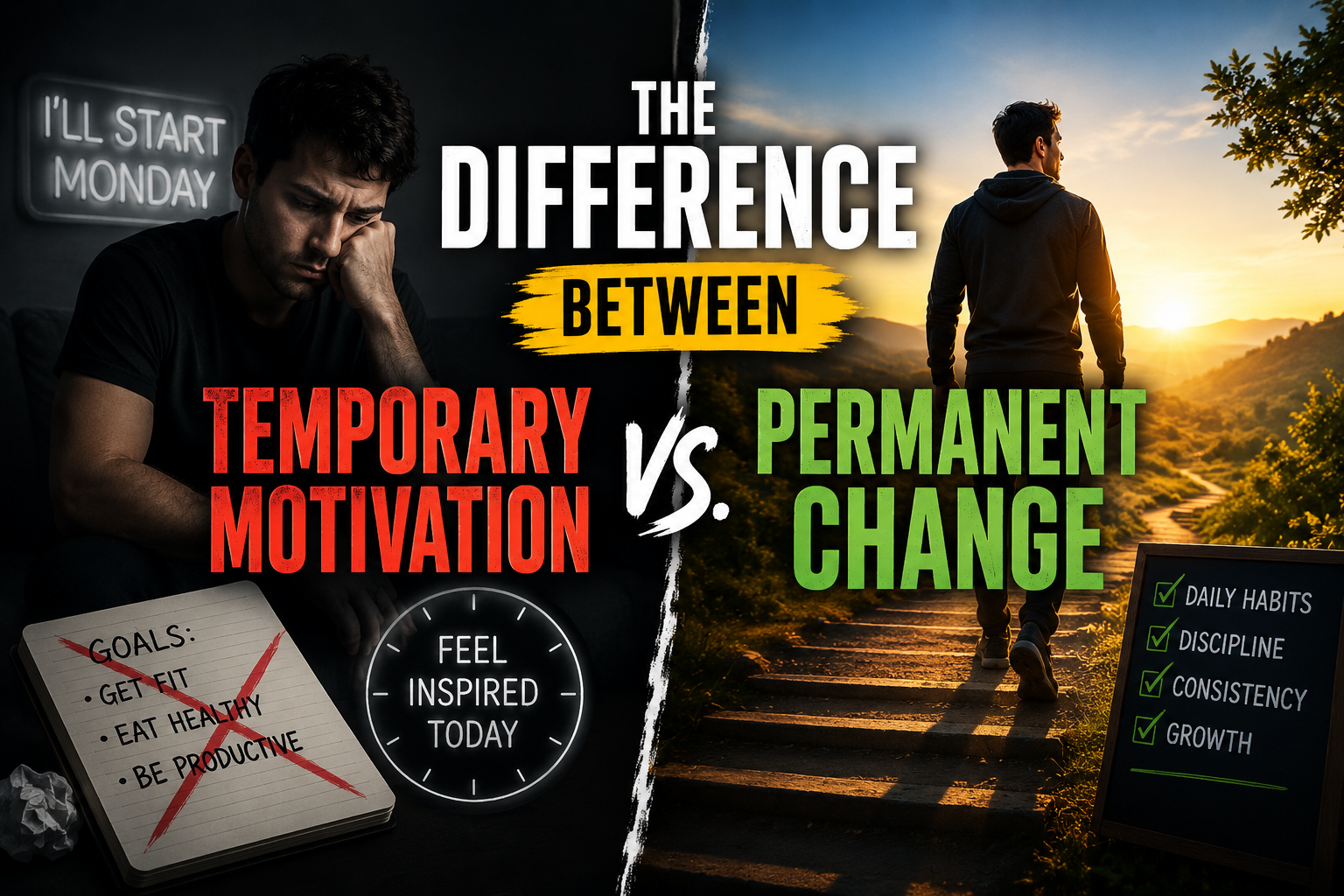
The Difference Between Temporary Motivation and Permanent Change
Every year, millions of people make promises to themselves. They decide to lose weight, save money, learn new skills, improve relationships, start businesses, or become more productive. For a few days or weeks, they feel energized and unstoppable. They watch inspirational videos, read motivational quotes, listen to successful people, and imagine a better future. Yet after a short period, many return to their old habits and routines. This raises an important question: if motivation is so powerful, why does it often fail to produce lasting results? The Difference Between Temporary Motivation and Permanent Change.
The answer lies in understanding the difference between temporary motivation and permanent change. While they may appear similar on the surface, they are fundamentally different forces. One creates short bursts of action, while the other transforms lives over the long term.
Temporary motivation is an emotional state. It is the excitement you feel after hearing a powerful speech, reading an inspiring book, watching a life changing documentary, or experiencing a major event. Motivation creates energy. It makes difficult tasks seem easier. It fills people with confidence and optimism. During moments of high motivation, goals feel achievable and the future looks bright.
The problem is that emotions are naturally unstable. Human beings are emotional creatures whose feelings constantly change. What excites you today may not excite you tomorrow. The same person who feels motivated on Monday may feel tired, distracted, or discouraged by Friday. Because motivation depends heavily on emotions, it often fades when challenges appear.
This explains why many people start strong but fail to finish. They mistake motivation for commitment. They believe that feeling inspired is enough to guarantee success. Unfortunately, motivation alone cannot carry a person through months or years of consistent effort. It is easy to wake up early when excitement is high. It is much harder to wake up early when you are tired, stressed, or facing setbacks.
Permanent change operates differently. Instead of relying on emotion, it relies on systems, habits, identity, and discipline. Permanent change occurs when a person fundamentally alters the way they think, behave, and live. It becomes part of who they are rather than something they occasionally do.
A motivated person may decide to exercise for a week. A permanently changed person becomes someone who exercises regardless of mood. A motivated person may save money after watching a financial video. A permanently changed person develops financial habits that continue even when nobody is watching. The difference is not intensity but consistency.
One of the biggest misconceptions about success is the belief that successful people are always motivated. In reality, many of the world’s most accomplished individuals continue working even when motivation disappears. They have built routines that function independently of emotions. They understand that feelings are temporary but systems can be permanent.
Consider the example of learning a new skill. Motivation may inspire someone to purchase books, register for courses, and create ambitious plans. However, permanent change occurs when the person develops a habit of learning every day. Over time, the daily habit becomes automatic. The individual no longer depends on excitement to continue. The behavior becomes part of their lifestyle.
This distinction explains why some people repeatedly start over while others steadily progress. People who depend on motivation are constantly searching for inspiration. They need another video, another quote, another seminar, or another success story to reignite their enthusiasm. Their progress rises and falls with their emotions.
People who experience permanent change focus on building structures that support their goals. They create routines, schedules, accountability systems, and environments that encourage consistent action. They understand that lasting results are rarely produced by occasional bursts of effort. Instead, they emerge from repeated actions performed over long periods.
Another important difference involves identity. Temporary motivation focuses on what a person wants to achieve. Permanent change focuses on who a person wants to become. Goals are important, but identity is often more powerful.
Someone who says, “I want to lose weight,” is focused on an outcome. Someone who says, “I am becoming a healthy person,” is focused on identity. The first statement seeks a temporary result. The second statement creates a long term transformation. When behavior becomes connected to identity, consistency becomes easier because actions reinforce self image.
Human beings naturally act in ways that align with their beliefs about themselves. If a person sees themselves as responsible, they are more likely to make responsible choices. If they see themselves as disciplined, they are more likely to behave with discipline. Permanent change occurs when actions and identity begin working together.
Another reason temporary motivation often fails is that it focuses heavily on the rewards while ignoring the process. Motivated individuals imagine success, recognition, wealth, fitness, or happiness. They become excited by the destination. However, permanent change requires embracing the journey.
Every worthwhile goal includes periods of boredom, frustration, repetition, and difficulty. These moments are rarely exciting. They do not produce dramatic emotions or instant gratification. Yet they are essential for growth. People who create permanent change learn to respect the process even when the rewards are not immediately visible.
This principle can be seen in nearly every area of life. Successful athletes train when they do not feel like training. Successful entrepreneurs continue improving their businesses during difficult seasons. Successful students study even when distractions are everywhere. Their progress is not powered by constant motivation but by consistent commitment.
Environment also plays a significant role in creating permanent change. Many people underestimate the influence of their surroundings. Motivation encourages action, but environment shapes behavior. A person who wants to eat healthier but surrounds themselves with unhealthy food faces a difficult battle. Similarly, someone who wants to become productive but remains in a distracting environment will struggle to maintain progress.
Permanent change often begins when people redesign their environment to support desired behaviors. They remove obstacles, create reminders, simplify positive actions, and reduce exposure to negative influences. Instead of relying solely on willpower, they make success easier and failure harder.
Another key difference is that motivation seeks immediate action while permanent change values long term consistency. Temporary motivation often encourages people to make dramatic changes overnight. They create unrealistic schedules, set enormous goals, and expect rapid transformation. When reality fails to match expectations, disappointment follows.
Permanent change takes a more sustainable approach. It recognizes that small improvements repeated consistently produce remarkable results over time. A person who reads ten pages daily may finish dozens of books each year. Someone who saves a small amount consistently may build significant wealth. Someone who exercises moderately several times per week may achieve better health than someone who exercises intensely for only a few weeks.
The power of permanent change lies in accumulation. Small actions compound. Tiny improvements grow. Progress that seems insignificant today can become extraordinary over months and years. This is why consistency often defeats intensity in the long run.
Many people spend years chasing motivation because it feels good. Inspiration creates emotional highs that are enjoyable and exciting. Permanent change, however, requires accepting that meaningful growth often happens quietly. There may be no applause, recognition, or immediate rewards. The work continues anyway.
The truth is that motivation has value. It can spark action, provide encouragement, and help people begin. The problem arises when people expect motivation to sustain them indefinitely. Motivation should be viewed as a starting point, not a permanent fuel source.
The individuals who achieve lasting success understand this reality. They use motivation to start but rely on discipline to continue. They create systems that function even when enthusiasm disappears. They focus on identity, habits, consistency, and long term thinking rather than emotional excitement alone.
Ultimately, the difference between temporary motivation and permanent change is the difference between feeling inspired and becoming transformed. Motivation can make you start a journey, but only permanent change can help you finish it. One depends on emotion. The other depends on commitment. One fades with time. The other grows stronger through repetition.
The most successful people are not necessarily the most motivated. They are often the people who learned how to keep moving forward after motivation disappeared. They discovered that lasting transformation is not built on occasional inspiration but on consistent action. When a person stops waiting to feel motivated and starts building habits that support their goals, they move beyond temporary excitement and enter the realm of permanent change.
In the end, motivation may open the door, but permanent change is what allows you to walk through it and keep moving forward long after the excitement is gone.

EarnSmartOnline.com.ng is dedicated to helping readers make smarter financial decisions through practical guides on online income, personal finance, technology, digital business, and wealth creation. Our goal is to provide reliable, easy-to-understand, and actionable content that empowers individuals to earn smarter, build sustainable income streams and achieve long-term financial success.
Recommended: Start Earning Online
- Ultimate Affiliate Marketing Program — learn affiliate marketing with a done-for-you sales system ($15). Check it out
- The Newbie Affiliate Guide — the beginner-friendly starter guide (~$6.68). Check it out
- Easy Dollar Maker — earn in dollars uploading AI images and videos from your phone ($17). Check it out
Disclosure: These are affiliate links. If you buy through them, I may earn a commission at no extra cost to you.



