
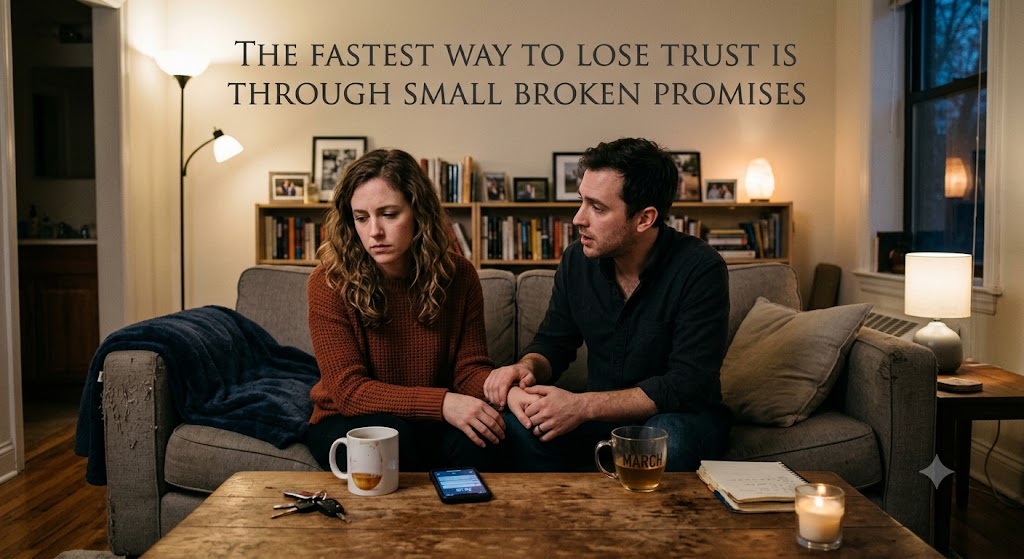
Trust is one of the most valuable things any person can earn, yet it is also one of the easiest things to lose. Most people imagine that trust disappears after a major betrayal, a shocking lie, or a dramatic act of disloyalty. While those events certainly destroy relationships, the truth is often far less dramatic. Trust usually dies quietly. It fades through repeated disappointments that seem too small to matter on their own. A forgotten phone call, an unanswered message, a missed deadline, an unfulfilled promise, or a casual “I’ll do it tomorrow” that never happens may appear insignificant in isolation, but together they create a pattern that slowly erodes confidence. The fastest way to lose trust is rarely through one catastrophic mistake. It is through small broken promises that accumulate until people stop believing your words altogether.
Every relationship, whether personal or professional, is built on expectations. When someone gives their word, they create an expectation in another person’s mind. That expectation becomes a silent agreement. It may not involve a written contract or legal obligation, but emotionally it carries enormous weight. Every time you keep your word, you strengthen that invisible bridge between yourself and others. Every time you fail without explanation or accountability, you remove another brick from that bridge. Eventually there comes a moment when the bridge can no longer support the relationship, and people begin to distance themselves.
Many people underestimate the importance of consistency because they focus only on intentions. They believe that having good intentions should count for something. Unfortunately, the world judges reliability by actions, not intentions. You may genuinely have wanted to help your friend move house, complete a work assignment on time, return borrowed money, or attend an important family gathering. If you repeatedly fail to follow through, people will remember what happened, not what you meant to do. Intentions make us feel good about ourselves, but actions determine whether others trust us.
The Fastest Way to Lose Trust Is Through Small Broken Promises
One of the biggest misconceptions about trust is that it can survive endless excuses. Modern life gives people countless reasons to explain away broken promises. Traffic was terrible. Work became stressful. The internet failed. An emergency came up. The phone battery died. While these explanations may occasionally be genuine, they quickly lose credibility when they become a habit. People are remarkably forgiving of honest mistakes, but they become sceptical when mistakes become predictable. At some point, excuses begin to sound like evidence that someone simply cannot be relied upon.
Consider how trust develops in everyday life. Imagine meeting someone who always arrives five minutes late. At first, you overlook it because everyone experiences delays occasionally. After the tenth or twentieth occurrence, however, you no longer expect them to be punctual. You adjust your expectations. You tell yourself to invite them earlier than everyone else if you want them to arrive on time. You begin making decisions based on their unreliability. They may still be kind, intelligent, and entertaining, but one aspect of trust has already disappeared.
The same principle applies in business. A company may promise next-day delivery but repeatedly deliver several days late. A freelancer may promise to finish a project by Friday but consistently request extensions. A manager may promise promotions, salary reviews, or opportunities that never materialise. Customers, employees, and clients eventually stop believing future promises because past experiences have trained them otherwise. Reputation is built one fulfilled commitment at a time, but it can collapse through countless minor disappointments.
This is why successful people often guard their promises carefully. They understand that every commitment creates a future obligation. Instead of saying yes to everything, they become comfortable saying no when necessary. Ironically, people who make fewer promises often earn greater trust because the promises they do make are consistently honoured. It is better to promise less and deliver more than to promise everything and deliver very little.
Small broken promises are especially dangerous because they often escape immediate confrontation. Major betrayals usually trigger difficult conversations. Minor disappointments rarely do. Instead of confronting the issue, people silently adjust their expectations. They stop asking for help. They stop depending on you. They stop sharing important opportunities. They stop recommending you to others. They stop involving you in decisions that require reliability. The relationship appears normal on the surface, but underneath, trust has already been withdrawn.
This silent withdrawal happens in friendships every day. One friend repeatedly cancels plans at the last minute. Another never returns borrowed items. Someone constantly says, “I’ll call you later,” but never does. These behaviours may not end the friendship immediately, yet over time they communicate a powerful message. They suggest that other priorities consistently matter more. Even if that was never the intention, perception often becomes reality.
Romantic relationships provide some of the clearest examples. Partners rarely separate because one person forgot to wash the dishes once or missed one anniversary. Instead, resentment grows through repeated small disappointments. Forgotten birthdays, ignored conversations, empty reassurances, and neglected responsibilities slowly convince one partner that they cannot rely on the other. The relationship weakens long before anyone officially acknowledges it. Emotional security depends not only on love but also on dependable behaviour.
Parents also teach trust through consistency. A child who repeatedly hears promises that are never fulfilled gradually learns not to believe them. If a parent constantly says, “We’ll play later,” “We’ll go to the park this weekend,” or “I’ll come to your school event,” but frequently fails to follow through, the child begins protecting themselves from disappointment by expecting less. Children may not fully understand the reasons behind broken promises, but they remember the emotional impact of unmet expectations.
Leadership depends even more heavily on trust. Employees are far more likely to respect leaders whose words consistently match their actions. A leader who announces new policies but never implements them gradually loses credibility. Team members stop taking announcements seriously because experience has taught them that promises often disappear. On the other hand, leaders who communicate honestly, admit limitations, and deliver consistently create environments where people feel secure and motivated.
There is also a psychological reason why small broken promises damage trust so effectively. Human beings naturally look for patterns. We constantly collect evidence about whether someone is dependable. Every interaction becomes another piece of information stored in memory. One broken promise may be forgiven as an exception. Five similar incidents begin forming a pattern. Ten incidents create a reputation. Once someone develops a reputation for unreliability, reversing it requires significant effort because future actions are filtered through previous experiences.
Ironically, many people who lose trust never realise when it happened. They continue believing everything is fine because nobody openly complains. What they fail to notice is that opportunities quietly disappear. Friends stop inviting them. Employers hesitate before assigning important responsibilities. Clients seek alternative providers. Family members stop depending on them. Trust rarely announces its departure. It simply leaves.
Technology has made this issue even more relevant. Communication has become instant, making it easier than ever to confirm plans, update others, or explain unavoidable delays. Yet many people still disappear without responding, ignore messages, or fail to communicate changes. These behaviours may seem minor, but they signal disrespect for another person’s time and expectations. A simple message saying, “I’m running late,” often preserves trust far better than arriving late without explanation.
Social media has also encouraged a culture of exaggerated promises. People publicly announce ambitious goals, exciting projects, and dramatic transformations before taking meaningful action. They repeatedly promise consistency, daily content, business launches, fitness journeys, or financial breakthroughs only to abandon them days later. Followers eventually stop paying attention because repeated declarations without consistent execution reduce credibility. Authenticity grows stronger when actions speak before announcements.
Self-trust follows exactly the same principles. Every promise you make to yourself carries psychological weight. When you repeatedly tell yourself that you will wake up early, start exercising, save money, finish reading a book, or learn a new skill but consistently fail to act, you gradually weaken confidence in your own discipline. Eventually your mind begins treating your own commitments as optional. This internal loss of trust often contributes to procrastination, low self-esteem, and reduced motivation because your subconscious no longer believes your promises.
Rebuilding self-trust starts with making smaller commitments that you can consistently honour. Instead of promising to exercise every day for two hours, commit to ten minutes. Instead of promising to save half your income immediately, begin with a realistic amount. Each completed commitment strengthens your confidence that your words have value. Over time, this internal reliability extends naturally into your relationships with others.
One important lesson is that honesty often protects trust more effectively than unrealistic optimism. If you know you cannot complete a task by Friday, saying so immediately is far better than repeatedly promising a deadline you will miss. People generally appreciate transparency because it allows them to adjust their expectations. False reassurance creates disappointment, whereas honest communication creates respect.
Another overlooked factor is the emotional cost imposed on others by broken promises. Every unmet commitment forces someone else to reorganise their plans, invest additional effort, or experience unnecessary stress. A missed business deadline may delay an entire project. A forgotten appointment wastes valuable time. A cancelled meeting may require complicated rescheduling. Even seemingly small failures create ripple effects that extend far beyond the original promise itself.
Successful organisations understand this principle exceptionally well. Airlines know that delayed flights damage customer confidence. Online retailers recognise that inaccurate delivery estimates reduce repeat purchases. Financial institutions understand that missed commitments affect long-term loyalty. Every reliable system depends upon keeping countless small promises consistently. This is why the most respected brands often focus obsessively on operational consistency rather than occasional spectacular performances.
Trust also influences opportunities that people never see. Employers recommend dependable employees for promotions because reliability reduces risk. Investors back entrepreneurs who consistently honour commitments. Customers return to businesses they can predict. Friends introduce trustworthy people to valuable contacts because their own reputation is attached to the recommendation. Reliability quietly opens doors that talent alone cannot unlock.
Many people chase impressive achievements while neglecting basic dependability. They focus on becoming more skilled, more knowledgeable, more influential, or more successful, forgetting that others first need confidence that they can be relied upon. Exceptional ability loses much of its value when accompanied by inconsistent behaviour. An average performer who always delivers often becomes more valuable than a brilliant performer whose promises cannot be trusted.
Forgiveness remains possible after trust has been damaged, but rebuilding confidence requires far more than apologies. Words alone cannot restore credibility. People need repeated evidence that behaviour has genuinely changed. This process takes patience because trust grows slowly. Every fulfilled commitment adds another brick to the relationship until confidence gradually returns. Unfortunately, many people seek immediate forgiveness without demonstrating consistent improvement. Genuine restoration depends upon proving reliability over time rather than requesting instant belief.
There is wisdom in pausing before making any promise. Ask yourself whether you truly have the time, resources, energy, and commitment required to fulfil it. If uncertainty exists, communicate honestly instead of making optimistic guarantees. Saying, “I’ll try,” “I need to check first,” or “I cannot commit to that right now,” may initially feel uncomfortable, but it preserves integrity. People generally respect realistic expectations far more than repeated disappointments.
The most trustworthy individuals are rarely perfect. They occasionally make mistakes, miss deadlines, or encounter unexpected challenges like everyone else. The difference lies in how they respond. They communicate early, accept responsibility, apologise sincerely, and work diligently to correct the situation. Their occasional failures do not destroy trust because they are exceptions within a much larger pattern of reliability.
Ultimately, trust is not measured by grand speeches, emotional declarations, or impressive intentions. It is measured by ordinary moments repeated consistently over time. Every kept appointment, every returned phone call, every honoured deadline, every fulfilled commitment, and every promise remembered strengthens the invisible foundation upon which all meaningful relationships depend. Conversely, every forgotten obligation, ignored message, delayed responsibility, and empty assurance quietly weakens that same foundation.
Life rewards people whose words carry weight. When others know that your yes truly means yes and your no genuinely means no, they begin placing greater confidence in you. They seek your advice, recommend your services, include you in important decisions, and rely upon your leadership because experience has taught them that your commitments are dependable. That reputation cannot be purchased, inherited, or demanded. It is earned through countless ordinary decisions to do exactly what you said you would do.
The fastest way to lose trust is not through one spectacular act of betrayal but through the accumulation of small broken promises that gradually convince people your words no longer match your actions. Fortunately, the opposite is equally true. The fastest way to build lasting trust is through countless small promises consistently kept. Every time you honour your commitments, however ordinary they may seem, you send a powerful message that your character is dependable. In a world where reliability has become increasingly rare, simply doing what you said you would do may be one of the greatest competitive advantages, the strongest relationship builder, and the clearest reflection of personal integrity anyone can possess.

EarnSmartOnline.com.ng is dedicated to helping readers make smarter financial decisions through practical guides on online income, personal finance, technology, digital business, and wealth creation. Our goal is to provide reliable, easy-to-understand, and actionable content that empowers individuals to earn smarter, build sustainable income streams and achieve long-term financial success.
Recommended: Start Earning Online
- Ultimate Affiliate Marketing Program — learn affiliate marketing with a done-for-you sales system ($15). Check it out
- The Newbie Affiliate Guide — the beginner-friendly starter guide (~$6.68). Check it out
- Easy Dollar Maker — earn in dollars uploading AI images and videos from your phone ($17). Check it out
Disclosure: These are affiliate links. If you buy through them, I may earn a commission at no extra cost to you.



