
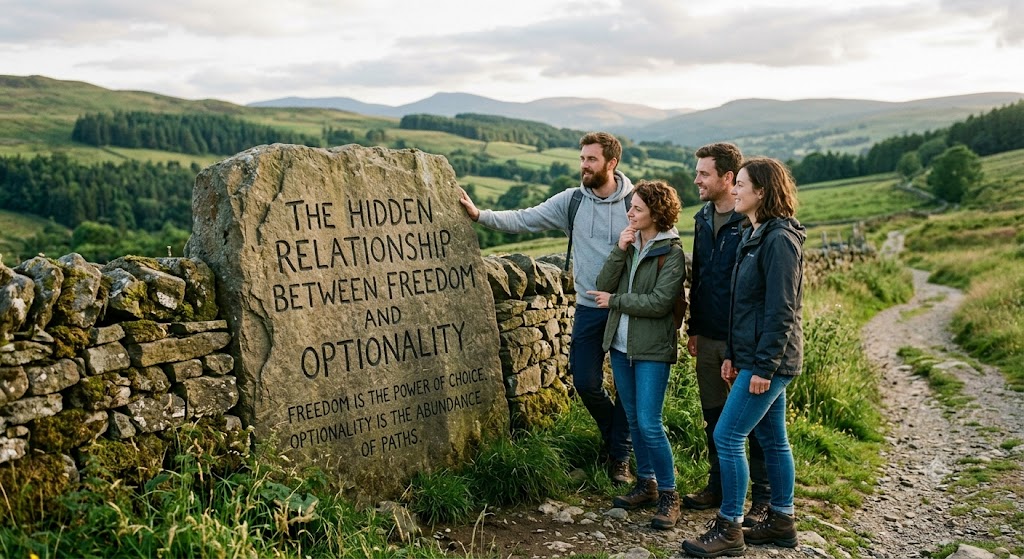
Freedom is one of the most desired goals in life. Almost everyone dreams about becoming free, yet very few people stop to ask what freedom truly means. Many assume freedom is simply having money, owning expensive possessions, travelling whenever they want, or escaping the traditional nine to five lifestyle. While these things may certainly make life more enjoyable, they do not automatically create genuine freedom. The hidden relationship between freedom and optionality reveals a deeper truth that many people overlook. Freedom is not merely about what you possess. It is about the number of meaningful choices available to you at any given moment.
Optionality is the ability to choose between multiple favourable paths without being forced into one. It means you can decide where to work, who to work with, when to take a break, what opportunities to pursue, and even which problems deserve your attention. Every additional option increases your freedom, while every lost option quietly reduces it. Most people spend years chasing wealth without realising that wealth itself is only valuable because it creates options.
Imagine two people who each earn the same income. The first person spends every penny they receive on maintaining an expensive lifestyle. Their salary pays for luxury accommodation, a costly vehicle, premium subscriptions, fashionable clothing, and countless monthly commitments. If they lose their job tomorrow, financial disaster arrives almost immediately because they have no savings, no investments, and no alternative income sources. The second person earns the same amount but chooses a different approach. They save consistently, invest wisely, develop valuable skills, and build additional streams of income over time. If they lose their primary job, they still have choices. They can search for better employment, launch a business, pursue freelance work, or even take time to rest before making another decision. Both individuals earned identical incomes, but only one possesses genuine freedom because only one has optionality.
Many people unknowingly sacrifice their future freedom for present comfort. They become trapped by loans they cannot comfortably repay, careers they secretly dislike, friendships they have outgrown, and lifestyles that demand constant income simply to survive. Every unnecessary financial obligation reduces future choices. Every neglected skill limits future opportunities. Every ignored relationship closes potential doors that might one day become important.
This is why optionality often matters more than immediate success. Success without optionality can become another form of prison. A highly paid executive may appear successful while secretly feeling trapped because leaving the job would immediately threaten their financial stability. A business owner may generate impressive revenue while being unable to take a single week off because the entire company depends on their daily presence. On the surface they seem free, yet beneath the appearance lies dependence. Real freedom exists when your life continues functioning even when you decide to change direction.
One of the greatest misunderstandings about freedom is believing it arrives suddenly. Many people imagine that one large payday, one profitable investment, or one successful business launch will instantly transform their lives forever. Reality usually works differently. Freedom grows gradually through countless small decisions that increase your future options. Saving a portion of every income creates future flexibility. Reading regularly expands knowledge that may unlock unexpected opportunities. Building professional relationships introduces possibilities that cannot be predicted today. Learning digital skills creates income opportunities that did not exist a decade ago. Every wise decision quietly adds another option to your future.
Technology has dramatically changed the meaning of optionality. In previous generations, earning a living often depended entirely on local opportunities. Someone living in a small town had limited career choices because employment was restricted by geography. Today, a graphic designer in Nigeria can serve clients in Canada. A software developer in Kenya can build applications for businesses in Australia. A writer in Ghana can publish content read by millions around the world. A teacher can educate students online without ever entering a traditional classroom. The internet has created unprecedented optionality for those willing to develop valuable skills.
However, technology has also created new traps. Endless entertainment competes for attention every hour of every day. Social media encourages comparison instead of growth. Many people spend years consuming content without creating anything valuable themselves. Every hour spent scrolling mindlessly is an hour not invested in building additional options. Time is the one resource that cannot be recovered, making it the foundation upon which all future optionality depends.
The relationship between freedom and optionality also explains why lifelong learning remains essential. The modern economy changes rapidly. Industries evolve. Artificial intelligence automates routine tasks. Consumer preferences shift. New careers emerge while others gradually disappear. Those who continuously learn maintain more options because they adapt alongside change. Those who stop learning often discover that their once valuable skills have become obsolete. Education should never be viewed as something completed after graduation. Instead, it becomes an ongoing investment in future freedom.
Financial independence is often discussed as the ultimate destination, but financial flexibility may be even more important during the journey. Someone with modest savings and low expenses often enjoys greater freedom than someone earning ten times more while carrying enormous debt. Wealth should not only be measured by income but by resilience. How long could you maintain your current lifestyle if your primary income disappeared tomorrow? The answer reveals more about your freedom than your monthly salary ever could.
Relationships also influence optionality in powerful ways. Trustworthy friendships, supportive family members, professional mentors, and reliable business partners all expand life’s possibilities. They introduce opportunities that money alone cannot purchase. A recommendation from a respected colleague may open a career opportunity that years of applications never achieve. A supportive spouse may provide emotional strength during difficult transitions. A mentor’s advice may help avoid expensive mistakes. Human relationships often create invisible networks of optionality that only become visible when life changes unexpectedly.
Conversely, unhealthy relationships reduce freedom. Manipulative friendships, controlling partnerships, toxic workplaces, and dishonest business associates gradually eliminate options by draining confidence, finances, and emotional energy. Many people remain trapped not because they lack ability but because their environment continuously discourages growth. Protecting your freedom sometimes requires leaving situations that quietly limit your future possibilities.
Optionality also changes the way we respond to uncertainty. Most people fear uncertainty because they feel unprepared for unexpected events. Yet those with many options often view uncertainty differently. Economic recessions, technological disruption, and industry changes may create challenges, but they also create opportunities for adaptable individuals. When one path closes, another often appears. Optionality transforms uncertainty from an enemy into a landscape filled with potential.
Entrepreneurs frequently understand this principle intuitively. The most successful business owners rarely depend on a single customer, one supplier, or one product. They diversify revenue sources, explore new markets, and continuously innovate because they recognise that dependence creates vulnerability. Investors apply similar thinking by diversifying portfolios rather than relying entirely on one company or one industry. Optionality reduces risk because it prevents a single failure from becoming a complete disaster.
Career development follows the same principle. Employees who master only one narrow task often become vulnerable when automation or organisational restructuring occurs. Those who combine communication skills, leadership abilities, technical expertise, critical thinking, and adaptability possess broader optionality. They become valuable across multiple industries rather than depending on one specific employer. Their skills create portable freedom.
Many people delay building optionality because immediate rewards appear more attractive than long term preparation. Saving money is less exciting than spending it. Studying after work feels harder than watching entertainment. Networking requires effort while isolation feels comfortable. Yet nearly every significant form of freedom begins with disciplined choices that produce invisible benefits long before visible results appear.
Perhaps the greatest advantage of optionality is psychological rather than financial. Knowing that you have alternatives changes how you think, negotiate, and make decisions. People with options rarely act out of desperation. They can reject unfair treatment, decline unsuitable opportunities, and patiently wait for better possibilities. Desperation often forces poor decisions because survival becomes the only priority. Optionality restores patience, confidence, and perspective.
This is why employers value employees who have choices. Businesses respect professionals whose expertise is genuinely difficult to replace. Clients appreciate freelancers who consistently deliver exceptional value because they know those individuals are not competing solely on price. Confidence naturally grows when you know your future does not depend entirely upon one fragile source of security.
Freedom also influences the quality of our decisions in ways that are often invisible. When someone is trapped by financial pressure, emotional dependence or a lack of opportunity, they frequently make decisions simply to escape immediate discomfort. They accept jobs they dislike because they need the next pay cheque. They remain in unhealthy relationships because they believe they have nowhere else to go. They abandon promising ideas because they cannot afford temporary failure. Optionality changes that equation. It creates enough breathing room to think clearly instead of reacting emotionally. It allows people to choose what is right rather than what is merely urgent.
This explains why building an emergency fund is about much more than money. It is actually the purchase of future choices. Every amount saved represents additional time to make thoughtful decisions instead of desperate ones. Someone with twelve months of living expenses saved possesses something far more valuable than a bank balance. They possess the freedom to reject poor opportunities while searching for better ones. They can invest in learning a new skill. They can relocate if necessary. They can recover from setbacks without immediately compromising their values.
The Hidden Relationship Between Freedom and Optionality
The same principle applies to knowledge. Every book read, every course completed and every meaningful conversation adds another layer of optionality. Knowledge compounds in ways that money often cannot. A person who understands finance, marketing, communication, technology and human psychology has significantly more opportunities than someone who has mastered only a single discipline. They are better equipped to solve problems, identify trends and adapt when circumstances change. Knowledge expands the mind first and eventually expands the opportunities available in the real world.
History repeatedly demonstrates that those who maintain optionality often recover from adversity faster than those who place everything on one path. Entire industries have disappeared because of innovation. Film cameras gave way to digital photography. Physical music stores were overtaken by streaming services. Video rental shops became obsolete almost overnight. Businesses that refused to adapt lost their options until none remained. Those willing to learn, evolve and embrace change found entirely new opportunities where others saw only endings.
On an individual level the same pattern continues every day. A person who learns artificial intelligence tools alongside their existing profession becomes more valuable than someone who insists nothing will ever change. A teacher who embraces online education reaches students across continents instead of remaining limited to a single classroom. A small business owner who understands digital marketing reaches customers twenty four hours a day instead of depending solely on foot traffic. Every adaptation creates another option. Every refusal to adapt quietly removes one.
Many people believe freedom comes from avoiding responsibility, but true freedom often comes from accepting the right responsibilities. Taking responsibility for your finances gives you options later. Taking responsibility for your health increases your future choices. Taking responsibility for your education creates career flexibility. Responsibility may feel restrictive in the present, yet it often produces the greatest freedom in the future. Neglect, on the other hand, feels comfortable today but frequently becomes tomorrow’s prison.
Health itself is one of the greatest forms of optionality that people rarely appreciate until it begins to decline. Good health allows someone to travel, work, exercise, learn, build businesses and enjoy relationships. Poor health can silently remove many of those options regardless of wealth. This is why investing in physical fitness, proper nutrition, quality sleep and mental wellbeing should never be viewed as luxuries. They are investments in future freedom.
Time management deserves similar attention. Everyone receives the same twenty four hours each day, yet people invest those hours differently. Some spend years developing skills, building businesses and strengthening relationships. Others spend those same years drifting without direction, assuming there will always be more time later. Eventually the difference becomes impossible to ignore. One person wakes up with multiple opportunities while another wonders why life feels increasingly restrictive. Optionality is often the accumulated result of thousands of ordinary days rather than one extraordinary moment.
There is also a strong connection between optionality and courage. It is much easier to pursue ambitious goals when failure does not threaten complete ruin. An entrepreneur with savings, valuable skills and a supportive network approaches risk differently from someone who has no financial cushion and no alternative plan. This does not mean wealthy people are automatically more courageous. Rather, optionality reduces the cost of experimentation. It allows people to test ideas, learn from mistakes and try again without losing everything.
Ironically, those with the greatest freedom often appear more disciplined than everyone else. They budget carefully despite earning substantial incomes. They continue learning even after achieving success. They maintain healthy habits instead of assuming success will last forever. Outsiders sometimes mistake this discipline for unnecessary caution, yet it is precisely this behaviour that preserves their optionality. Freedom is not maintained by luck. It is maintained by consistent decisions that protect future choices.
Consumer culture frequently encourages the opposite mindset. Advertising constantly suggests that freedom comes from purchasing more possessions. Bigger homes, newer vehicles, luxury gadgets and expensive lifestyles are presented as symbols of success. Yet many of these purchases increase monthly obligations instead of reducing them. The more someone must earn simply to maintain appearances, the fewer genuine choices remain. Owning impressive possessions means little if they quietly own your future.
Minimalism has gained popularity partly because it recognises this hidden truth. Owning fewer unnecessary possessions often creates more flexibility. Lower expenses make career changes easier. Smaller financial commitments allow greater experimentation. Simplicity is not about rejecting comfort. It is about ensuring that comfort does not become dependence.
Optionality also transforms leadership. Effective leaders rarely force people into narrow choices. Instead they create environments where creativity, initiative and independent thinking flourish. Businesses that encourage innovation generate more solutions because employees feel empowered to explore different approaches. Families that teach children how to think instead of merely what to think prepare them for a changing world. Education should expand options rather than limit imagination.
One fascinating aspect of optionality is that it often attracts additional opportunities. People who possess valuable skills, financial stability and strong reputations tend to receive more offers than they can accept. They can choose projects aligned with their values because they are not compelled to accept every opportunity presented to them. Meanwhile those with limited options frequently accept whatever becomes available regardless of whether it supports their long term goals. Success therefore becomes partially self reinforcing because each wise decision creates even more future possibilities.
Reputation plays an enormous role in this process. Trust is one of the most powerful forms of optionality available. A reputation for honesty, reliability and excellence opens doors that remain permanently closed to those known for dishonesty or inconsistency. Trust cannot usually be purchased, but it can be earned patiently over many years. Every promise kept strengthens future opportunities. Every shortcut taken for immediate gain risks destroying years of accumulated credibility.
The digital economy has made reputation even more valuable. Reviews, testimonials, recommendations and online portfolios influence decisions across almost every industry. A freelancer with hundreds of satisfied clients possesses significantly greater optionality than someone constantly searching for their first opportunity. Likewise, a business known for quality enjoys resilience during difficult economic periods because loyal customers continue returning.
Freedom also requires saying no. Many people believe opportunity means accepting everything, but genuine optionality often depends upon selective focus. Every commitment consumes time, energy and attention that could have been invested elsewhere. Learning to decline projects, partnerships or obligations that do not align with long term objectives preserves the flexibility needed to pursue truly meaningful opportunities. Saying yes to everything eventually becomes another form of imprisonment.
Perhaps the most overlooked relationship between freedom and optionality involves identity. People often define themselves too narrowly. Someone may believe they are only an accountant, only a teacher or only an engineer. When that identity is threatened, they feel as though their entire future has disappeared. Yet human beings are capable of continuous reinvention. Skills transfer across industries. Experiences create unexpected strengths. Curiosity leads to entirely new careers. The willingness to redefine yourself may be one of the greatest sources of optionality available.
Every generation faces different challenges, but one principle remains constant. Those who deliberately create options consistently navigate uncertainty better than those who depend entirely upon a single source of security. Freedom is not guaranteed by income alone, by qualifications alone or even by intelligence alone. It is created through resilience, adaptability, relationships, disciplined financial decisions, lifelong learning and the courage to keep expanding the number of meaningful choices available.
The hidden relationship between freedom and optionality ultimately changes the way we measure success. Instead of asking only how much money someone earns, perhaps we should ask how many meaningful choices they possess. Can they spend time with family without financial panic? Can they change careers if their passions evolve? Can they recover from unexpected setbacks? Can they contribute to causes they believe in? Can they choose work that aligns with their values instead of merely paying the bills? These questions reveal a deeper form of wealth than numbers alone ever could.
In the end, freedom is rarely handed to anyone. It is built patiently through countless decisions that expand rather than restrict future possibilities. Every new skill learned, every wise financial decision made, every healthy relationship nurtured and every act of disciplined preparation quietly increases optionality. Over time those seemingly ordinary decisions compound into something extraordinary: a life where choices replace desperation, purpose replaces survival and genuine freedom becomes not a distant dream but an everyday reality.

EarnSmartOnline.com.ng is dedicated to helping readers make smarter financial decisions through practical guides on online income, personal finance, technology, digital business, and wealth creation. Our goal is to provide reliable, easy-to-understand, and actionable content that empowers individuals to earn smarter, build sustainable income streams and achieve long-term financial success.
Recommended: Start Earning Online
- Ultimate Affiliate Marketing Program — learn affiliate marketing with a done-for-you sales system ($15). Check it out
- The Newbie Affiliate Guide — the beginner-friendly starter guide (~$6.68). Check it out
- Easy Dollar Maker — earn in dollars uploading AI images and videos from your phone ($17). Check it out
Disclosure: These are affiliate links. If you buy through them, I may earn a commission at no extra cost to you.



