
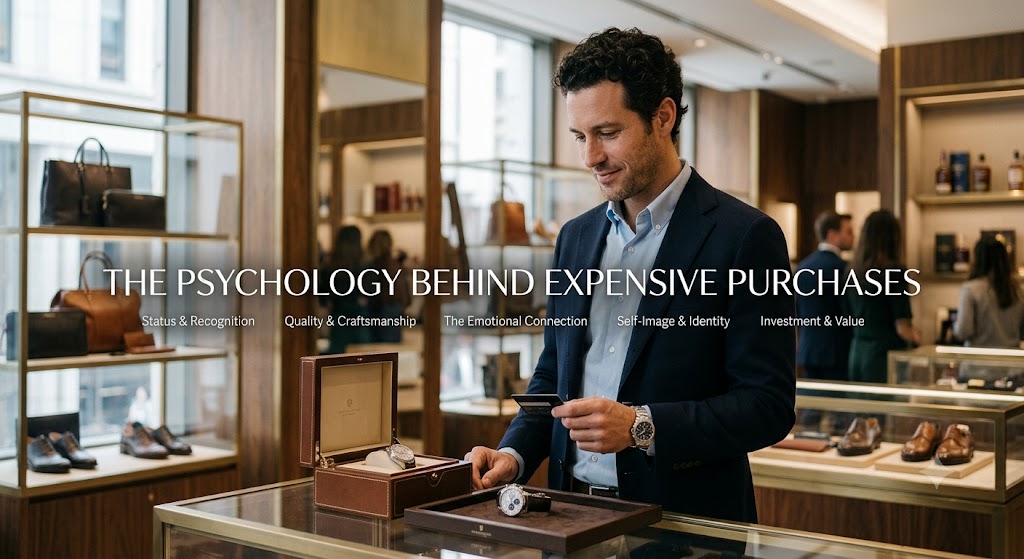
Why do people spend enormous amounts of money on things they do not necessarily need? Why can someone carefully compare prices when buying groceries but suddenly become emotionally attached to a luxury phone, expensive car, designer clothes, premium watch or dream holiday? Why does paying ₦5 million for something sometimes feel painful while paying ₦500,000 ten times can feel surprisingly easy? The Psychology Behind Expensive Purchases
The psychology behind expensive purchases is far more complicated than simply having enough money to afford something. People do not always buy expensive things because they need them. They often buy because of emotions, identity, social pressure, status, fear, aspiration, reward, convenience and the desire to feel successful. In many cases, the decision happens emotionally before the person creates a logical explanation for it.
Understanding the psychology behind expensive purchases is important because spending money is rarely just a financial activity. Every purchase communicates something about how a person sees themselves, how they want others to see them and what they believe will make their life better. Sometimes the purchase genuinely improves someone’s life. At other times, it temporarily fills an emotional gap that money cannot permanently solve.
An expensive purchase can begin with desire long before it begins with money. Someone sees a beautiful car on the road and imagines themselves driving it. Someone watches a content creator using the newest smartphone and suddenly feels that their current phone is outdated. Someone walks into a luxury shop and sees a designer bag that costs several months of their income. They may not need the bag, but something inside them says, “I deserve this.”
That sentence is powerful because purchasing decisions are often connected to emotional rewards. People use money not only to obtain products and services but also to purchase feelings. They buy comfort, excitement, confidence, recognition, belonging and sometimes even evidence that they are making progress in life.
This is one of the most important ideas behind the psychology of spending. The product may be physical, but the real thing being purchased is often psychological.
Consider someone who has worked for years, struggled through difficult circumstances and finally receives a significant amount of money. They may immediately buy an expensive car. To an outsider, the purchase may appear financially irresponsible. But emotionally, the car may represent freedom, achievement or proof that the difficult years were not wasted.
The person is not simply buying transportation. They are buying a symbol of what they believe they have accomplished.
This explains why expensive purchases can feel disproportionately satisfying. The emotional meaning attached to the object can be much larger than the object itself.
Luxury brands understand this extremely well. A luxury product is rarely marketed purely according to its practical function. A normal watch tells time. A luxury watch may be marketed as craftsmanship, heritage, exclusivity and status. A normal vehicle moves you from one location to another. A luxury vehicle may be presented as success, sophistication, power and achievement.
The psychological difference is enormous.
If two products perform almost the same practical function, why would someone willingly pay many times more for one of them? Because humans do not evaluate value purely through utility. Perceived value can be influenced by scarcity, reputation, social meaning, emotional attachment and personal identity.
This is where status becomes important.
Humans are social creatures. Whether we admit it or not, many of us care about how other people perceive us. Expensive purchases can therefore become tools of social communication. A luxury car can communicate success. An expensive phone can communicate technological awareness. Designer clothing can communicate wealth or taste. A prestigious home can communicate stability and achievement.
The Psychology Behind Expensive Purchases
This does not automatically mean that everyone who buys expensive things is trying to impress people. Some people genuinely appreciate quality, craftsmanship or performance. But social perception remains an important psychological factor in many purchasing decisions.
The desire for status is not new. Long before smartphones, designer clothing and luxury cars existed, societies had symbols of wealth and power. People have always searched for ways to communicate position, achievement and belonging.
Modern consumer culture simply gives people more sophisticated tools for doing it.
Social media has made this psychology even stronger. People are constantly exposed to carefully selected images of other people’s lifestyles. They see luxury holidays, expensive restaurants, beautiful houses, new cars, designer clothes and seemingly effortless success.
The problem is that social media rarely shows the full financial story behind the lifestyle.
A person may see someone carrying a ₦2 million handbag without knowing whether that person owns the bag outright, borrowed it, received it as a gift or purchased it while carrying significant debt. Yet the viewer may compare their own life against that image.
This comparison can create dissatisfaction.
Psychologists have long studied social comparison, and modern social media has amplified opportunities for it. When people repeatedly see others displaying expensive possessions, their perception of what is normal can change. A lifestyle that once seemed luxurious can gradually begin to look ordinary. The Psychology Behind Expensive Purchases
This is one reason lifestyle inflation can become dangerous.
Someone receives a salary increase and upgrades their phone. Later, they upgrade their apartment. Then their car. Then their wardrobe. Then their holidays. Eventually, their income may have increased significantly while their financial security has barely improved.
The problem is not necessarily any single purchase. The problem is that expectations have grown alongside income.
The human brain is remarkably adaptable. Something that once felt luxurious can quickly become normal. This phenomenon is closely related to hedonic adaptation, where people tend to return towards a familiar level of satisfaction after positive or negative changes.
Imagine buying your dream phone. For the first few days, you are excited every time you pick it up. You admire the camera, screen and features. After several months, however, it becomes your normal phone. The excitement fades.
Then a newer model appears.
Suddenly, the phone that once represented achievement begins to feel old.
This cycle can continue indefinitely if someone allows external products to determine their sense of satisfaction.
Marketing companies understand this perfectly. Advertising does not simply tell people that a product exists. Modern marketing often creates a gap between who people are and who they believe they could become.
The advertisement says, directly or indirectly, “This is the kind of person who owns this.”
The consumer then begins to imagine themselves as that person.
This is particularly powerful with luxury products because luxury is often associated with identity. The question changes from “Do I need this?” to “What does owning this say about me?”
That is why expensive purchases can become emotionally difficult to resist.
Another psychological factor is the concept of scarcity. People tend to place greater value on things they believe are limited or difficult to obtain. Luxury brands frequently use exclusivity to strengthen this perception. Limited editions, restricted availability and premium experiences can create urgency.
When people believe that an opportunity may disappear, they become more willing to act quickly.
This can reduce rational decision making.
A person who would normally spend hours comparing a ₦50,000 purchase may spend millions within minutes when they believe an expensive item is rare or unavailable tomorrow.
The fear of missing out can be extremely powerful.
FOMO is particularly visible in technology, fashion, investment trends, travel and social experiences. People may purchase something not because they genuinely want it but because they are afraid of being left behind.
This leads to an important question: Are you buying because you want the thing or because you are afraid of not having it?
Those are completely different motivations.
Another powerful psychological force is the reward system. Spending money can produce excitement and anticipation. The process of searching, comparing, ordering and finally receiving an item can create a temporary emotional high.
This is why some people shop when they are stressed, lonely, bored or frustrated.
The purchase becomes a form of emotional regulation.
Someone has a terrible day at work. They feel unappreciated. They open an online shopping app and discover something expensive they have wanted for months. Buying it gives them an immediate sense of control and pleasure.
The underlying problem has not disappeared.
But the emotional discomfort has temporarily been replaced by excitement.
This is one reason emotional spending can become dangerous. The individual may repeatedly use purchases to manage feelings instead of addressing the underlying problem.
There is nothing inherently wrong with buying something that makes you happy. Money is supposed to be used. The problem begins when spending becomes the primary way someone manages their emotions.
Another psychological factor behind expensive purchases is the justification effect. People often know that an expensive purchase may not be financially sensible, so they create reasons to make themselves comfortable with the decision.
“I deserve it.”
“I have worked hard.”
“It will motivate me.”
“I will use it for many years.”
“It is an investment.”
“It is better to buy quality.”
Sometimes these statements are completely true.
Sometimes they are simply emotional arguments wearing the clothes of logic.
The danger is not that these explanations exist. The danger is failing to distinguish between genuine reasoning and post purchase rationalisation.
People are remarkably good at defending decisions they have already emotionally made.
This is related to cognitive dissonance. When behaviour conflicts with beliefs, people often adjust their interpretation of the situation to reduce discomfort.
Someone who believes they are financially disciplined but spends heavily on unnecessary luxury may experience internal tension. Instead of questioning the purchase, they may convince themselves that it was necessary.
This makes self awareness extremely important.
Expensive purchases can also be influenced by the sunk cost effect. Once someone has invested heavily in a lifestyle, they may feel compelled to continue maintaining it.
A person buys an expensive car and then discovers that maintenance, insurance and fuel are expensive. Instead of reconsidering the lifestyle, they continue spending because they have already invested so much.
The same thing can happen with expensive homes, businesses, hobbies and social circles.
The initial purchase may be only the beginning.
This is why the true cost of an expensive purchase is often higher than the price tag.
A luxury car does not only cost the purchase price. It may involve maintenance, fuel, insurance, repairs and depreciation. An expensive house may involve taxes, maintenance, security, utilities and renovations. An expensive lifestyle may create expectations that require continuous spending.
The psychology behind expensive purchases therefore extends beyond the moment money leaves your account.
There is also the psychological concept of identity signalling. People often purchase things that reinforce the person they believe they are or want to become.
Someone who sees themselves as successful may be attracted to premium products. Someone who sees themselves as environmentally conscious may spend more on sustainable products. Someone who identifies strongly with fitness may spend heavily on gym equipment, clothing and supplements.
The purchase becomes part of the identity.
This can be positive when the purchase supports meaningful goals. For example, buying quality equipment for a genuine business can increase productivity. Paying for education can increase knowledge and earning potential. Purchasing reliable tools can save time and improve performance.
The key difference is whether the purchase supports the identity through action or merely creates the appearance of the identity.
Buying a ₦1 million camera does not make someone a photographer.
Buying expensive business clothes does not make someone successful.
Buying financial books does not automatically make someone financially intelligent.
The object can support the identity, but it cannot substitute for the behaviour.
Another interesting psychological factor is the price quality assumption. People often assume that expensive products are automatically better.
Sometimes they are.
Sometimes they are not.
Price can influence perceived quality even before the consumer has tested the product. When people see a higher price, they may subconsciously interpret the product as more valuable, sophisticated or reliable.
This is one reason premium pricing can itself become a marketing tool.
However, expensive does not always mean valuable.
The distinction between price and value is one of the most important lessons in personal finance.
Price is what you pay.
Value is what you receive.
A product can be expensive and provide extraordinary value. Another product can be cheap and provide poor value. Likewise, something can be expensive and provide almost no meaningful benefit beyond status.
Smart spending therefore requires asking what the purchase actually gives you.
Does it save time?
Does it increase income?
Does it improve health or productivity?
Does it provide lasting enjoyment?
Does it solve a genuine problem?
Does it strengthen your business?
Does it improve your quality of life?
Or are you mainly buying recognition?
These questions can expose the real motivation behind an expensive purchase.
There is also the emotional connection between money and self worth. Some people use expensive purchases as evidence that they are finally doing well.
After years of financial struggle, purchasing something luxurious can feel like crossing an invisible line.
“I have made it.”
That feeling can be powerful.
But tying self worth too closely to possessions can create a dangerous cycle. If your confidence depends on maintaining an expensive lifestyle, every financial setback can feel like a personal failure.
A healthier approach is to recognise achievement without making possessions the foundation of identity.
You can enjoy a beautiful car without believing that the car makes you valuable.
You can own an expensive watch without believing that the watch makes you important.
You can live in a beautiful home without believing that the house determines your worth.
The healthiest relationship with money allows you to enjoy things without becoming psychologically dependent on them.
The psychology behind expensive purchases also explains why people sometimes spend more when paying with credit. When money leaves your bank account immediately, the pain of payment is obvious. Credit and instalment systems can separate the pleasure of receiving something from the discomfort of paying for it.
This can make expensive purchases feel psychologically smaller than they actually are.
A ₦3 million purchase can sound frightening.
But ₦100,000 per month may sound manageable.
The total cost has not changed.
Only the psychological framing has changed.
This is why consumers need to look beyond monthly payment amounts and consider the full financial commitment.
Before making a major purchase, one useful strategy is to create a waiting period. Instead of buying immediately, wait a few days or weeks depending on the size of the purchase.
If the desire disappears, it was probably emotional.
If the desire remains and the purchase still makes financial sense, you can reconsider it with a clearer mind.
Another powerful strategy is to calculate the purchase in terms of working hours.
Instead of asking, “Can I afford ₦500,000?” ask, “How many hours of my life does this represent?”
That question changes the psychology.
Money represents time. Every naira you earn requires some combination of labour, skill, risk, opportunity and time. Thinking about purchases in terms of time can make their real cost easier to understand.
An expensive purchase is not necessarily a bad purchase.
In fact, some expensive purchases can be among the best financial decisions a person ever makes.
Quality education can create opportunities.
A reliable business tool can increase productivity.
A strategically purchased property can create long term value.
A good computer can become an income generating asset.
Professional training can increase earning capacity.
The issue is not whether something is expensive.
The issue is why you are buying it and what it does for your future.
The most financially intelligent people are not necessarily people who never spend money. They are people who understand their own psychology well enough to know when money is serving them and when emotions are controlling them.
They understand that spending can be both rational and emotional.
They know that advertisements are designed to influence desire.
They recognise social pressure.
They understand lifestyle inflation.
They question status consumption.
They distinguish between price and value.
Most importantly, they learn to pause before making decisions that can affect their financial future.
Perhaps the biggest lesson from the psychology behind expensive purchases is that the most dangerous purchase is not always the one that costs the most money.
Sometimes the most dangerous purchase is the one that convinces you that you need to become someone else before you can feel successful.
You do not need the newest phone to prove that you are progressing.
You do not need a luxury car to prove that you have succeeded.
You do not need designer clothes to prove that you have value.
You do not need an expensive lifestyle to prove that you are worthy.
Buy expensive things when they genuinely improve your life, support your goals or bring meaningful enjoyment that you can comfortably afford.
But learn to recognise when the purchase is attempting to repair something inside you.
Because if you are trying to buy confidence, approval, status or happiness, the product may give you a temporary feeling, but the feeling may eventually disappear.
Then another product will appear.
And another.
And another.
Until you realise that you have spent years buying things that were supposed to make you feel successful while neglecting the things that actually create financial security.
The smartest purchase may therefore be the one you decide not to make.
Not because you cannot afford it.
Not because expensive things are bad.
But because you have finally understood the psychology behind your desire.
You have stopped asking, “Can I afford this?”
You have started asking, “Why do I want this?”
That single question can change the way you spend money.
It can help you separate genuine needs from emotional impulses, value from status, quality from branding and long term satisfaction from temporary excitement. The Psychology Behind Expensive Purchases
Money gives you purchasing power, but psychological awareness gives you control.
And when you understand why you buy what you buy, you are no longer simply spending money.
You are making deliberate decisions about what your money is allowed to mean in your life.

EarnSmartOnline.com.ng is dedicated to helping readers make smarter financial decisions through practical guides on online income, personal finance, technology, digital business, and wealth creation. Our goal is to provide reliable, easy-to-understand, and actionable content that empowers individuals to earn smarter, build sustainable income streams and achieve long-term financial success.
Recommended: Start Earning Online
- Ultimate Affiliate Marketing Program — learn affiliate marketing with a done-for-you sales system ($15). Check it out
- The Newbie Affiliate Guide — the beginner-friendly starter guide (~$6.68). Check it out
- Easy Dollar Maker — earn in dollars uploading AI images and videos from your phone ($17). Check it out
Disclosure: These are affiliate links. If you buy through them, I may earn a commission at no extra cost to you.



