
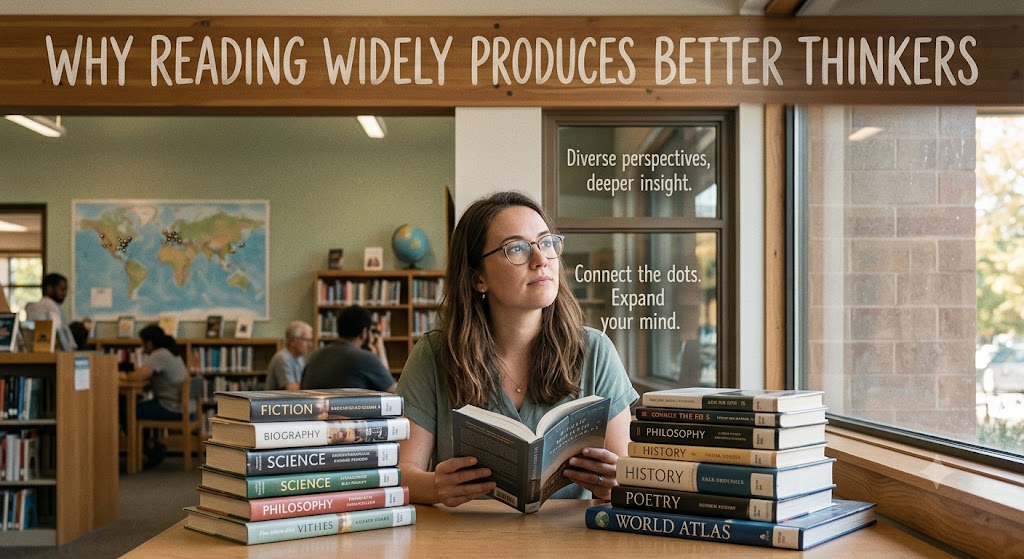
Why Reading Widely Produces Better Thinkers
In a world overflowing with information, reading has never been more important. Yet many people limit themselves to only one type of content, one perspective, or one area of interest. They read only about their profession, only the latest news, or only what confirms what they already believe. While this approach may provide temporary comfort, it also limits intellectual growth. One of the greatest habits anyone can develop is the ability to read widely across different subjects, disciplines, cultures, and viewpoints. Reading widely does far more than increase knowledge. It transforms the way people think, analyse problems, make decisions, communicate ideas, and understand the world around them.
The reason reading widely produces better thinkers is simple. Every book, article, biography, research paper, or historical account represents years of someone else’s learning and experience. Instead of spending decades discovering every lesson through trial and error, readers can absorb valuable insights in a matter of hours. Every page introduces new ideas, different perspectives, and fresh ways of solving problems. Over time, these pieces of knowledge connect together, creating a broader understanding that improves judgment and decision-making.
One of the greatest dangers in modern society is intellectual narrowness. People often consume information that agrees with their existing beliefs while avoiding ideas that challenge them. This creates an echo chamber where opinions become stronger but understanding becomes weaker. Wide reading breaks this cycle. It exposes readers to opposing viewpoints, unfamiliar cultures, different economic systems, historical events, scientific discoveries, psychological principles, and philosophical debates. Instead of seeing issues as black and white, readers begin to appreciate complexity and nuance.
Reading across different subjects strengthens critical thinking because it teaches people to compare ideas rather than accept them blindly. A person who reads only about finance may understand money but miss valuable lessons from psychology that explain why people make irrational financial decisions. Someone who studies only technology may overlook historical patterns that reveal how innovation has shaped societies for centuries. A business owner who reads only marketing books may struggle to understand leadership if they never explore philosophy, sociology, or behavioural science. Wide reading allows knowledge from one field to improve understanding in another.
The human brain naturally looks for patterns. Every new piece of information becomes more valuable when it connects with previous knowledge. This is why reading broadly creates stronger thinkers. A historical event may suddenly explain a modern political issue. A scientific discovery may inspire a business innovation. A philosophical concept may improve leadership skills. A biography may reveal lessons about resilience that no management textbook could teach. The ability to connect unrelated ideas often separates exceptional thinkers from average ones.
Many of history’s greatest innovators were known for reading beyond their primary fields. They understood that breakthroughs rarely come from repeating what everyone else already knows. Instead, innovation often happens when ideas from different disciplines combine in unexpected ways. Someone who studies engineering alongside psychology may design products that people genuinely enjoy using. A medical researcher who understands artificial intelligence may develop faster diagnostic tools. A writer who studies economics may produce more insightful commentary about society. The wider the knowledge base, the greater the potential for creative thinking.
Reading widely also develops intellectual humility. The more people learn, the more they realise how much remains unknown. This awareness reduces arrogance and encourages curiosity. Instead of assuming they have all the answers, broad readers become comfortable asking better questions. They understand that every subject contains complexities that cannot be fully understood from a single perspective. This mindset creates lifelong learners who continue improving throughout their lives.
Another reason reading widely produces better thinkers is that it improves decision-making. Every important decision depends on the quality of available information. People who have encountered different ideas, situations, and historical examples possess a larger mental library from which to draw conclusions. They recognise patterns others overlook and avoid mistakes that have already been documented countless times throughout history. Good judgment is rarely the result of intelligence alone. It often comes from exposure to many different experiences, even if those experiences were gained through reading rather than personal experience.
Reading fiction deserves special attention because many people underestimate its value. Novels place readers inside the minds of different characters, exposing them to emotions, motivations, struggles, and perspectives they may never encounter in real life. This develops empathy, emotional intelligence, and social awareness. Understanding how different people think improves relationships, leadership, communication, and conflict resolution. Fiction reminds readers that every person has a story, and that understanding others often requires imagination as much as logic.
Non-fiction, on the other hand, provides practical knowledge that helps readers navigate the real world. Books on economics explain how markets operate. Psychology explores why people behave the way they do. History reveals recurring patterns of success and failure. Science teaches evidence-based reasoning. Philosophy encourages careful examination of values and ethics. Business books explain strategy, leadership, and organisational growth. Personal development books introduce habits that improve productivity and resilience. Together, these subjects create a balanced intellectual foundation.
Wide reading also protects people from misinformation. In today’s digital world, false information spreads quickly through social media and online platforms. Individuals who possess broad knowledge are less likely to accept misleading claims without verification because they have developed habits of questioning sources, evaluating evidence, and comparing information against what they already know. They understand that extraordinary claims require strong evidence and that complex issues rarely have simple explanations.
Communication skills improve naturally through reading. Exposure to high-quality writing expands vocabulary, strengthens grammar, and improves sentence structure. Readers learn how experienced authors organise ideas, persuade audiences, explain difficult concepts, and tell compelling stories. Over time, this influence appears in both spoken and written communication. Better communication often leads to stronger careers because every profession rewards people who can express ideas clearly and confidently.
Reading widely also enhances creativity. Creative thinking is rarely about inventing completely new ideas. More often, it involves combining existing ideas in original ways. Every book adds new concepts to the mind, increasing the number of possible connections. This explains why people who read across many subjects frequently develop innovative solutions. Their minds contain a larger collection of mental building blocks from which to create something unique.
Another overlooked benefit is adaptability. The world changes rapidly. Industries evolve, technology advances, and new challenges constantly emerge. People who read broadly become comfortable learning unfamiliar topics because they have already developed flexible thinking. They understand that knowledge is always expanding and that staying relevant requires continuous education. Instead of resisting change, they adapt more quickly because learning has become part of their identity.
Reading history provides particularly valuable lessons because human nature changes far less than technology. Although societies evolve, many of today’s political conflicts, economic crises, leadership failures, and social challenges resemble events from centuries ago. History demonstrates the consequences of poor decisions while also highlighting timeless principles that lead to progress. Readers who study history gain perspective that helps them interpret current events with greater accuracy.
Science encourages evidence-based thinking. Instead of relying on assumptions or emotional reactions, scientific thinking emphasises observation, experimentation, and verification. Reading scientific literature teaches readers to distinguish between opinion and evidence, making them less vulnerable to manipulation or misinformation. This habit extends beyond laboratories into everyday decision-making.
Philosophy encourages deeper reflection about life’s biggest questions. It explores morality, justice, knowledge, happiness, responsibility, and the nature of truth itself. Readers who engage with philosophical ideas become more thoughtful because they learn to examine assumptions rather than simply accepting conventional wisdom. Philosophy teaches that asking the right question is often more valuable than rushing towards an answer.
Biographies remain among the most valuable forms of reading because they reveal how extraordinary individuals handled failure, uncertainty, criticism, setbacks, and success. Reading about real lives provides practical lessons that abstract theories cannot always capture. Every successful person faced obstacles, made mistakes, adapted strategies, and continued learning. These stories remind readers that progress rarely follows a straight path.
Wide reading also improves patience and concentration. In an age dominated by short videos, instant notifications, and fragmented attention spans, sustained reading trains the brain to focus deeply for extended periods. This ability has become increasingly valuable because complex problems require uninterrupted thinking. Individuals who can concentrate deeply often outperform those constantly distracted by digital interruptions.
The habit of reading widely benefits every profession. Entrepreneurs recognise emerging opportunities by studying economics, technology, psychology, and consumer behaviour together. Teachers explain concepts more effectively by drawing examples from multiple disciplines. Doctors improve patient care by understanding communication, ethics, and behavioural science alongside medicine. Engineers develop better products by studying design, history, and human psychology. Lawyers strengthen arguments by understanding philosophy and economics. Leaders inspire teams by learning from history, literature, and biographies. Regardless of occupation, broader knowledge improves performance.
Parents who read widely become better role models for their children. Children naturally imitate adult behaviour. When they observe parents reading regularly, discussing ideas, asking thoughtful questions, and remaining curious, they begin viewing learning as a lifelong pursuit rather than a school requirement. This influence often shapes attitudes towards education for decades.
Reading broadly also encourages independent thinking. Instead of relying solely on popular opinion, readers develop confidence in evaluating evidence for themselves. They become comfortable disagreeing respectfully because their conclusions are based on careful consideration rather than social pressure. Independent thinking does not mean rejecting every common belief. It means examining ideas carefully before accepting or rejecting them.
Technology has made wide reading easier than ever before. Libraries, e-books, online journals, educational websites, and audiobooks provide access to millions of resources covering virtually every subject imaginable. The challenge is no longer finding information but choosing wisely. Quality matters more than quantity. Reading thoughtful books written by respected experts provides far greater value than endlessly scrolling through superficial content.
Building a habit of reading widely does not require reading hundreds of books each year. Consistency matters more than speed. Reading twenty or thirty pages each day accumulates into thousands of pages over the course of a year. Those pages represent hundreds of hours of learning, reflection, and intellectual growth. Small daily efforts produce remarkable long-term results through the power of consistency.
It is equally important to read authors with whom you disagree. Agreement confirms existing beliefs, but disagreement stimulates deeper thinking. Challenging books force readers to evaluate evidence, question assumptions, and strengthen their reasoning. Even when readers ultimately reject an author’s conclusions, they often emerge with clearer thinking and stronger arguments.
Reading widely is ultimately an investment in the quality of one’s mind. Wealth can disappear, technology can become obsolete, careers can change, and circumstances can shift unexpectedly, but a well-developed mind remains a lifelong asset. Every book adds another layer of understanding, another perspective, another lesson, and another opportunity to think more clearly. Better thinkers make better decisions, solve problems more effectively, communicate more persuasively, adapt more quickly, and contribute more meaningfully to society.
The greatest thinkers are rarely those who know the most about one narrow subject. They are often those who understand enough about many subjects to recognise patterns, connect ideas, challenge assumptions, and approach problems from multiple perspectives. Reading widely cultivates exactly these abilities. It transforms information into understanding, understanding into wisdom, and wisdom into better decisions. In an increasingly complex world where knowledge grows every day, the habit of reading broadly remains one of the most reliable ways to sharpen the mind, expand perspective, and become a more thoughtful, informed, and capable human being.

EarnSmartOnline.com.ng is dedicated to helping readers make smarter financial decisions through practical guides on online income, personal finance, technology, digital business, and wealth creation. Our goal is to provide reliable, easy-to-understand, and actionable content that empowers individuals to earn smarter, build sustainable income streams and achieve long-term financial success.
Recommended: Start Earning Online
- Ultimate Affiliate Marketing Program — learn affiliate marketing with a done-for-you sales system ($15). Check it out
- The Newbie Affiliate Guide — the beginner-friendly starter guide (~$6.68). Check it out
- Easy Dollar Maker — earn in dollars uploading AI images and videos from your phone ($17). Check it out
Disclosure: These are affiliate links. If you buy through them, I may earn a commission at no extra cost to you.



