
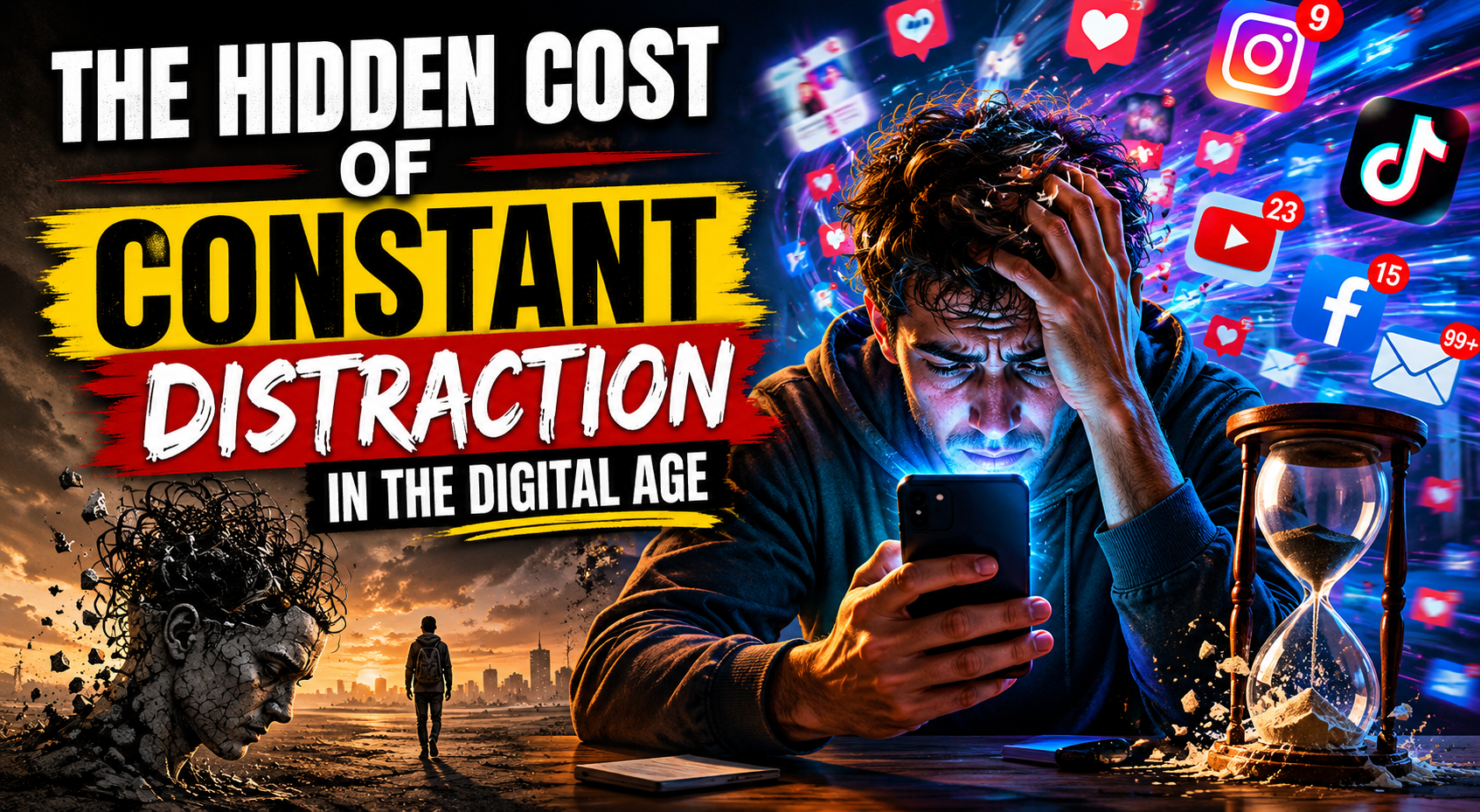
The Hidden Cost of Constant Distraction in the Digital Age
In the modern world, attention has become one of the most valuable resources a person can possess, yet it is also the most heavily exploited. The digital age promised convenience, connection, and access to unlimited information, but it also introduced a hidden cost that most people are only beginning to notice. Constant distraction has quietly reshaped how we think, how we work, how we make decisions, and ultimately how we build our lives. What looks like harmless scrolling, quick notifications, and short bursts of entertainment is actually a continuous drain on focus, productivity, and mental clarity.
The hidden cost of constant distraction in the digital age is not just about wasting time. It is about what that wasted time prevents from forming. Deep thinking, long-term planning, emotional stability, and skill mastery all require sustained attention. When attention is fragmented into small pieces throughout the day, the mind never stays in one place long enough to build anything meaningful. This creates a life that feels busy but lacks real progress, active but not productive, engaged but not fulfilled.
One of the most damaging effects of constant digital distraction is the loss of deep work ability. Deep work refers to the capacity to focus on a task without interruption for an extended period. It is in this state that high level thinking, creativity, and problem solving happen. However, in a world where messages, alerts, videos, and updates compete for attention every few seconds, the brain becomes conditioned to expect interruption. Over time, sustained focus begins to feel uncomfortable, even unnatural. People start to avoid long tasks, not because they are difficult, but because their attention span has been reshaped.
This shift has serious consequences for personal growth. Skills are not built through scattered attention. Whether it is learning a profession, mastering a craft, or developing financial intelligence, progress depends on consistency and depth. When distraction becomes a constant companion, learning becomes shallow. Information is consumed but not retained. Ideas are seen but not applied. Knowledge becomes surface level, and surface level understanding rarely produces transformation.
Another hidden cost is the illusion of productivity. Many people spend hours every day switching between apps, messages, and content feeds, feeling engaged and mentally active. Yet at the end of the day, very little meaningful output has been produced. This creates a dangerous gap between activity and achievement. The mind begins to associate being busy with being productive, even when the results do not support that belief. Over time, this illusion prevents honest evaluation of progress and slows down real success.
The digital environment is designed to keep attention moving. Platforms are built around engagement metrics, not human well being. Every notification, recommendation, and infinite scroll feature is engineered to capture and hold attention for as long as possible. This creates a system where distraction is not accidental but intentional. Understanding this is important because it shifts responsibility back to the individual. Without intentional control, attention is constantly being pulled in directions that do not align with personal goals.
Constant distraction also affects emotional health in subtle ways. The brain is not designed to process endless streams of information and stimulation. When exposed to continuous input without rest, it becomes overstimulated and fatigued. This can lead to anxiety, irritability, and difficulty relaxing. Many people now find it hard to sit in silence or enjoy moments without stimulation because the mind has become dependent on constant input. Peaceful moments start to feel empty rather than restorative.
There is also a social cost to digital distraction. Conversations are interrupted by phones, presence is divided between physical and digital spaces, and relationships suffer from partial attention. When someone is physically present but mentally elsewhere, connection becomes shallow. Over time, this weakens communication, reduces empathy, and creates emotional distance even among people who spend a lot of time together.
One of the most overlooked consequences is the impact on long-term thinking. Constant distraction trains the mind to prioritize immediate stimulation over delayed reward. This makes it harder to commit to goals that require patience and consistency. Financial planning, career development, and personal growth all depend on the ability to think beyond the present moment. When attention is constantly pulled toward short term entertainment, the future becomes less clear and less prioritized.
The hidden cost of constant distraction also shows up in decision making. A distracted mind is more reactive than reflective. Instead of carefully considering options, decisions are made quickly and often emotionally. This leads to impulsive choices, inconsistent behavior, and regret later on. Over time, these small decisions accumulate and shape life outcomes in significant ways. Poor focus does not only reduce productivity, it reduces the quality of life decisions.
Another important aspect is the effect on creativity. Creativity requires mental space, boredom, and the ability to let thoughts develop naturally without interruption. However, when every spare moment is filled with digital input, the mind never gets the chance to wander freely. This constant stimulation suppresses imagination and reduces original thinking. Many people feel less creative not because they lack ideas, but because their attention is always occupied.
The economic impact of distraction is also significant. In a world where value is increasingly tied to skill, expertise, and output, those who cannot focus for long periods fall behind. High income skills require deep concentration and repeated practice. Whether in business, technology, or any professional field, the ability to stay focused directly affects earning potential. Distraction quietly reduces productivity, which in turn limits financial growth over time.
Education is also affected. Students and learners who are constantly distracted struggle to retain information and develop critical thinking skills. Reading long materials becomes difficult, and attention shifts toward shorter, easier content. This creates a learning gap where information is consumed quickly but not understood deeply. As a result, many people leave formal education with knowledge but without mastery.
The hidden cost extends into self identity as well. People begin to define themselves based on fragmented experiences rather than consistent development. Instead of seeing themselves as focused, disciplined, or skilled in a particular area, they see themselves as constantly switching between interests and distractions. This weakens confidence and reduces the sense of personal direction.
Breaking free from constant distraction does not require rejecting technology. The issue is not the tools themselves but the relationship people have with them. Technology can be powerful when used intentionally, but destructive when used unconsciously. The difference lies in control. When attention is directed by choice rather than reaction, digital tools become assets instead of traps.
Rebuilding focus requires small but consistent changes. Creating intentional periods without digital interruption allows the brain to recover its ability to concentrate. Engaging in single task activities instead of multitasking helps restore depth of thinking. Even simple habits like reducing notification frequency or setting boundaries around device usage can gradually rebuild attention strength.
Over time, the benefits of improved focus become clear. Work becomes more meaningful, learning becomes more effective, and thinking becomes more structured. Tasks that once felt overwhelming become manageable because attention is no longer scattered. Life begins to feel more intentional rather than reactive.
The hidden cost of constant distraction in the digital age is not immediately visible, which is why it is often ignored. It does not announce itself loudly. Instead, it accumulates slowly through lost time, weakened focus, reduced creativity, and diminished clarity. But once recognized, it becomes one of the most important areas of personal improvement.
In a world competing for every second of attention, the ability to stay focused is no longer just a skill. It is a form of control. Those who learn to protect their attention gain an advantage that goes beyond productivity. They gain clarity, direction, and the ability to build something meaningful in a noisy world.

EarnSmartOnline.com.ng is dedicated to helping readers make smarter financial decisions through practical guides on online income, personal finance, technology, digital business, and wealth creation. Our goal is to provide reliable, easy-to-understand, and actionable content that empowers individuals to earn smarter, build sustainable income streams and achieve long-term financial success.
Recommended: Start Earning Online
- Ultimate Affiliate Marketing Program — learn affiliate marketing with a done-for-you sales system ($15). Check it out
- The Newbie Affiliate Guide — the beginner-friendly starter guide (~$6.68). Check it out
- Easy Dollar Maker — earn in dollars uploading AI images and videos from your phone ($17). Check it out
Disclosure: These are affiliate links. If you buy through them, I may earn a commission at no extra cost to you.



