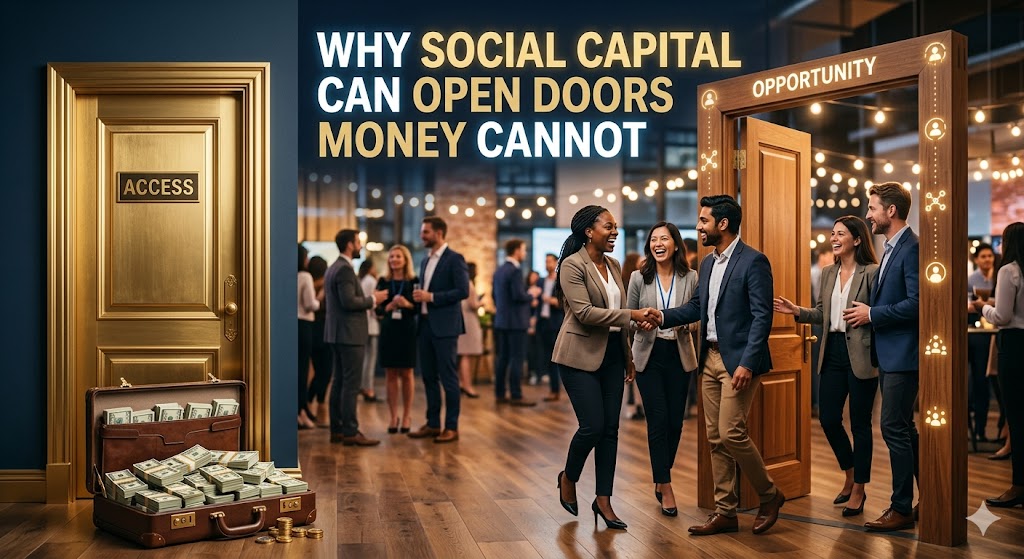
Why Social Capital Can Open Doors Money Cannot
In most discussions about success, people tend to focus heavily on money as the primary tool for unlocking opportunities. While financial resources are undeniably important, they are often misunderstood as the ultimate key to progress. In reality, there is another form of capital that frequently outperforms money in terms of access, influence, and long term advantage. This is social capital, the value created through relationships, trust, reputation, and the networks you build over time. Social capital can open doors that money alone cannot even approach, and understanding this truth can completely change how someone approaches success.
Social capital is not just about knowing many people. It is about the quality of those relationships and the level of trust that exists within them. When people trust you, they are more willing to recommend you, support you, collaborate with you, and give you opportunities that are not publicly available. Unlike money, which can be spent and depleted, social capital grows when it is used correctly. Every meaningful interaction has the potential to strengthen it, while every broken trust can reduce it significantly.
One of the strongest ways social capital opens doors is through access to hidden opportunities. Many of the best jobs, partnerships, investments, and collaborations are never publicly advertised. They are shared privately within networks of people who already trust each other. In these situations, money is not the deciding factor. Trust is. A recommendation from someone credible often carries more weight than any financial offer because it reduces risk for the person making the decision. People prefer to work with individuals who come highly recommended by someone they already trust.
Another important aspect is that social capital reduces friction in decision making. When someone already knows your character, your work ethic, or your reliability, they do not need long processes to verify you. This is why two individuals with the same skills and the same financial capacity can experience completely different levels of success. One might struggle to get attention while the other is constantly invited into new opportunities simply because of who they know and how those people perceive them.
Social capital also plays a major role in credibility. In many industries, credibility is more powerful than advertising. A strong reputation spreads through word of mouth in ways that money cannot fully replicate. If people consistently speak positively about you, your name becomes associated with trust and value. This reputation can precede you into rooms you have never entered, creating opportunities before you even present yourself. Money can help you advertise, but it cannot force people to trust you. Trust must be earned and shared socially.
Another reason social capital is so powerful is because it creates leverage. When you have strong relationships, you can accomplish more with fewer resources. A well connected person can gain access to expertise, funding, partnerships, and information simply by reaching out within their network. Instead of starting from zero, they start from a position of support. This form of leverage often accelerates growth in ways that money alone cannot achieve, because it is based on cooperation rather than transaction.
It is also important to understand that social capital compounds over time. Just like financial investments grow with interest, relationships grow in value when they are nurtured consistently. A simple act of kindness or support today may become a significant opportunity years later. Many people underestimate this because they think in short term gains rather than long term relational equity. However, those who invest in people consistently often find themselves surrounded by opportunities that seem to appear effortlessly, when in reality they were built over years of connection and trust.
Unlike money, which can create temporary access, social capital creates lasting influence. Money might get someone into a room once, but relationships can keep them there. When people genuinely respect and trust you, they are more likely to include you in ongoing conversations, decisions, and collaborations. This sustained access is what builds long term success. It ensures that opportunities are not just one time events but recurring possibilities.
Social capital also helps in moments of crisis. Financial resources can solve many problems, but during difficult times, it is often relationships that provide the fastest and most reliable support. Whether it is emotional encouragement, professional advice, or practical assistance, people are more likely to step in for those they trust and respect. This support system becomes an invisible safety net that money alone cannot replicate.
Another critical point is that social capital influences perception. How people perceive your value is often shaped by who you are associated with. Being connected to credible, successful, or respected individuals can elevate how others view you. This does not mean that success is borrowed, but rather that association often creates a context in which your abilities are taken more seriously. Perception plays a powerful role in opportunity creation, and social networks heavily shape that perception.
However, social capital is not something that can be faked or rushed. It is built through consistency, honesty, and value creation. People quickly recognize when someone is only interested in taking rather than contributing. Strong networks are built on mutual benefit, not exploitation. This is why genuine contribution is essential. The more value you bring into your relationships, the stronger your social capital becomes over time.
One of the most overlooked aspects of social capital is that it often multiplies other forms of capital. Financial capital, intellectual capital, and even emotional resilience are all strengthened through strong relationships. For example, access to mentors can accelerate learning. Access to collaborators can increase income potential. Access to supportive communities can improve mental strength. In this way, social capital acts as a foundation that enhances every other area of life.
It is also important to recognize that isolation limits growth. Many people focus solely on individual effort and forget that success is rarely achieved in isolation. Without networks, even highly skilled individuals can struggle to find opportunities that match their abilities. Meanwhile, individuals with average skills but strong networks often outperform them simply because they are more visible and more connected. This is not about unfair advantage, but about how human systems naturally function through relationships.
Building social capital requires intentional effort. It involves listening more than speaking, offering help without expecting immediate returns, and maintaining relationships even when there is no obvious benefit. It also requires emotional intelligence, the ability to understand how others feel, what they value, and how to communicate in ways that strengthen trust. Over time, these behaviors create a reputation that attracts opportunities naturally.
Another important dimension is consistency. Social capital is not built through occasional interactions. It is built through repeated positive experiences over time. People trust consistency more than intensity. A person who shows up reliably, even in small ways, often builds stronger relationships than someone who appears occasionally with large but inconsistent contributions. Trust is formed through patterns, not isolated actions.
In modern society, where digital communication has expanded dramatically, social capital has become even more powerful. Online platforms allow relationships to form across distances, but they also make authenticity more important than ever. People can quickly sense whether interactions are genuine or transactional. Those who build authentic digital and real world relationships often find themselves with access to global opportunities that were previously unimaginable.
Ultimately, social capital is a form of wealth that determines access, influence, and long term success. While money can buy temporary advantages, relationships create enduring pathways. The people you know, the trust you build, and the reputation you maintain often matter more than the money you have at any given moment. In many cases, social capital is what determines how effectively money can even be used.
Understanding this shifts the focus from purely financial thinking to relational thinking. It encourages investment not only in assets but in people. It reminds us that success is not just a matter of accumulation but of connection. And most importantly, it shows that the most valuable doors in life are often opened not by money, but by trust.

EarnSmartOnline.com.ng is dedicated to helping readers make smarter financial decisions through practical guides on online income, personal finance, technology, digital business, and wealth creation. Our goal is to provide reliable, easy-to-understand, and actionable content that empowers individuals to earn smarter, build sustainable income streams and achieve long-term financial success.
Recommended: Start Earning Online
- Ultimate Affiliate Marketing Program — learn affiliate marketing with a done-for-you sales system ($15). Check it out
- The Newbie Affiliate Guide — the beginner-friendly starter guide (~$6.68). Check it out
- Easy Dollar Maker — earn in dollars uploading AI images and videos from your phone ($17). Check it out
Disclosure: These are affiliate links. If you buy through them, I may earn a commission at no extra cost to you.