
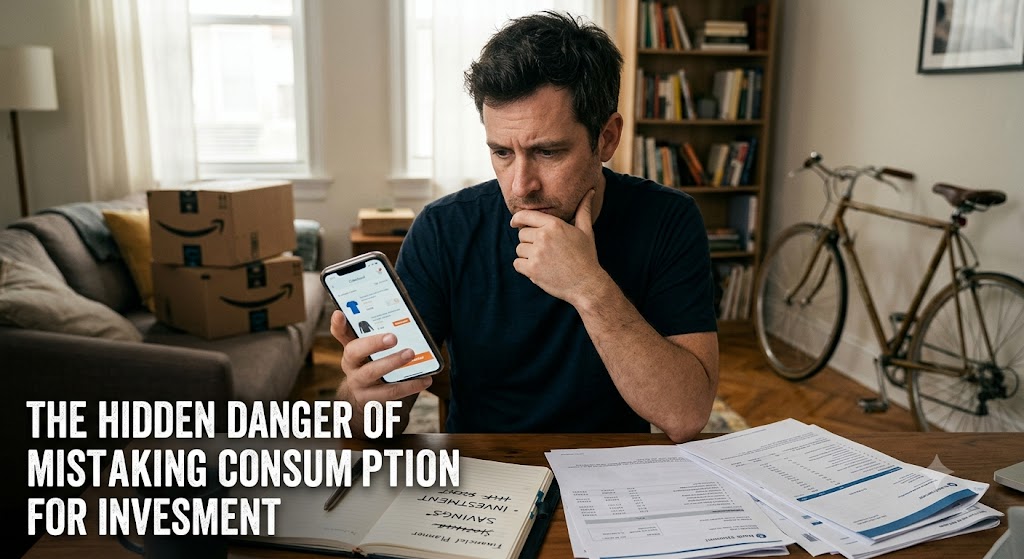
The Hidden Danger of Mistaking Consumption for Investment
Money has a way of revealing what people truly value. Every purchase, every financial decision, and every sacrifice tells a story about priorities. Yet one of the biggest financial mistakes made by millions of people is confusing consumption with investment. This hidden danger quietly drains bank accounts, delays financial freedom, and keeps hardworking people trapped in a cycle of earning and spending without building lasting wealth. Many people sincerely believe they are investing in their future when they are simply consuming products and services that lose value almost immediately. The difference may appear small at first, but over time it creates two completely different financial futures.
Consumption is necessary because everyone needs food, shelter, clothing, transportation, healthcare, and entertainment. These are part of everyday life, and there is nothing wrong with spending money on genuine needs. The problem begins when people convince themselves that every expensive purchase is somehow an investment. They buy luxury phones every year and call it investing in productivity. They purchase designer clothes and claim they are investing in confidence. They finance expensive cars beyond their means and insist they are investing in their image. They spend huge amounts on trendy gadgets, lavish parties, and unnecessary upgrades while believing these expenses will somehow create future wealth.
Real investments have one defining characteristic. They have the potential to generate future value that exceeds their cost. They either produce income, appreciate in value, increase your earning capacity, or reduce future expenses. Consumption, on the other hand, delivers immediate satisfaction but rarely creates long-term financial returns. Once the excitement fades, the money is gone, leaving little or nothing behind except memories and sometimes debt.
The distinction sounds obvious, yet it is surprisingly difficult to recognise in everyday life because modern marketing deliberately blurs the line between wants and investments. Advertisements rarely tell people they are buying another consumer product. Instead, companies present purchases as investments in happiness, success, popularity, beauty, status, confidence, or productivity. Consumers are constantly encouraged to believe that spending more automatically means living better.
Social media has amplified this confusion. Every day people scroll through carefully edited lifestyles filled with luxury holidays, expensive restaurants, designer fashion, premium electronics, and luxury vehicles. Because these lifestyles are constantly displayed as symbols of success, many people begin to believe these purchases represent financial progress. In reality, many of these individuals may be financing appearances through loans, credit cards, or unstable income.
This misunderstanding often begins early in life. Young adults receive their first salary and immediately increase their spending instead of increasing their assets. Rather than asking how their income can create more income, they ask what new product they can afford. Their salary becomes a licence for consumption instead of a tool for wealth creation. Years later they wonder why they have worked for decades without accumulating meaningful financial security.
The hidden danger becomes even more serious because consumption provides instant emotional rewards while investment usually requires patience. Buying a new phone produces immediate excitement. Investing the same amount in a productive asset may produce no emotional thrill today, but its benefits could multiply over many years. Human psychology naturally prefers immediate gratification over delayed rewards, making consumption feel more satisfying even when it damages long-term financial health.
Many people mistake expensive education for investment without carefully evaluating its actual return. Education can certainly be one of the best investments a person ever makes, but only when it develops valuable skills, improves earning potential, or opens meaningful opportunities. Paying large sums for courses that are never applied or qualifications that offer little market value may simply become another form of consumption disguised as self-improvement.
The same principle applies to business. Purchasing expensive office furniture does not necessarily improve profitability. Buying the latest computer equipment does not automatically increase productivity. Renting luxurious office space may impress visitors but fail to generate additional revenue. Business owners frequently consume under the belief that they are investing, when in reality they are increasing expenses without improving future returns.
Technology provides another excellent example. A graphic designer purchasing a powerful computer that allows faster work, better quality, and higher-paying projects is making an investment because the equipment contributes directly to future income. Someone replacing a perfectly functional device every year simply to own the newest model is primarily consuming. The difference lies not in the product itself but in the financial outcome it creates.
Cars represent one of the most misunderstood financial decisions in modern society. Many people insist that buying an expensive vehicle is an investment. In most cases, private vehicles are depreciating assets. Their value begins falling almost immediately after purchase while maintenance, insurance, fuel, repairs, and taxes continue increasing the overall cost of ownership. Unless the vehicle directly generates income or provides measurable business value, it functions primarily as consumption rather than investment.
Housing creates similar confusion. Purchasing a home can provide long-term financial stability and potential appreciation, but not every property automatically becomes a good investment. Buying an overpriced home that stretches finances beyond comfort may limit the ability to invest elsewhere. The true value depends on location, market conditions, affordability, maintenance costs, financing structure, and long-term objectives.
One of the most dangerous forms of disguised consumption is lifestyle inflation. As income increases, expenses rise just as quickly. A promotion leads to a more expensive apartment. A salary increase leads to luxury holidays. Business growth leads to unnecessary luxury purchases. Instead of allowing additional income to purchase productive assets, it disappears into a higher standard of living. Wealth never accumulates because consumption grows at the same speed as earnings.
Credit makes this problem even worse. Easy financing allows people to consume tomorrow’s income today. Monthly payments make expensive purchases appear affordable while hiding their true long-term cost. Interest charges quietly increase the final price, meaning consumers often pay far more than the original purchase value. Instead of using debt to acquire productive assets, many people use it to finance rapidly depreciating consumer goods.
True investors think differently. Before spending money, they ask whether the purchase will produce measurable value over time. They evaluate expected returns, future opportunities, maintenance costs, risks, and alternative uses for the same money. They understand that every pound, dollar, euro, or naira spent on one decision cannot be spent elsewhere. Economists describe this as opportunity cost, and it is one of the most powerful concepts in personal finance.
Imagine two individuals earning identical salaries over twenty years. One consistently spends surplus income on luxury consumption. The other consistently acquires productive assets, develops valuable skills, builds investments, and creates additional income streams. At the beginning, their lifestyles may appear similar. Twenty years later, their financial positions will likely be dramatically different. One depends entirely on continued employment. The other has accumulated assets capable of generating income independently.
Consumption is temporary by nature. Meals are eaten. Clothes wear out. Electronics become obsolete. Fashion changes. Trends disappear. Entertainment ends. Investment seeks permanence by creating something that continues producing value long after the original purchase.
Another reason people confuse consumption with investment is emotional attachment. Purchases often become symbols of achievement. After years of hard work, people naturally want visible rewards. There is nothing wrong with enjoying the fruits of labour, provided consumption does not replace financial planning. Problems arise when emotional satisfaction becomes the primary justification for every significant purchase.
Businesses understand these emotions extremely well. Marketing campaigns rarely focus only on product features. They sell identity, belonging, confidence, prestige, freedom, excitement, and personal transformation. Consumers begin believing they are purchasing a better version of themselves rather than another product. This emotional framing makes it far easier to overspend while convincing oneself that the expense represents personal growth.
The wealthiest individuals often separate personal satisfaction from investment decisions. They may enjoy luxury items, but they usually acquire income-producing assets first. Consumption becomes the reward generated by investments rather than the substitute for investing. Their lifestyle is supported by cash flow created through productive assets instead of relying solely on earned income.
Developing this mindset requires changing everyday questions. Instead of asking, “Can I afford this?” ask, “Will this improve my financial position five years from now?” Instead of asking, “How much does this cost?” ask, “What return will this generate?” Instead of asking, “Will people be impressed?” ask, “Will this create lasting value?”
The difference between wealthy individuals and perpetual consumers often has less to do with income than with decision-making. Many people with modest incomes steadily build wealth through disciplined investing, while others earning several times more remain financially vulnerable because almost everything they earn is consumed.
Investing also includes intangible assets that strengthen future earning potential. Learning a valuable skill, building professional relationships, improving communication abilities, developing leadership qualities, or creating intellectual property may produce returns for decades. These investments cannot always be measured immediately, yet they frequently outperform many financial investments over time because they increase the ability to generate future income.
Time itself is one of the greatest investments available. Hours spent reading, practising, learning, creating, networking, or building a business often generate far greater lifetime returns than hours spent endlessly consuming entertainment. Just as money can be invested or consumed, time follows the same principle. Every hour either creates future value or simply disappears forever.
Financial literacy plays a crucial role in avoiding this hidden danger. People who understand assets, liabilities, cash flow, compound growth, opportunity cost, and risk management are less likely to mistake consumption for investment. They recognise marketing tactics, evaluate financial trade-offs more objectively, and make purchasing decisions based on long-term outcomes rather than temporary emotions.
This does not mean eliminating enjoyment from life. Responsible consumption contributes to happiness, health, relationships, and memorable experiences. The objective is balance. Financial success does not require living in permanent deprivation. It requires recognising consumption for what it is instead of pretending it is something else. Honest financial decisions begin with honest definitions.
Many of history’s greatest fortunes were not built through extraordinary income but through consistently directing surplus resources toward productive assets instead of excessive consumption. Small decisions repeated over many years become powerful financial forces. A modest monthly investment sustained for decades often outperforms occasional large financial efforts interrupted by excessive spending.
Children who grow up observing financially responsible behaviour develop healthier attitudes toward money. They learn that income is not simply for spending but for creating opportunities, security, and independence. Teaching future generations the difference between investment and consumption may become one of the most valuable financial lessons parents can provide.
Technology has made investing more accessible than ever before. Individuals can now learn new skills online, start businesses with relatively low capital, invest in financial markets, create digital products, build websites, publish books, produce educational content, or establish multiple income streams from almost anywhere in the world. Yet these same technologies also make consumption easier than ever. One-click purchases, endless advertisements, personalised recommendations, and constant digital promotions compete for every available pound, dollar, euro, or naira.
Financial freedom is ultimately determined not by how much money passes through your hands but by what happens after it arrives. Income creates possibilities, but spending patterns determine outcomes. Every financial decision either strengthens future opportunities or weakens them. Every purchase either creates future value or merely provides temporary satisfaction.
Perhaps the greatest hidden danger of mistaking consumption for investment is not the money that disappears today but the wealth that never has the chance to exist tomorrow. Every unnecessary luxury purchased with investment capital represents assets that were never acquired, businesses that were never started, skills that were never learned, opportunities that were never pursued, and financial independence that was unnecessarily delayed.
Those who consistently recognise this distinction gradually shift from being consumers of wealth to creators of wealth. They understand that true investment is not measured by how impressive a purchase appears today but by the value it continues generating years into the future. They build lives where assets work alongside them, opportunities multiply, and financial decisions become increasingly intentional.
The path to lasting wealth rarely begins with earning extraordinary amounts of money. More often, it begins with a simple but transformative habit of asking one question before every significant purchase. Is this truly an investment that will improve my future, or is it simply consumption disguised as one? The answer to that single question, repeated consistently over a lifetime, may become one of the most profitable financial decisions anyone ever makes.

EarnSmartOnline.com.ng is dedicated to helping readers make smarter financial decisions through practical guides on online income, personal finance, technology, digital business, and wealth creation. Our goal is to provide reliable, easy-to-understand, and actionable content that empowers individuals to earn smarter, build sustainable income streams and achieve long-term financial success.
Recommended: Start Earning Online
- Ultimate Affiliate Marketing Program — learn affiliate marketing with a done-for-you sales system ($15). Check it out
- The Newbie Affiliate Guide — the beginner-friendly starter guide (~$6.68). Check it out
- Easy Dollar Maker — earn in dollars uploading AI images and videos from your phone ($17). Check it out
Disclosure: These are affiliate links. If you buy through them, I may earn a commission at no extra cost to you.



