
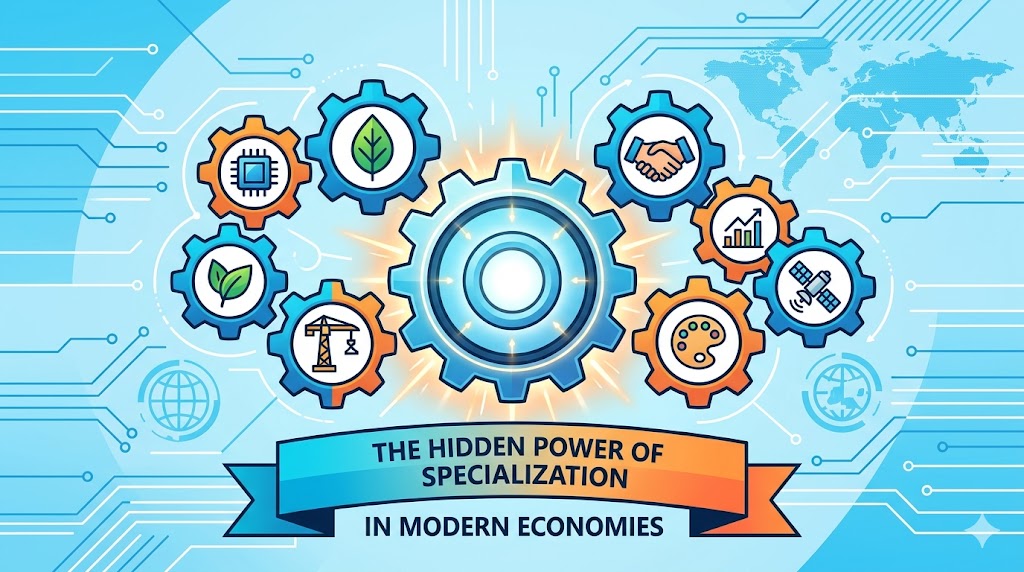
The Hidden Power of Specialization in Modern Economies
In today’s rapidly evolving world, specialization has become one of the most powerful forces shaping modern economies. While many people focus on working harder, earning more money, or gaining additional qualifications, they often overlook the hidden advantage that specialization provides. Across industries, businesses, professions, and entire economies, those who focus deeply on a specific area frequently outperform those who try to do everything. The hidden power of specialization lies in its ability to create efficiency, increase value, improve productivity, and generate opportunities that would otherwise remain inaccessible.
At its core, specialization refers to concentrating efforts, skills, knowledge, or resources on a particular task, industry, or field. Instead of attempting to master every aspect of a profession or business, individuals and organizations focus on becoming exceptionally good at a specific function. This simple concept has transformed economies throughout history and continues to play a critical role in determining who succeeds in today’s competitive environment.
One of the primary reasons specialization is so powerful is because it increases efficiency. When people repeatedly perform a specific task, they naturally become faster and more skilled at it. Practice reduces mistakes, improves accuracy, and shortens the time required to complete work. A worker who focuses on one area every day often produces better results than someone who constantly switches between unrelated tasks. This efficiency benefits not only the individual but also employers, customers, and the broader economy.
Modern businesses rely heavily on specialization because it allows them to maximize productivity. Within a single company, employees often perform highly specialized roles. Accountants manage finances, marketers attract customers, software developers build applications, and customer service representatives handle client concerns. Each specialist focuses on a specific responsibility, enabling the organization to operate smoothly and efficiently. Without specialization, businesses would struggle to maintain the level of productivity required to compete in modern markets.
Specialization also drives innovation. When individuals dedicate significant time and attention to a particular field, they develop deeper expertise and understanding. This expertise allows them to identify problems, discover opportunities, and create solutions that general knowledge alone may never reveal. Many technological breakthroughs, medical advancements, and scientific discoveries have emerged because specialists spent years studying narrow areas that others ignored. Their focused efforts often lead to innovations that benefit entire industries and societies.
The hidden power of specialization becomes even more evident in the labor market. Employers increasingly seek individuals with specific skills rather than broad but shallow knowledge. While general knowledge remains valuable, organizations often pay premium salaries to professionals who possess expertise in areas that are difficult to replace. Specialists can solve unique problems, improve processes, and provide insights that create measurable value. As a result, their skills become highly sought after in competitive industries.
Another important advantage of specialization is the ability to create differentiation. In crowded markets, standing out is often difficult. Countless businesses and professionals compete for attention, customers, and opportunities. Specialization allows individuals and organizations to distinguish themselves by focusing on a specific niche. Rather than serving everyone, they become known for solving a particular problem exceptionally well. This reputation often leads to greater trust, stronger customer loyalty, and increased demand.
The rise of the digital economy has amplified the value of specialization. The internet has created global markets where individuals can offer highly specialized services to clients worldwide. A graphic designer specializing in brand identity, a writer focusing on financial content, or a programmer dedicated to cybersecurity can attract customers far beyond their local region. Technology has expanded the reach of specialists, allowing them to build successful careers and businesses by serving narrowly defined markets.
Specialization also contributes significantly to economic growth at the national level. Countries often develop competitive advantages by specializing in industries where they possess unique strengths. Some nations excel in technology, others in manufacturing, agriculture, finance, or natural resources. By focusing on areas where they can produce efficiently and competitively, countries increase productivity, boost exports, and improve living standards. International trade itself depends heavily on specialization, as nations exchange goods and services based on their comparative advantages.
Despite its many benefits, specialization is sometimes misunderstood. Many people fear that focusing too narrowly may limit their opportunities. They worry that becoming highly specialized could make them vulnerable if market conditions change. While this concern has some validity, the reality is that specialization and adaptability are not mutually exclusive. The most successful specialists continuously update their knowledge, learn emerging trends, and adapt their expertise to changing circumstances. Their deep understanding often allows them to pivot more effectively than generalists when industries evolve.
Another hidden benefit of specialization is the development of credibility. Expertise takes time to build, and individuals who dedicate years to mastering a specific area naturally earn greater trust. Customers, employers, and colleagues often prefer working with specialists because they perceive them as more knowledgeable and reliable. Credibility can become a powerful asset, opening doors to opportunities that may remain unavailable to those without a clear area of expertise.
Specialization also creates economic value because it reduces complexity. In modern economies, knowledge has become increasingly vast and sophisticated. No single person can master every aspect of technology, medicine, law, engineering, finance, or countless other disciplines. By dividing knowledge into specialized areas, societies can advance more rapidly. Each specialist contributes expertise within a focused domain, and together they create systems far more advanced than any individual could achieve alone.
The healthcare industry provides a clear example of the power of specialization. Medical science has become so complex that doctors often focus on specific areas such as cardiology, neurology, orthopedics, or dermatology. This specialization enables them to develop deeper expertise, improve patient outcomes, and handle complex cases more effectively. Patients benefit from receiving care from professionals who possess extensive knowledge within a particular field.
The same principle applies in technology. Software development alone includes specialists in cybersecurity, artificial intelligence, cloud computing, data science, mobile applications, and countless other areas. As technology becomes more advanced, demand for specialists continues to increase. Organizations seek professionals who can address highly specific challenges and deliver solutions that generalists may struggle to provide.
From a personal financial perspective, specialization often leads to increased earning potential. Individuals who develop rare and valuable skills can command higher compensation because their expertise is difficult to replace. While hard work remains important, specialization frequently determines how much value the market assigns to a person’s contributions. In many industries, the difference between average and exceptional income levels is closely tied to the depth of expertise an individual possesses.
Entrepreneurs can also benefit enormously from specialization. Many successful businesses achieve growth by focusing on a specific market segment rather than attempting to serve everyone. A company that specializes in serving a particular customer group often understands its audience more deeply and can provide better solutions than broader competitors. This focus allows businesses to build stronger brands, improve customer satisfaction, and create sustainable competitive advantages.
The hidden power of specialization extends beyond economics into personal development. Mastery brings confidence, purpose, and a sense of accomplishment. As individuals deepen their expertise, they often gain greater control over their careers and professional futures. Rather than competing solely on effort, they compete on value, knowledge, and unique capabilities. This shift can dramatically improve long term prospects and opportunities.
However, specialization should not be confused with rigidity. Successful specialists remain curious and continue learning throughout their careers. They recognize that industries evolve, technologies change, and customer needs shift over time. Continuous learning ensures that expertise remains relevant and valuable. The combination of deep specialization and ongoing adaptation creates a powerful foundation for long term success.
As modern economies become increasingly knowledge driven, the importance of specialization is likely to grow even further. Automation and artificial intelligence are transforming routine tasks, making specialized expertise more valuable in many fields. Individuals who develop advanced skills, unique knowledge, and specialized capabilities will often find themselves better positioned to thrive in changing economic environments.
The hidden power of specialization lies not merely in doing one thing repeatedly but in creating extraordinary value through focused expertise. It allows individuals to become more productive, businesses to operate more efficiently, and economies to grow more rapidly. It drives innovation, creates competitive advantages, and generates opportunities that broad approaches often fail to capture.
In a world where competition continues to intensify and information expands at an unprecedented pace, specialization has become more than a professional strategy. It is an economic force that shapes industries, influences income levels, and determines long term success. Those who recognize its value and invest in developing deep expertise often discover opportunities that remain invisible to others. The future increasingly belongs to those who understand that true value is not found in trying to be everything to everyone but in becoming exceptionally valuable in a specific area where their knowledge, skills, and expertise can make the greatest impact.

EarnSmartOnline.com.ng is dedicated to helping readers make smarter financial decisions through practical guides on online income, personal finance, technology, digital business, and wealth creation. Our goal is to provide reliable, easy-to-understand, and actionable content that empowers individuals to earn smarter, build sustainable income streams and achieve long-term financial success.
Recommended: Start Earning Online
- Ultimate Affiliate Marketing Program — learn affiliate marketing with a done-for-you sales system ($15). Check it out
- The Newbie Affiliate Guide — the beginner-friendly starter guide (~$6.68). Check it out
- Easy Dollar Maker — earn in dollars uploading AI images and videos from your phone ($17). Check it out
Disclosure: These are affiliate links. If you buy through them, I may earn a commission at no extra cost to you.



