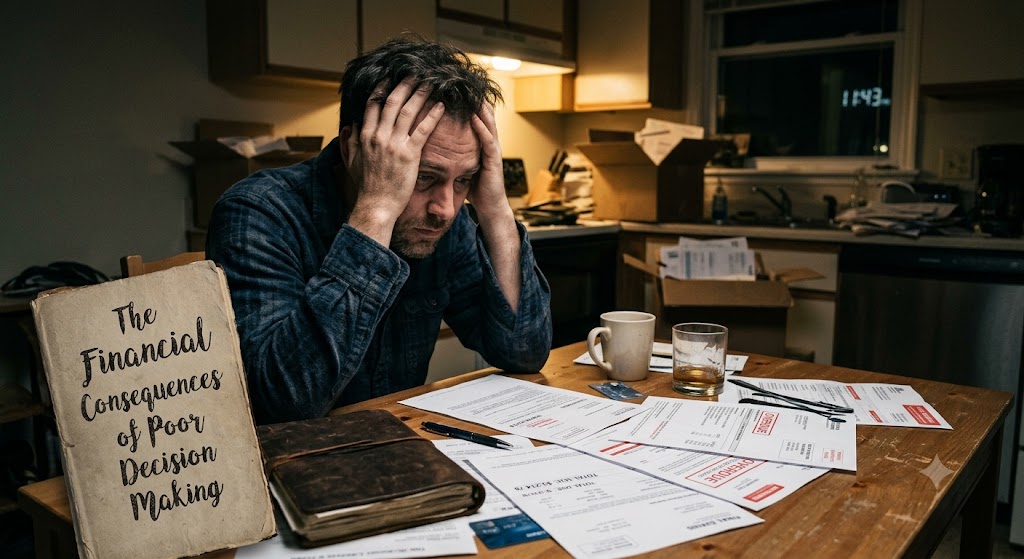
The financial consequences of poor decision making are often far greater than most people realise. Every day, people make choices that appear insignificant at the moment but gradually shape their financial future in ways that cannot easily be reversed. A single impulsive purchase may seem harmless, delaying savings by one month may not appear dangerous, and ignoring a financial plan for another year may feel like a minor issue. However, when these choices become habits, they create a pattern that can determine whether a person enjoys financial freedom or spends years struggling under the weight of unnecessary debt and missed opportunities. Money rarely disappears overnight. It usually leaks away through poor decisions made repeatedly over time. Understanding the financial consequences of poor decision making is one of the most important lessons anyone can learn because every financial outcome is first created by a decision.
Many people blame their financial struggles on circumstances beyond their control. While unexpected events such as illness, economic downturns, or job losses certainly affect financial stability, countless financial problems begin with decisions that could have been avoided. Buying things to impress people who are not paying your bills, ignoring opportunities to learn new skills, refusing to budget, borrowing without considering repayment, or delaying investments are examples of decisions that quietly shape future financial realities. The most dangerous aspect of poor financial decisions is that they often feel comfortable in the present while creating discomfort in the future. Good decisions frequently require discipline today but produce freedom tomorrow.
One of the greatest financial consequences of poor decision making is the accumulation of unnecessary debt. Debt itself is not always harmful because it can be used strategically for education, business expansion, or acquiring appreciating assets. The problem begins when borrowing becomes a lifestyle rather than a tool. Many people borrow to satisfy temporary desires instead of long term needs. Credit facilities, personal loans, and informal borrowing may provide immediate relief, but they often become long lasting financial burdens when repayments consume income that could have been invested or saved. Every interest payment represents money that can no longer be used to improve one’s financial future. The emotional stress associated with overwhelming debt frequently affects productivity, relationships, and overall quality of life.
Another serious consequence is the loss of investment opportunities. Money has the unique ability to grow when invested wisely over time. Every year that someone delays investing because of poor spending habits represents years of potential compound growth that can never be recovered. Time is one of the most valuable assets in wealth creation. A young person who begins investing modest amounts consistently often accumulates significantly more wealth than someone who waits until later in life, even if the latter invests larger sums. Poor decisions that delay investing effectively reduce the earning power of money itself. Lost time cannot be purchased back regardless of future income.
Lifestyle inflation is another hidden result of poor decision making. As people’s income increases, many automatically increase their expenses without considering long term financial goals. A salary increase becomes an excuse to purchase a more expensive vehicle, move into a larger house, or buy luxury items that require ongoing maintenance. Instead of allowing higher income to increase savings and investments, it simply funds a more expensive lifestyle. Eventually, individuals discover that despite earning more than ever before, they still struggle financially because their expenses have expanded to match or exceed their earnings. Wealth is not determined solely by income but by the gap between income and expenditure.
Poor decision making also affects career growth and earning potential. Choosing comfort over continuous learning can significantly reduce future income. The modern economy rewards individuals who develop valuable skills, adapt to technological changes, and continuously improve themselves. Those who ignore education, professional development, or networking opportunities often find themselves trapped in jobs with limited earning potential. Every decision to postpone learning represents income that may never be earned. Knowledge is one of the few investments that can continue generating financial returns for decades.
Another overlooked financial consequence involves missed business opportunities. Entrepreneurs who fail to research markets, understand customer needs, or manage cash flow carefully often experience preventable business failures. Many businesses collapse not because the ideas were poor but because the decisions surrounding pricing, marketing, inventory management, and financial planning were flawed. A single careless decision can destroy years of hard work and investment. Successful businesses are rarely built upon luck alone. They are usually the result of thousands of thoughtful decisions made consistently over time.
Emotional spending is another area where poor decision making quietly damages financial health. Many individuals spend money to relieve stress, celebrate achievements, or escape negative emotions. Shopping becomes therapy instead of necessity. While these purchases may provide temporary satisfaction, the financial consequences remain long after the emotional benefits disappear. The habit of emotional spending often leads to cluttered homes, empty savings accounts, and increasing debt. Recognising the emotional triggers behind spending decisions is an essential step towards improving financial wellbeing.
The inability to distinguish between wants and needs creates another pathway towards financial instability. Modern advertising constantly encourages consumers to believe that happiness can be purchased. Social media amplifies this pressure by showcasing lifestyles that often represent carefully edited highlights rather than everyday reality. People begin making financial decisions based on appearances rather than priorities. They purchase expensive gadgets, fashionable clothing, luxury holidays, and premium subscriptions while neglecting emergency savings or retirement planning. The desire to keep up with others has driven countless people into financial hardship.
Poor financial decisions also affect families across generations. Parents who consistently make irresponsible financial choices often pass unhealthy money habits to their children. Children observe spending behaviour, attitudes towards debt, saving practices, and work ethic long before they receive formal financial education. Families trapped in cycles of poor financial decision making may unknowingly create patterns that continue for generations. Conversely, parents who model disciplined financial behaviour provide one of the greatest gifts possible by teaching children how to build financial security through wise decisions.
Relationships frequently suffer because of poor financial choices. Financial stress remains one of the leading causes of conflict between couples. Secret debts, uncontrolled spending, gambling, poor budgeting, and conflicting financial priorities create tension that gradually weakens trust. Money itself is not usually the root problem. Instead, the decisions surrounding money management become the source of disagreement. Couples who communicate openly about finances, establish shared goals, and make decisions together often experience greater financial stability and stronger relationships.
The Financial Consequences of Poor Decision Making
Another major consequence involves inadequate emergency preparation. Life is unpredictable. Medical emergencies, job losses, natural disasters, and unexpected repairs can occur without warning. Individuals who repeatedly choose immediate gratification over building emergency savings often find themselves relying on expensive loans or credit when unexpected expenses arise. An emergency fund provides more than financial security. It offers peace of mind and the ability to respond to life’s uncertainties without creating long term financial damage.
The financial consequences of poor decision making become especially visible during retirement. Many individuals postpone retirement planning because it seems distant. Years later, they discover they have insufficient savings to maintain their desired lifestyle. Retirement cannot depend solely on hope. It requires decades of intentional planning, consistent investing, and disciplined spending. Every year of delay reduces the effectiveness of compound growth and increases the amount that must later be saved. Those who ignore retirement planning often become financially dependent on relatives or government support despite working for many years.
Poor decision making also exposes individuals to fraud and financial scams. People seeking quick wealth without careful research frequently become victims of fraudulent investment schemes, pyramid structures, fake business opportunities, and unrealistic promises of guaranteed returns. Scammers understand that greed, desperation, and impatience cloud judgement. They exploit individuals who prioritise rapid financial gain over careful evaluation. Wise financial decisions require scepticism, patience, and thorough investigation before committing money.
Another hidden consequence is the opportunity cost associated with every financial choice. Every pound, dollar, or naira spent today represents something that cannot be purchased or invested tomorrow. Choosing expensive daily habits may appear insignificant individually, but over several years they often amount to substantial sums that could have funded education, business ventures, property purchases, or retirement investments. Opportunity cost reminds us that every decision carries invisible alternatives that deserve consideration before money changes hands.
Many people underestimate how poor health decisions eventually become financial decisions. Ignoring exercise, healthy eating, preventive healthcare, or adequate rest can result in medical expenses, reduced productivity, and lost income later in life. Physical wellbeing directly influences earning ability. Investing in health often produces significant financial returns by reducing medical costs and preserving the capacity to work effectively throughout adulthood.
Technology has made poor financial decisions easier than ever before. Online shopping platforms, instant digital payments, one click purchasing, and buy now pay later services reduce the psychological barrier associated with spending money. Consumers no longer physically hand over cash, making it easier to underestimate how much they are spending. Without deliberate budgeting and financial awareness, technology can accelerate poor financial habits rather than improve financial management.
Education plays a critical role in preventing poor financial decisions. Unfortunately, many people complete formal education without learning practical money management skills. They understand complex academic subjects but struggle with budgeting, investing, taxation, insurance, debt management, or financial planning. Financial literacy empowers individuals to evaluate choices carefully, recognise risks, and build sustainable wealth over time. Investing in financial education often generates returns far exceeding the initial cost of learning.
One encouraging truth is that poor financial decisions do not have to define the future. Many successful entrepreneurs, investors, and business leaders have experienced financial setbacks caused by poor judgement. Their success came not from avoiding every mistake but from learning quickly, accepting responsibility, and making better decisions moving forward. Financial recovery begins with honest self assessment rather than blaming external circumstances. Every wise decision made today reduces the impact of yesterday’s mistakes and creates a stronger financial tomorrow.
The financial consequences of poor decision making ultimately remind us that wealth is built through consistent choices rather than dramatic events. Every budget created, every unnecessary purchase avoided, every investment made, every new skill learned, and every financial goal pursued contributes towards lasting prosperity. Likewise, every careless decision gradually moves individuals further away from financial security. The difference between financial success and financial struggle is often not intelligence, luck, or income but the quality of daily decisions. People who learn to pause before spending, evaluate risks before borrowing, seek knowledge before investing, and think long term instead of pursuing immediate gratification position themselves for lasting financial independence. The future belongs to those who understand that every financial decision, no matter how small it appears today, has the power to shape the life they will live tomorrow.

EarnSmartOnline.com.ng is dedicated to helping readers make smarter financial decisions through practical guides on online income, personal finance, technology, digital business, and wealth creation. Our goal is to provide reliable, easy-to-understand, and actionable content that empowers individuals to earn smarter, build sustainable income streams and achieve long-term financial success.
Recommended: Start Earning Online
- Ultimate Affiliate Marketing Program — learn affiliate marketing with a done-for-you sales system ($15). Check it out
- The Newbie Affiliate Guide — the beginner-friendly starter guide (~$6.68). Check it out
- Easy Dollar Maker — earn in dollars uploading AI images and videos from your phone ($17). Check it out
Disclosure: These are affiliate links. If you buy through them, I may earn a commission at no extra cost to you.