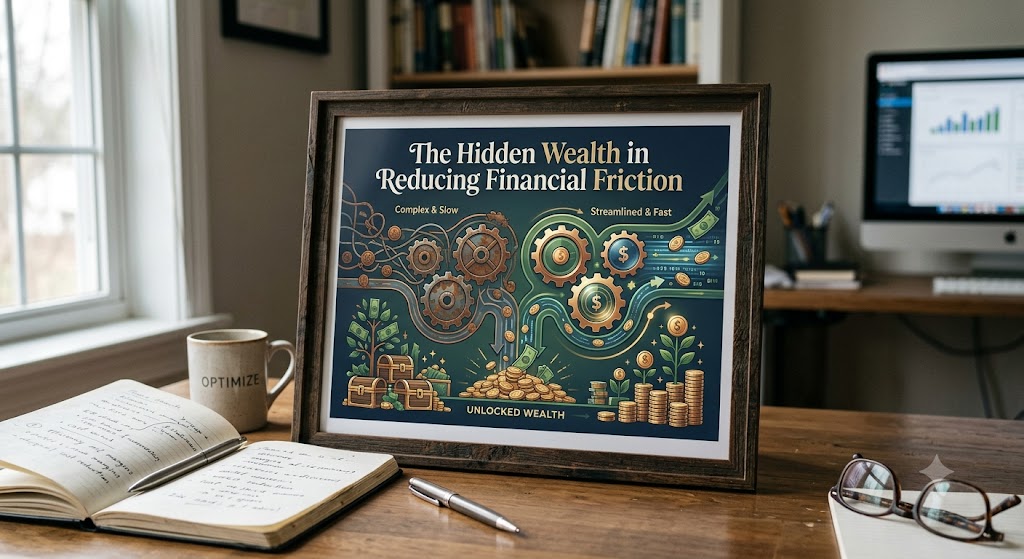
The Hidden Wealth in Reducing Financial Friction
Most people spend years searching for the next big opportunity to improve their finances. They chase promotions, look for better-paying jobs, dream about successful businesses, and constantly search for investment opportunities that promise extraordinary returns. While there is nothing wrong with increasing income, one of the most overlooked paths to financial success is not earning more money but making it easier for money to work efficiently. This often comes down to something many people never think about: reducing financial friction.
Financial friction refers to anything that slows down, complicates, or unnecessarily drains your financial progress. It is the collection of small obstacles, poor habits, inefficient systems, hidden fees, emotional spending, forgotten subscriptions, delayed decisions, and disorganized finances that quietly consume wealth over time. Individually, these problems may seem insignificant. Together, they create a powerful force that works against financial growth every single day.
Many people assume that financial success is built only through massive investments or dramatic lifestyle changes. The reality is often much simpler. Wealth is frequently built by removing unnecessary resistance. Every unnecessary expense eliminated, every bill automated, every financial decision simplified, and every inefficient habit corrected creates more room for money to grow naturally.
Think about water flowing through a river. When rocks, fallen trees, and debris block the current, the water slows down. Remove those obstacles, and the river flows freely without needing additional water. Money behaves in much the same way. Most people do not necessarily have an income problem. They have a financial friction problem. Their money encounters obstacles long before it has the opportunity to create lasting wealth.
One of the most common forms of financial friction is decision fatigue. Every day, people make countless financial choices without realizing the mental cost involved. They decide where to eat, whether to save, what to buy, which bills to pay first, and whether a purchase is necessary. The more decisions people make, the more likely they become to choose convenience over wisdom.
Research into human behaviour consistently shows that mental exhaustion reduces decision quality. After making numerous choices throughout the day, people naturally become more impulsive. This explains why many unnecessary purchases happen late in the evening or after stressful workdays. The problem is rarely a lack of intelligence. It is the gradual depletion of mental energy.
Reducing financial friction means removing unnecessary decisions wherever possible. Automatic savings plans, scheduled bill payments, pre-planned grocery budgets, and investment automation reduce the number of financial choices that require willpower. Instead of relying on motivation every month, successful people build systems that function regardless of how they feel.
Another hidden source of financial friction is disorganization. Many individuals have multiple bank accounts they rarely use, forgotten insurance policies, scattered investment records, unpaid invoices, and documents stored in different places. Every minute spent searching for financial information represents unnecessary friction.
Organisation creates speed. When financial documents are easily accessible, tax preparation becomes simpler, investment decisions become clearer, and unexpected emergencies become less stressful. Wealth grows faster when information is available exactly when it is needed.
Subscription services have quietly become one of the biggest sources of financial friction in modern life. Streaming platforms, software memberships, fitness applications, cloud storage, online learning services, premium newsletters, and countless recurring payments often continue long after their usefulness has disappeared.
Because these payments occur automatically, many people stop noticing them entirely. A small monthly charge seems harmless until it is multiplied across several years. What begins as five insignificant subscriptions can quietly become a substantial annual expense that provides little real value.
Reducing financial friction requires periodic financial audits. Reviewing every recurring payment forces people to confront whether each expense genuinely improves their lives. Eliminating unnecessary subscriptions immediately increases disposable income without requiring higher earnings.
Financial friction also appears in the form of delayed maintenance. Many people postpone repairing vehicles, servicing appliances, maintaining homes, or replacing worn-out equipment because they want to avoid immediate expenses. Unfortunately, small maintenance problems often develop into major financial disasters.
A leaking roof eventually damages ceilings and electrical systems. Ignoring vehicle servicing often results in expensive engine repairs. Delaying medical check-ups frequently increases future healthcare costs. In almost every area of life, prevention costs less than correction.
Reducing financial friction means accepting that maintenance is an investment rather than an expense. Protecting valuable assets preserves wealth far more effectively than repeatedly replacing neglected possessions.
Emotional spending represents another invisible obstacle. Human beings often use money to reward themselves after difficult days, celebrate achievements, escape boredom, or temporarily improve their mood. Unfortunately, emotional purchases rarely produce lasting satisfaction.
The excitement of buying something new usually fades quickly, while the financial consequences remain much longer. Over months and years, these seemingly harmless purchases create enormous financial leakage.
People who successfully reduce financial friction develop purchasing habits that separate emotion from financial decisions. They delay non-essential purchases, compare alternatives carefully, and give themselves time before committing money. This simple pause often eliminates many unnecessary expenses.
One of the greatest hidden costs in personal finance is procrastination. Delaying investment decisions, postponing retirement contributions, avoiding debt repayment, and ignoring financial planning create enormous long-term consequences.
Time is one of the most powerful wealth-building tools available. Every year lost to indecision reduces the ability of savings and investments to compound. Even modest returns become extraordinary over long periods. Conversely, delayed action significantly reduces lifetime financial growth.
Many people assume they need perfect knowledge before making financial decisions. In reality, thoughtful action usually outperforms endless preparation. Reducing financial friction means replacing unnecessary hesitation with informed progress.
Technology has introduced both opportunities and obstacles. Digital banking, budgeting applications, investment platforms, and online financial management tools have simplified money management. At the same time, online shopping, one-click purchases, targeted advertising, and personalised marketing have made spending easier than ever.
Companies invest billions understanding consumer psychology. They design websites to minimise hesitation and maximise purchases. Saved payment details, personalised recommendations, limited-time offers, countdown timers, and free shipping thresholds all reduce buying friction while increasing spending.
Consumers who recognise these tactics regain control over their finances. Removing stored payment methods, avoiding impulse shopping, unsubscribing from promotional emails, and creating waiting periods before purchases increase healthy friction around spending decisions.
Ironically, successful financial management often involves increasing friction where spending occurs while reducing friction where saving and investing occur.
For example, automatically transferring money into savings immediately after receiving income makes saving effortless. At the same time, requiring multiple authentication steps before making unnecessary purchases encourages thoughtful decision-making.
This principle works because human behaviour naturally follows the path of least resistance. If saving is easier than spending, wealth gradually increases without requiring extraordinary discipline.
Financial friction also exists inside debt. Credit cards with multiple balances, payday loans, high-interest borrowing, and poorly structured repayment plans create ongoing financial resistance.
Interest payments quietly consume future income before it even arrives. Every pound, dollar, naira, or euro spent servicing unnecessary debt represents money unavailable for investment, education, business opportunities, or emergency savings.
Reducing financial friction frequently begins with simplifying debt. Consolidating balances where appropriate, prioritising high-interest obligations, making consistent repayments, and avoiding unnecessary borrowing remove barriers to future wealth creation.
Lifestyle inflation represents another major obstacle. Many individuals automatically increase spending whenever income rises. A promotion leads to a more expensive car. A salary increase results in a larger house. Business success encourages luxury purchases.
While these decisions often appear reasonable individually, they frequently eliminate the financial benefits of earning more.
Reducing financial friction means allowing income growth to increase savings before increasing lifestyle costs. Wealth grows fastest when income expands faster than expenses.
Relationships also influence financial efficiency. Poor communication about money creates unnecessary conflict, duplicate spending, inconsistent financial priorities, and preventable mistakes.
Couples who openly discuss budgets, savings goals, investment strategies, and long-term objectives reduce friction within their household finances. Shared understanding produces better financial outcomes than individual assumptions.
Education itself reduces financial friction. The more people understand taxes, investing, insurance, budgeting, negotiation, and financial planning, the fewer expensive mistakes they make throughout life.
Knowledge simplifies decisions. Instead of feeling overwhelmed by financial complexity, educated individuals confidently navigate opportunities while avoiding unnecessary risks.
Perhaps the greatest misconception about wealth is believing that extraordinary success requires extraordinary actions. In reality, remarkable financial outcomes often emerge from consistently improving ordinary behaviours.
A person who eliminates unnecessary fees, automates savings, controls emotional spending, maintains valuable assets, organises financial records, reviews subscriptions regularly, pays bills on time, and invests consistently may never appear financially extraordinary. Yet over decades, these seemingly small improvements compound into remarkable wealth.
Compounding does not only apply to investment returns. It also applies to habits. Every efficient financial decision increases the effectiveness of future decisions. Every unnecessary obstacle removed creates additional momentum. Every simplified system frees mental energy for higher-value opportunities.
This explains why financially successful individuals often describe life as becoming easier over time. They are not necessarily working harder than everyone else. They have simply reduced the friction that slows everyone else down.
The opposite is equally true. Financial friction compounds negatively. Forgotten bills create penalties. Penalties reduce savings. Reduced savings increase borrowing. Borrowing creates interest. Interest reduces investment capacity. The cycle continues until small problems become major financial burdens.
Many households believe they need dramatic financial transformation when what they actually need is systematic simplification.
Imagine removing just one unnecessary expense every month, negotiating lower insurance costs each year, eliminating bank fees, maintaining valuable possessions properly, investing automatically, paying debts consistently, avoiding impulse purchases, and reviewing financial goals regularly. None of these actions are spectacular individually. Together, they reshape an entire financial future.
The hidden wealth in reducing financial friction lies precisely in its invisibility. Because the improvements happen gradually, people rarely notice them immediately. They simply wake up years later with lower stress, stronger savings, healthier investments, greater financial confidence, and more freedom to make choices based on opportunity rather than necessity.
Financial freedom is rarely the result of one brilliant investment or one extraordinary business deal. More often, it is the cumulative result of thousands of intelligent decisions that removed unnecessary resistance from everyday financial life.
Money naturally moves toward efficiency. Every obstacle removed allows income to travel further, savings to accumulate faster, investments to compound longer, and opportunities to become more accessible. The objective is not merely to earn more. The objective is to ensure that every unit of income performs its maximum possible function before leaving your hands.
Ultimately, wealth is not created solely by increasing financial inflows. It is equally created by reducing the invisible forces that quietly drain resources every day. Those who recognise and eliminate financial friction place themselves in a powerful position. They build systems instead of relying on willpower, simplify instead of complicating, prepare instead of reacting, and preserve instead of wasting.
In the long run, these invisible improvements become visible results. Bank balances grow steadily. Financial stress declines. Investment opportunities become easier to pursue. Unexpected emergencies become manageable rather than catastrophic. Most importantly, money begins serving its true purpose: creating security, freedom, opportunity, and peace of mind.
The hidden wealth in reducing financial friction is not hidden because it is difficult to achieve. It is hidden because most people are looking in the wrong direction. They search for bigger pay cheques, riskier investments, and faster profits while overlooking the countless small obstacles quietly preventing their existing income from reaching its full potential. Remove those obstacles consistently, and wealth often follows with remarkable consistency.

EarnSmartOnline.com.ng is dedicated to helping readers make smarter financial decisions through practical guides on online income, personal finance, technology, digital business, and wealth creation. Our goal is to provide reliable, easy-to-understand, and actionable content that empowers individuals to earn smarter, build sustainable income streams and achieve long-term financial success.
Recommended: Start Earning Online
- Ultimate Affiliate Marketing Program — learn affiliate marketing with a done-for-you sales system ($15). Check it out
- The Newbie Affiliate Guide — the beginner-friendly starter guide (~$6.68). Check it out
- Easy Dollar Maker — earn in dollars uploading AI images and videos from your phone ($17). Check it out
Disclosure: These are affiliate links. If you buy through them, I may earn a commission at no extra cost to you.