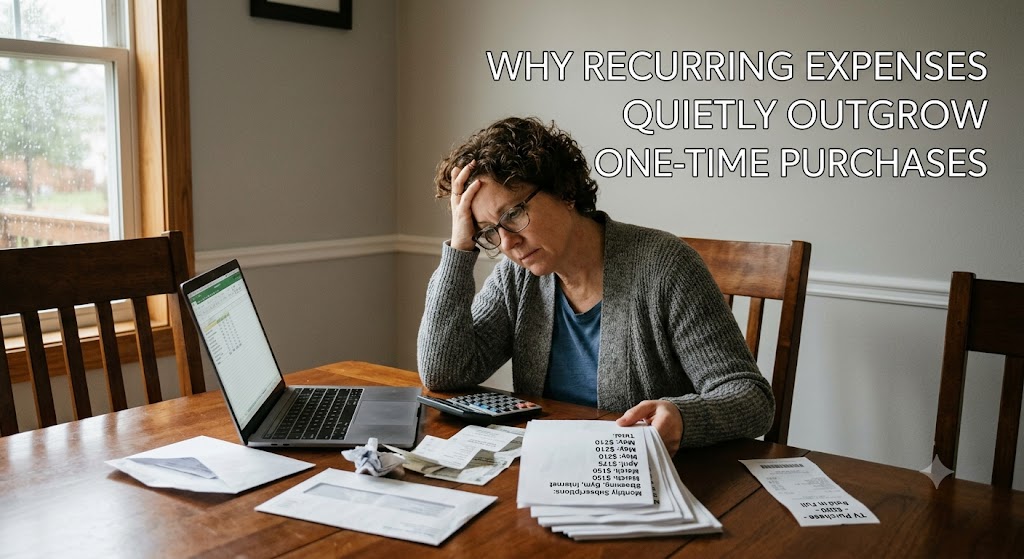
Why Recurring Expenses Quietly Outgrow One-Time Purchases
Most people worry about expensive one time purchases because they are highly visible. Buying a new smartphone, replacing a damaged laptop, purchasing a television, paying for a piece of furniture, or investing in a new appliance usually requires careful thought because the amount leaving the bank account is immediately obvious. These purchases often force people to compare prices, negotiate discounts, read reviews, and even postpone buying until they are financially ready. Ironically, while these large expenses receive the most attention, they are rarely the biggest threat to long term financial stability. The true danger often comes from the recurring expenses that quietly drain money every single day, week, or month without attracting much attention.
Why Recurring Expenses Quietly Outgrow One Time Purchases is an important financial lesson because it reveals how small, repeated payments eventually become much larger than single expensive transactions. Many people proudly avoid buying luxury items while unknowingly committing themselves to subscriptions, memberships, service fees, convenience charges, loan repayments, delivery costs, premium upgrades, and countless other recurring payments that silently consume their income year after year.
Human psychology plays a significant role in this financial trap. Large purchases trigger emotional caution because the financial impact is immediate. A person may spend several weeks thinking about buying a new refrigerator worth several hundred dollars, but the same individual may subscribe to five different streaming platforms, multiple cloud storage services, music subscriptions, premium mobile applications, fitness memberships, gaming passes, and automatic renewals without realizing that these combined monthly expenses eventually exceed the cost of the refrigerator many times over.
The danger lies in repetition. A one time purchase happens once and ends. Recurring expenses continue regardless of whether you actively think about them. Every month they quietly appear on your bank statement, often unnoticed because the individual amounts seem small. The problem is not necessarily the size of each payment but the frequency with which they occur. Small numbers repeated consistently over many years become surprisingly large numbers.
Consider someone paying just twenty dollars each month for a subscription. Twenty dollars does not seem significant. Many people would spend that amount without hesitation. However, twenty dollars every month becomes two hundred and forty dollars every year. Over ten years that single subscription costs two thousand four hundred dollars without accounting for future price increases. If that individual maintains five similar subscriptions, the total quietly reaches twelve thousand dollars over the same period. Most people would never willingly spend twelve thousand dollars on a single purchase, yet they do so gradually without noticing.
This is exactly why recurring expenses often outgrow one time purchases. They benefit from time. Time transforms small payments into major financial commitments. The longer these recurring costs remain active, the greater their impact on overall financial health.
Technology has made recurring expenses even more common than ever before. Businesses increasingly prefer subscription models because predictable monthly income creates stability for the company. Instead of convincing customers to make one large purchase, companies encourage smaller monthly payments that appear affordable. Customers often focus on the monthly cost rather than the total lifetime expense.
A streaming platform may charge only a small monthly fee. A cloud storage provider may request another monthly payment. Music services, online newspapers, productivity software, antivirus programs, language learning applications, fitness platforms, business tools, artificial intelligence services, password managers, and countless digital products all compete for recurring payments. Individually they appear harmless. Together they can consume a significant percentage of monthly income.
The financial impact extends far beyond digital subscriptions. Utility bills increase gradually over time. Mobile phone plans become more expensive after promotional periods end. Insurance premiums quietly rise each year. Banking charges slowly accumulate. Maintenance contracts renew automatically. Homeowners association fees increase. Vehicle maintenance becomes routine. Internet packages receive annual price adjustments. Even food delivery memberships encourage spending more frequently than before.
Many people never stop to calculate the lifetime cost of these recurring commitments. They simply accept them as part of daily life. Unfortunately, every recurring expense reduces future financial flexibility.
Another reason recurring expenses become dangerous is inflation. Prices rarely remain constant. Subscription services increase their fees. Insurance companies adjust premiums. Utility providers revise tariffs. Educational institutions increase tuition. Internet providers update pricing structures. Because these increases happen gradually, consumers often accept them without resistance.
One subscription that starts at ten dollars monthly may eventually cost fifteen dollars or twenty dollars after several years. When this pattern repeats across numerous recurring expenses, the combined financial burden grows much faster than income for many households.
Lifestyle inflation compounds the problem even further. As people earn more money, they rarely add only one recurring expense. Instead, they accumulate many new financial commitments. A salary increase leads to a better phone plan, additional entertainment services, premium banking, upgraded insurance, larger homes, higher utility bills, improved internet packages, more frequent food deliveries, and various convenience services.
Each new commitment appears affordable because it represents only a small percentage of the latest income increase. Over time these recurring obligations permanently raise the cost of maintaining the person’s lifestyle. Eventually, even substantial salary increases fail to create financial freedom because every increase in income is matched by an increase in recurring expenses.
This explains why many high income earners still struggle financially. Their problem is not insufficient income but excessive recurring obligations. They may earn several times more than they did a decade earlier, yet their financial pressure remains unchanged because their recurring expenses have expanded alongside their earnings.
Recurring expenses also reduce financial resilience during emergencies. Someone with minimal monthly obligations can adapt quickly after losing a job or facing unexpected medical bills. Someone carrying numerous subscriptions, loan repayments, memberships, service contracts, insurance premiums, lease payments, and recurring financial commitments has much less flexibility.
During financial hardship, cancelling recurring expenses is often more difficult than expected. Contracts may impose penalties. Essential services cannot simply be discontinued. Loan repayments continue regardless of employment status. Insurance remains necessary. Housing costs persist. What once appeared to be manageable monthly payments suddenly become overwhelming when income decreases.
This financial rigidity explains why emergency funds are so important. They provide temporary protection against recurring obligations that continue even when income temporarily stops. Unfortunately, many people spend so much on recurring expenses that they never build sufficient emergency savings in the first place.
Businesses understand the psychological advantage of recurring billing extremely well. Instead of advertising the total lifetime cost, they emphasize the monthly affordability. A product costing one thousand two hundred dollars sounds expensive. The same product presented as only one hundred dollars per month appears much easier to accept. Consumers naturally evaluate the smaller number rather than calculating the long term commitment.
Automatic payments strengthen this effect even further. Once a payment is automated, people stop actively making purchasing decisions. Money simply leaves the account every billing cycle. Because no conscious action is required, awareness gradually fades. Months become years before many people realize how much they have actually spent.
Financial awareness begins with measurement. Many households know exactly how much they paid for their television or smartphone, yet very few can immediately list every recurring payment leaving their bank account each month. This imbalance in attention often explains why financial stress continues despite stable income.
One useful exercise involves listing every recurring expense on paper. Include subscriptions, memberships, loan repayments, insurance, internet services, mobile plans, software licenses, storage services, maintenance contracts, security systems, streaming platforms, banking fees, educational subscriptions, cloud services, gaming memberships, and every automatic deduction. Add them together to determine the true monthly commitment. Multiply that figure by twelve to understand the annual cost. Finally, project the same expenses over five or ten years. The results often surprise even financially responsible individuals.
Many people discover they are spending thousands every year on services they barely use. Gym memberships remain active despite infrequent attendance. Streaming services sit unused because there is no time to watch them. Software subscriptions continue after projects have ended. Premium services remain in place simply because cancelling them requires effort. These forgotten expenses quietly consume money that could have strengthened savings, reduced debt, funded investments, or created new opportunities.
Financial freedom is rarely achieved through one dramatic decision. Instead, it emerges from hundreds of small decisions repeated consistently over time. The same principle that allows recurring expenses to quietly drain wealth can also be reversed to build wealth. Every unnecessary recurring expense that is eliminated permanently increases future cash flow. Every dollar no longer committed to automatic spending becomes available for investing, saving, debt reduction, business development, education, or future opportunities.
Understanding why recurring expenses quietly outgrow one time purchases changes the way people evaluate financial decisions. Instead of asking whether a monthly payment seems affordable today, wiser consumers ask a different question. They ask what this recurring commitment will cost over the next five, ten, or twenty years and whether it will still provide enough value to justify that lifetime expense.

EarnSmartOnline.com.ng is dedicated to helping readers make smarter financial decisions through practical guides on online income, personal finance, technology, digital business, and wealth creation. Our goal is to provide reliable, easy-to-understand, and actionable content that empowers individuals to earn smarter, build sustainable income streams and achieve long-term financial success.
Recommended: Start Earning Online
- Ultimate Affiliate Marketing Program — learn affiliate marketing with a done-for-you sales system ($15). Check it out
- The Newbie Affiliate Guide — the beginner-friendly starter guide (~$6.68). Check it out
- Easy Dollar Maker — earn in dollars uploading AI images and videos from your phone ($17). Check it out
Disclosure: These are affiliate links. If you buy through them, I may earn a commission at no extra cost to you.