
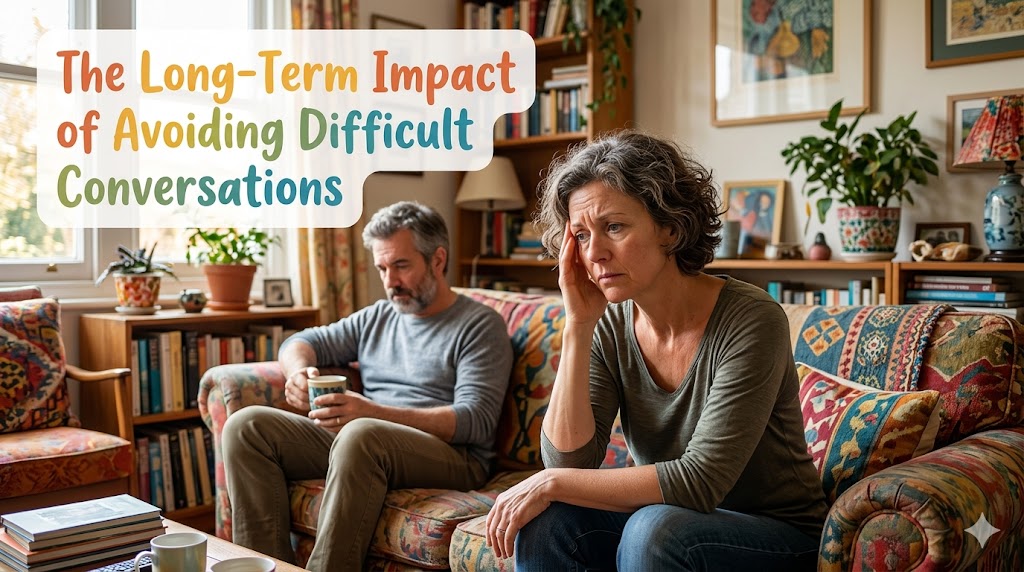
The Long-Term Impact of Avoiding Difficult Conversations
Avoiding difficult conversations might feel like a short-term relief, but over time it becomes one of the most expensive emotional, relational, and even professional habits a person can develop. What many people do not realize is that silence does not eliminate problems; it only delays them while allowing them to grow stronger in the background. Every unspoken truth accumulates weight, and eventually that weight shows up in stress, resentment, misunderstandings, and broken trust.
In personal relationships, avoiding difficult conversations slowly erodes emotional intimacy. When feelings are not expressed clearly, assumptions begin to take their place. A partner may interpret silence as indifference, rejection, or agreement when none of those are accurate. Over time, small misunderstandings evolve into emotional distance. The strange thing is that both individuals often feel something is wrong, but neither wants to initiate the discomfort of addressing it. This creates a cycle where silence becomes the default language of the relationship, and emotional connection weakens without any obvious moment of collapse.
Friendships are not immune to this pattern either. Many long-term friendships do not end because of one major conflict but because of hundreds of small unspoken grievances. A missed apology here, a boundary that was crossed there, a feeling that was never communicated. Each moment seems too small to address, but collectively they form emotional clutter. Eventually, distance replaces closeness, and both people may assume they simply “grew apart,” when in reality they avoided the conversations that could have preserved the bond.
In professional environments, the consequences of avoiding difficult conversations can be even more damaging. Workplaces rely heavily on clarity, feedback, and alignment. When employees avoid speaking up about concerns, misunderstandings about responsibilities begin to form. Tasks are mismanaged, expectations become unclear, and resentment builds silently. Managers who avoid giving honest feedback may think they are protecting morale, but in reality they are preventing growth. Likewise, employees who avoid raising issues may experience burnout or dissatisfaction without ever addressing the root cause.
One of the most overlooked impacts of avoiding difficult conversations is internal stress. When something important is left unsaid, the mind does not simply forget it. Instead, it continues to replay scenarios, imagine outcomes, and rehearse conversations that were never had. This mental repetition consumes emotional energy that could otherwise be used for focus, creativity, or rest. Over time, this leads to anxiety, irritability, and emotional fatigue. People often misinterpret this stress as being caused by external pressures when in reality it is often the result of unresolved communication.
Another long-term effect is the gradual loss of authenticity. When individuals consistently avoid difficult conversations, they begin to filter their true thoughts in order to maintain comfort. This might feel harmless at first, but over time it creates a version of self that is edited, restrained, and less genuine. The more a person suppresses honest expression, the harder it becomes to communicate openly even in safe environments. Eventually, they may lose clarity about their own boundaries, preferences, and emotional needs.
Avoidance also affects decision-making. When important conversations are delayed or ignored, decisions are often made based on incomplete information. This leads to poor outcomes, not because people lack intelligence, but because they lack clarity. Difficult conversations often contain the missing pieces of information required to make sound choices. Without them, individuals and groups operate in partial understanding, which increases the likelihood of repeated mistakes.
Over time, avoidance creates a culture of assumption. Instead of asking for clarity, people begin to guess intentions. Instead of confirming expectations, they interpret behavior. This reliance on assumption becomes dangerous because assumptions are rarely accurate. They are shaped by fear, past experiences, and personal bias rather than truth. As a result, relationships and systems begin to operate on distorted interpretations rather than reality.
There is also a deep connection between avoidance and regret. Many people look back at certain moments in their lives and wish they had spoken up, asked a question, or expressed how they felt. The weight of missed conversations often becomes heavier than the discomfort that would have come from having them in the first place. Regret has a way of amplifying silence, making past avoidance feel more significant over time.
In leadership and influence, the inability to engage in difficult conversations can severely limit effectiveness. Leaders who avoid addressing performance issues, conflict, or misalignment often create environments where problems spread unchecked. Team members may feel confused about expectations or frustrated by lack of direction. Over time, this reduces trust in leadership because clarity is replaced with uncertainty.
On a deeper psychological level, avoidance reinforces fear. Every time a difficult conversation is avoided, the brain learns that discomfort should be escaped rather than managed. This strengthens emotional resistance over time, making future conversations feel even more intimidating. What begins as a small habit eventually becomes a conditioned response, where avoidance feels safer than expression regardless of the situation.
However, the opposite is also true. Engaging in difficult conversations builds emotional resilience. Each time a person communicates something uncomfortable but necessary, they strengthen their ability to handle tension without collapsing into avoidance. Over time, this builds confidence, clarity, and stronger relationships. The discomfort does not disappear, but the ability to move through it improves significantly.
It is important to understand that difficult conversations are not about conflict; they are about clarity. Most of the issues people avoid are not inherently destructive. They only become destructive when left unaddressed. A misunderstood intention, an unclear expectation, or an unspoken feeling can often be resolved in a single honest conversation. The real damage comes from the accumulation of silence, not the conversation itself.
Many people also avoid these conversations because they fear confrontation will damage relationships. Ironically, the opposite is often true. Healthy relationships are not destroyed by honest communication; they are strengthened by it. What weakens relationships is hidden tension, unspoken expectations, and emotional distance created by avoidance. Truth delivered respectfully almost always preserves more connection than silence ever can.
Another reason avoidance persists is the discomfort of uncertainty. People often delay conversations because they are unsure how the other person will react. However, uncertainty does not disappear with time; it increases. The longer a conversation is delayed, the more imagined outcomes multiply, making the situation feel more complex than it originally was.
Ultimately, the long-term impact of avoiding difficult conversations is a life shaped by unspoken words, unresolved emotions, and missed opportunities for clarity. It affects relationships, mental health, professional growth, and self-awareness. While avoidance offers temporary comfort, it demands long-term payment in the form of confusion, distance, and internal tension.
Learning to engage in difficult conversations is not about becoming confrontational; it is about choosing clarity over confusion, truth over assumption, and growth over stagnation. The quality of life often improves not when all problems disappear, but when people become willing to face them directly. In that willingness lies emotional freedom, stronger relationships, and a more authentic way of living.

EarnSmartOnline.com.ng is dedicated to helping readers make smarter financial decisions through practical guides on online income, personal finance, technology, digital business, and wealth creation. Our goal is to provide reliable, easy-to-understand, and actionable content that empowers individuals to earn smarter, build sustainable income streams and achieve long-term financial success.
Recommended: Start Earning Online
- Ultimate Affiliate Marketing Program — learn affiliate marketing with a done-for-you sales system ($15). Check it out
- The Newbie Affiliate Guide — the beginner-friendly starter guide (~$6.68). Check it out
- Easy Dollar Maker — earn in dollars uploading AI images and videos from your phone ($17). Check it out
Disclosure: These are affiliate links. If you buy through them, I may earn a commission at no extra cost to you.



