
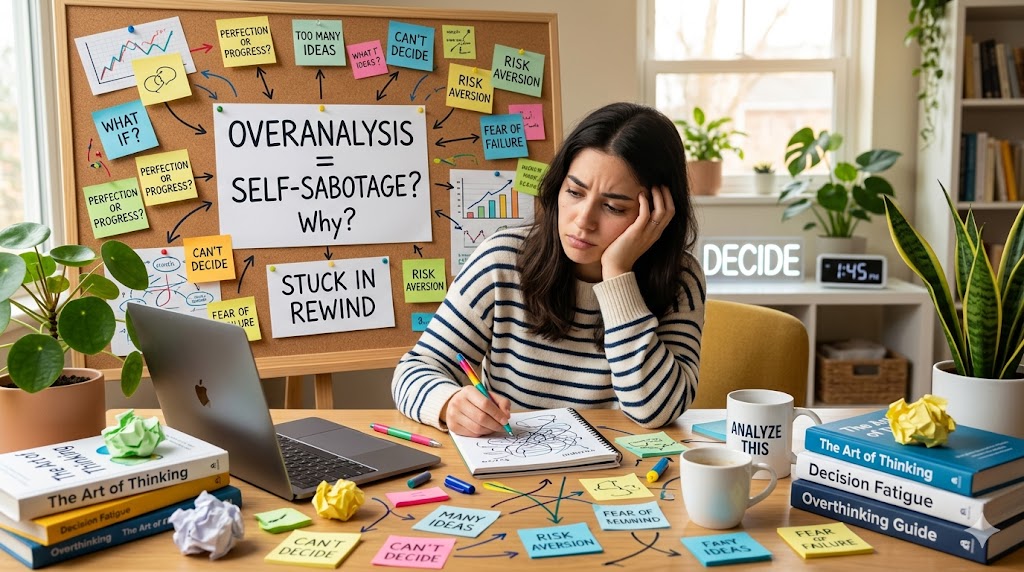
Why Overanalysis Can Become a Form of Self-Sabotage
Overanalysis often looks like intelligence on the surface. People tend to praise deep thinking, careful evaluation, and the ability to consider multiple angles before making a decision. In many situations, these traits are valuable and even necessary. However, there is a point where thinking stops being productive and starts becoming a barrier. At that point, overanalysis shifts from being a tool for better decisions into a quiet form of self-sabotage that keeps people stuck in cycles of hesitation, doubt, and inaction.
The core problem with overanalysis is not thinking too much, but thinking without resolution. The mind keeps generating possibilities, scenarios, risks, and counterarguments, but none of them lead to closure. Instead of narrowing down choices, the process keeps expanding them. What starts as an attempt to gain clarity gradually turns into mental clutter. The person becomes more informed in theory but less capable in practice. This creates a strange contradiction where increased thinking produces decreased progress.
One of the hidden dangers of overanalysis is that it disguises itself as preparation. Many people convince themselves that they are simply being thorough. They believe that more research, more planning, and more consideration will eventually lead to the perfect decision. The problem is that perfection is not a real endpoint in most decisions. Life rarely offers complete information, and waiting for absolute certainty often means waiting indefinitely. In the meantime, opportunities move forward without those who are still trying to think their way into complete confidence.
Overanalysis also feeds on fear, even when it appears logical. Behind excessive thinking is often a desire to avoid mistakes, embarrassment, loss, or regret. The mind tries to simulate every possible outcome in advance in an attempt to eliminate uncertainty. But this creates a false sense of control. No amount of mental rehearsal can fully predict real-world outcomes, and the attempt to do so only increases anxiety. Instead of reducing fear, overthinking amplifies it by continuously exposing the mind to imagined negative scenarios.
Another way overanalysis becomes self-sabotage is through decision paralysis. When too many options are considered equally important, the ability to choose weakens. The person begins to overvalue minor differences and overestimate potential risks. Simple decisions start to feel complex, and complex decisions start to feel impossible. As a result, action is delayed, sometimes indefinitely. This delay has a cost because life does not pause while decisions are being analyzed. Time continues to move, and with it, opportunities, momentum, and motivation fade.
Momentum is one of the most underestimated casualties of overthinking. Progress often creates its own energy. Once a person starts acting, even imperfectly, they gain feedback from reality. That feedback helps refine direction and improve future decisions. Overanalysis interrupts this natural learning cycle. Instead of learning through action, the person remains trapped in theoretical loops. The longer this continues, the harder it becomes to start because the mind builds the illusion that action must be perfectly planned before it is allowed to happen.
There is also a psychological toll that comes with chronic overanalysis. The mind becomes overloaded with unresolved thoughts. Instead of experiencing clarity, the person feels mentally crowded. This can lead to fatigue, irritability, and a constant sense of dissatisfaction. Even when no external problem exists, the internal noise creates discomfort. Over time, this state can reduce confidence because the individual starts to doubt their own judgment. If every decision feels uncertain, then self-trust naturally begins to weaken.
Overanalysis also distorts perception of risk. When thinking becomes excessive, small risks begin to appear larger than they actually are. The mind focuses heavily on what could go wrong while underestimating the cost of doing nothing. In reality, inaction is often the most expensive choice. It silently accumulates lost time, missed opportunities, and stagnation. However, because these costs are not immediate or visible, they are often ignored in favor of imagined risks that feel more urgent in the moment.
Another subtle effect of overanalysis is the illusion of productivity. Thinking feels like work. It creates the sensation of being engaged, responsible, and careful. However, mental activity is not the same as meaningful progress. A person can spend hours analyzing a decision and still remain exactly where they started. This illusion makes overthinking particularly dangerous because it reduces the motivation to act. The brain receives partial satisfaction from thinking itself, which replaces the need for execution.
Overanalysis can also weaken creativity. Creativity requires a certain level of openness, experimentation, and willingness to make imperfect moves. When the mind is locked in constant evaluation mode, it becomes harder to explore freely. Every idea is immediately judged, every possibility is quickly analyzed for flaws, and every direction is mentally filtered before it has a chance to develop. This restricts innovation and leads to repetitive thinking patterns that reinforce the same conclusions without generating anything new.
One of the most effective ways to understand overanalysis is to compare it with learning. Real learning happens through cycles of action, feedback, and adjustment. Overanalysis attempts to replace this cycle with prediction. Instead of testing reality, it tries to simulate reality mentally. The problem is that imagination is limited by perspective, experience, and bias. Reality, on the other hand, provides accurate and sometimes surprising feedback. By avoiding action, overthinking cuts off access to the most reliable source of information available.
It is also important to recognize that overanalysis often increases with intelligence and responsibility. People who care deeply about outcomes or who have experienced past mistakes are more likely to fall into this pattern. They want to avoid failure, so they think more. Ironically, this protective instinct can lead to the very stagnation they are trying to prevent. The desire to make better decisions becomes the reason decisions are not made at all. In this way, caution slowly transforms into limitation.
Breaking out of overanalysis does not mean abandoning thought or acting recklessly. It means shifting from infinite thinking to sufficient thinking. There is a point where enough information has been gathered to take a reasonable step forward. The key is recognizing that clarity often comes after movement, not before it. Action turns abstract uncertainty into concrete experience, and experience is what ultimately refines judgment.
Another important shift is learning to accept imperfect decisions. Not every choice will be optimal, and not every outcome will be predictable. However, most decisions are reversible or adjustable. Treating every choice as permanent increases pressure and encourages overthinking. When decisions are viewed as part of a process rather than final judgments, it becomes easier to act without being trapped by fear of error.
Ultimately, overanalysis becomes self-sabotage when it replaces progress with preparation, and replaces learning with imagining. It creates a cycle where thinking feels safe, but staying safe leads to stagnation. The irony is that the more someone tries to avoid mistakes through excessive thinking, the more they limit their ability to grow, adapt, and succeed. Real progress begins when thinking is used to guide action, not replace it.

EarnSmartOnline.com.ng is dedicated to helping readers make smarter financial decisions through practical guides on online income, personal finance, technology, digital business, and wealth creation. Our goal is to provide reliable, easy-to-understand, and actionable content that empowers individuals to earn smarter, build sustainable income streams and achieve long-term financial success.
Recommended: Start Earning Online
- Ultimate Affiliate Marketing Program — learn affiliate marketing with a done-for-you sales system ($15). Check it out
- The Newbie Affiliate Guide — the beginner-friendly starter guide (~$6.68). Check it out
- Easy Dollar Maker — earn in dollars uploading AI images and videos from your phone ($17). Check it out
Disclosure: These are affiliate links. If you buy through them, I may earn a commission at no extra cost to you.



