
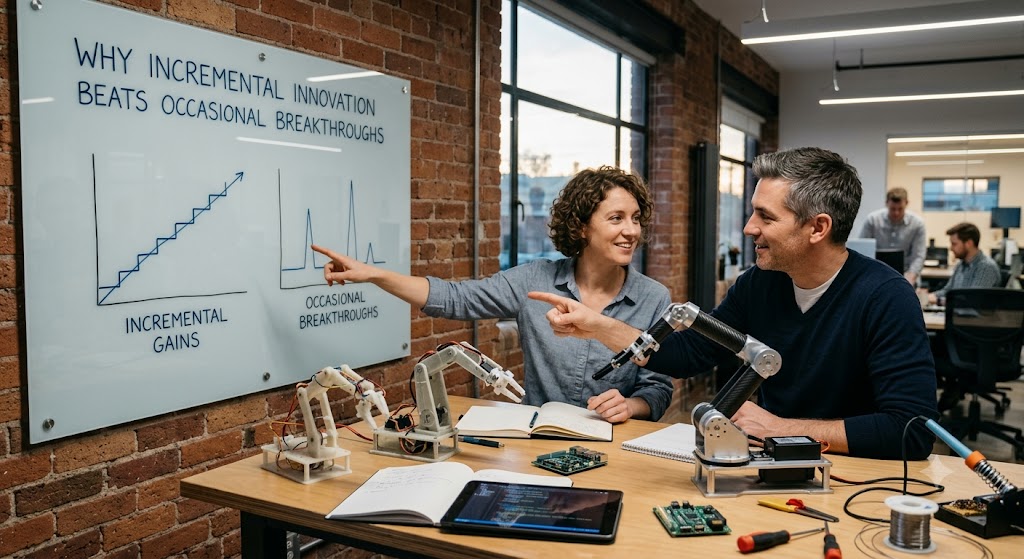
Why Incremental Innovation Beats Occasional Breakthroughs
Innovation is often portrayed as a dramatic event. Popular stories celebrate the entrepreneur who creates a revolutionary product overnight, the scientist who makes a once in a lifetime discovery, or the company that suddenly changes an entire industry with a single brilliant idea. These stories are inspiring, but they also create a dangerous misconception. They make people believe that success depends on waiting for one extraordinary breakthrough instead of building a habit of continuous improvement. The truth is that the greatest businesses, professionals, creators, and organisations rarely rely on one magical moment. Their success comes from making small improvements consistently over time. This is why incremental innovation beats occasional breakthroughs in the long run.
Incremental innovation refers to making regular improvements to products, services, systems, processes, or strategies without completely reinventing them. Instead of aiming to create something entirely new every few years, businesses constantly refine what already exists. They listen to customer feedback, identify weaknesses, improve efficiency, eliminate waste, enhance quality, and adapt to changing market conditions. While each improvement may seem insignificant on its own, the combined effect over months and years becomes extraordinary.
Many people underestimate the power of small changes because they focus on immediate results. A one percent improvement today may appear invisible. However, when similar improvements are made every week, every month, and every year, they compound into remarkable progress. Businesses that understand this principle rarely stand still because they know that remaining competitive requires continuous adaptation rather than occasional transformation.
The business world provides countless examples of companies that achieved lasting success through incremental innovation rather than dramatic breakthroughs. Successful companies rarely release a completely different product every year. Instead, they improve existing products by adding better features, increasing reliability, enhancing user experience, improving speed, reducing costs, and solving customer frustrations. Customers appreciate these consistent improvements because they make products more useful without forcing them to learn entirely new systems.
This approach also reduces risk. Betting everything on a revolutionary breakthrough can be dangerous because there is no guarantee that customers will accept the new idea. Many breakthrough products fail because they arrive too early, solve problems that customers do not care about, or require behaviour changes that people are unwilling to make. Incremental innovation, on the other hand, builds upon proven ideas. Businesses already understand what customers like, making improvements less risky and more predictable.
One of the greatest advantages of incremental innovation is that it creates a culture of learning. Organisations that encourage continuous improvement teach employees to observe problems, suggest solutions, and experiment regularly. Instead of waiting for executives to introduce revolutionary changes, every member of the team becomes responsible for making the organisation better. This collective mindset produces thousands of valuable ideas that would otherwise remain hidden.
Employees who participate in continuous improvement also become more engaged with their work. They understand that their observations matter and that even small suggestions can have significant impacts. This creates a positive feedback loop where innovation becomes everyone’s responsibility rather than belonging only to research departments or senior management.
Customer satisfaction also improves when businesses embrace incremental innovation. Markets constantly evolve, customer expectations change, technology advances, and competitors introduce new features. Companies that regularly update their products remain relevant because they respond to customer needs before dissatisfaction becomes widespread. Customers notice when businesses consistently improve their experience, even if the improvements appear modest.
The opposite approach often creates problems. Companies that wait for massive breakthroughs frequently ignore customer complaints until they become severe. They delay improvements because they hope to release a revolutionary solution later. Meanwhile, competitors continue making small enhancements that gradually attract dissatisfied customers. By the time the breakthrough arrives, the market may have already moved on.
Incremental innovation is especially valuable because it allows businesses to gather real world feedback continuously. Every small improvement generates customer responses that reveal whether the change was successful. This creates an ongoing learning process where future improvements become more informed. Instead of making enormous assumptions about what customers want, companies make smaller changes, observe reactions, and adjust accordingly.
This process resembles climbing a mountain one step at a time rather than attempting one giant leap to the summit. Each step provides new information about the terrain, helping travellers avoid dangerous mistakes while steadily moving closer to their destination. Businesses that innovate incrementally enjoy the same advantage because every improvement increases their understanding of customers, markets, and operations.
Financial sustainability is another major reason why incremental innovation often outperforms occasional breakthroughs. Revolutionary projects frequently require enormous investments in research, development, testing, marketing, and infrastructure. These projects may consume millions of dollars before generating any revenue. If the breakthrough fails, the financial consequences can be devastating.
Incremental innovation spreads investment over time. Companies improve existing products using manageable budgets while continuing to generate revenue from current operations. This balanced approach reduces financial pressure and allows organisations to remain profitable while still investing in innovation. The business becomes stronger instead of gambling its future on uncertain outcomes.
Small businesses particularly benefit from this strategy because they rarely possess unlimited financial resources. A startup may not have enough capital to create revolutionary technologies, but it can continuously improve customer service, simplify purchasing processes, improve product quality, reduce delivery times, and strengthen relationships with customers. These gradual improvements often create competitive advantages that larger organisations struggle to replicate.
The digital economy has made incremental innovation even more important. Software companies release updates almost constantly. Mobile applications receive regular improvements that enhance performance, fix bugs, improve security, and introduce useful features. Users have become accustomed to continuous enhancement rather than waiting years for entirely new products. This expectation has influenced nearly every industry, encouraging businesses to improve constantly instead of occasionally.
The principle also applies to marketing. Businesses rarely achieve sustainable growth through one viral campaign alone. Instead, they improve advertising strategies, refine messaging, optimise websites, enhance search engine visibility, improve social media engagement, and analyse customer behaviour continuously. These ongoing adjustments often produce more consistent results than relying on one spectacular marketing success.
Search engine optimisation itself demonstrates the power of incremental innovation. Websites rarely dominate search rankings immediately after publication. Success usually comes from regularly publishing valuable content, updating existing articles, improving page speed, strengthening internal links, earning quality backlinks, enhancing user experience, and responding to search engine algorithm changes. Each improvement may produce modest gains, but together they establish long term authority.
Entrepreneurs often become discouraged because they compare themselves with stories of overnight success. They assume that successful businesses emerged suddenly without recognising the years of incremental progress that occurred behind the scenes. Every successful company has countless stories of gradual improvements that rarely receive media attention. The public notices the breakthrough, but insiders understand that years of continuous refinement made that breakthrough possible.
This misunderstanding creates unrealistic expectations for new business owners. They become impatient when dramatic success does not arrive quickly and abandon promising ventures before incremental improvements have enough time to produce meaningful results. Patience combined with consistent innovation often separates successful entrepreneurs from those who give up too early.
The manufacturing industry has long demonstrated the effectiveness of incremental innovation. Factories continuously improve production methods, reduce waste, improve quality control, enhance worker safety, streamline logistics, and optimise equipment performance. Individually, these improvements may appear minor, but collectively they significantly reduce costs while improving customer satisfaction and profitability.
Healthcare also benefits enormously from incremental innovation. Medical breakthroughs certainly save lives, but many improvements in patient outcomes come from refining procedures, improving hospital management, enhancing diagnostic accuracy, reducing treatment delays, strengthening communication between healthcare providers, and improving infection prevention practices. Small improvements across multiple areas often produce greater health benefits than isolated revolutionary discoveries.
Education offers another excellent example. Schools that regularly improve teaching methods, update learning materials, strengthen student support systems, integrate useful technology, and refine assessment techniques often outperform institutions waiting for revolutionary educational reforms. Continuous improvement creates better learning environments while allowing educators to adapt to changing student needs.
Personal development follows the same principle. Few individuals transform their lives through one dramatic event. Most lasting improvements come from developing better habits, reading consistently, learning new skills regularly, exercising frequently, improving communication, managing finances wisely, and making better daily decisions. These incremental improvements eventually create extraordinary personal growth.
Professional careers also illustrate the value of continuous improvement. Employees who dedicate themselves to learning one new skill at a time steadily increase their value in the workplace. They improve technical knowledge, communication abilities, leadership skills, problem solving capabilities, and industry expertise over many years. Eventually, these accumulated improvements position them for promotions, higher salaries, and greater opportunities.
Innovation should not always be measured by the size of individual changes. Sometimes the greatest competitive advantage comes from making improvements that competitors overlook because they appear too small to matter. Improving customer response times by a few minutes, simplifying registration forms, reducing website loading times by one second, or improving packaging convenience can significantly influence customer satisfaction and purchasing decisions.
Customer loyalty often grows through repeated positive experiences rather than dramatic product launches. Every small improvement demonstrates that a company values its customers and remains committed to providing better experiences. Over time, customers develop trust because they know the business continually invests in serving them more effectively.
Incremental innovation also encourages adaptability. Markets rarely remain stable for long periods. Consumer preferences evolve, technologies advance, regulations change, and new competitors emerge regularly. Businesses accustomed to continuous improvement respond more quickly because innovation is already embedded within their culture. They do not fear change because they practise adapting every day.
In contrast, organisations dependent upon occasional breakthroughs often become rigid between major projects. Employees become accustomed to maintaining the status quo while waiting for the next revolutionary initiative. This slows response times when unexpected challenges arise because continuous adaptation is not part of the organisational culture.
Leadership plays a critical role in promoting incremental innovation. Effective leaders celebrate small improvements instead of recognising only dramatic achievements. They encourage experimentation, reward creative thinking, accept occasional failures as learning opportunities, and create environments where employees feel comfortable suggesting improvements regardless of their position within the organisation.
This leadership approach strengthens employee confidence because people understand that innovation does not require extraordinary genius. Every individual can identify inefficiencies, propose better methods, improve customer interactions, or enhance workplace processes. Innovation becomes accessible rather than intimidating.
Technology has accelerated the pace at which incremental innovation can occur. Businesses now collect vast amounts of customer data, monitor performance in real time, conduct rapid experiments, analyse user behaviour, and implement improvements much faster than ever before. These capabilities enable organisations to refine products and services continuously based on actual evidence rather than assumptions.
Artificial intelligence, automation, cloud computing, and advanced analytics further strengthen incremental innovation by providing insights that reveal opportunities for improvement. Companies no longer rely solely on intuition because data continuously identifies weaknesses and opportunities for optimisation. Every improvement becomes more targeted and measurable.
The psychology behind incremental innovation also deserves attention. Large goals often overwhelm people because they appear impossible to achieve. Small improvements feel manageable, encouraging consistent action. This psychological advantage increases motivation because progress becomes visible through regular accomplishments rather than distant dreams.
Businesses that embrace this mindset create momentum. Every successful improvement encourages additional improvements, generating enthusiasm throughout the organisation. Teams begin actively searching for opportunities to optimise operations because they experience the satisfaction of seeing their ideas implemented successfully.
Competitive advantage rarely disappears overnight. Instead, companies gradually lose relevance by ignoring countless small improvements that competitors embrace. Market leadership is often eroded through hundreds of incremental advantages accumulated by rivals rather than one revolutionary invention. Understanding this reality helps businesses appreciate why continuous improvement deserves constant attention.
Consumers also appreciate familiarity combined with improvement. People generally prefer products that evolve naturally rather than changing so dramatically that previous knowledge becomes useless. Incremental innovation respects existing customer experiences while introducing valuable enhancements that improve usability and satisfaction.
This balance between familiarity and progress explains why many successful products remain recognisable for decades despite undergoing continuous evolution. Customers enjoy improved performance without feeling disconnected from products they already understand and trust.
Even breakthrough innovations often emerge from years of incremental experimentation. Revolutionary discoveries rarely appear without preparation. Scientists conduct thousands of experiments, engineers refine countless prototypes, designers test numerous concepts, and entrepreneurs make endless adjustments before achieving remarkable results. The apparent breakthrough usually represents the visible outcome of invisible incremental progress accumulated over many years.
Therefore, occasional breakthroughs should not be viewed as alternatives to incremental innovation. Instead, they are frequently the natural consequence of sustained continuous improvement. Organisations committed to learning, experimentation, and refinement create environments where major innovations become more likely because knowledge accumulates steadily over time.
Economic uncertainty further strengthens the importance of incremental innovation. During challenging periods, businesses may hesitate to invest heavily in risky breakthrough projects. Continuous improvement offers a more resilient strategy because organisations can adapt gradually while preserving financial stability. Small innovations help businesses navigate changing economic conditions without exposing themselves to unnecessary risk.
The same principle applies to startups seeking growth. Rather than attempting to create perfect products before entering the market, successful startups often launch minimum viable products, gather customer feedback, improve continuously, and expand features based on real demand. This iterative approach reduces uncertainty while increasing the likelihood of building products customers genuinely value.
Innovation should ultimately solve problems rather than simply create excitement. Customers rarely care whether improvements are revolutionary or incremental. They care about receiving better value, greater convenience, higher quality, lower costs, improved reliability, and superior experiences. If consistent small improvements deliver these benefits more effectively than occasional dramatic changes, incremental innovation becomes the more practical strategy.
Business history repeatedly confirms this lesson. Companies that survive across generations rarely depend on one brilliant invention. They remain successful because they never stop improving. They listen carefully, learn continuously, adapt quickly, and refine relentlessly. Their commitment to ongoing progress allows them to remain competitive despite changing technologies, evolving customer expectations, and emerging competitors.
The future will likely reward organisations that embrace this philosophy even more strongly. Technological change continues accelerating, customer expectations continue rising, and competitive landscapes become increasingly dynamic. Businesses can no longer afford to remain static while waiting for the next revolutionary opportunity. Continuous improvement provides the flexibility necessary to thrive in unpredictable environments.
Ultimately, the greatest advantage of incremental innovation lies in its sustainability. Breakthroughs may generate headlines, attract attention, and create temporary excitement, but consistent improvement builds lasting success. Small innovations accumulate like compound interest, producing exponential returns that become increasingly powerful over time. Every improvement strengthens the foundation upon which future innovations can be built.
The most successful entrepreneurs, companies, professionals, and organisations understand that excellence is rarely achieved through isolated moments of brilliance. It is built through thousands of thoughtful decisions, careful refinements, valuable lessons, and consistent improvements made every single day. Those who commit themselves to continuous innovation rarely need to chase breakthroughs because, over time, their steady progress naturally positions them ahead of competitors who spend years waiting for the next big idea. In the modern business world, sustainable success belongs not to those who innovate spectacularly once in a while, but to those who improve relentlessly every single day.

EarnSmartOnline.com.ng is dedicated to helping readers make smarter financial decisions through practical guides on online income, personal finance, technology, digital business, and wealth creation. Our goal is to provide reliable, easy-to-understand, and actionable content that empowers individuals to earn smarter, build sustainable income streams and achieve long-term financial success.
Recommended: Start Earning Online
- Ultimate Affiliate Marketing Program — learn affiliate marketing with a done-for-you sales system ($15). Check it out
- The Newbie Affiliate Guide — the beginner-friendly starter guide (~$6.68). Check it out
- Easy Dollar Maker — earn in dollars uploading AI images and videos from your phone ($17). Check it out
Disclosure: These are affiliate links. If you buy through them, I may earn a commission at no extra cost to you.



