
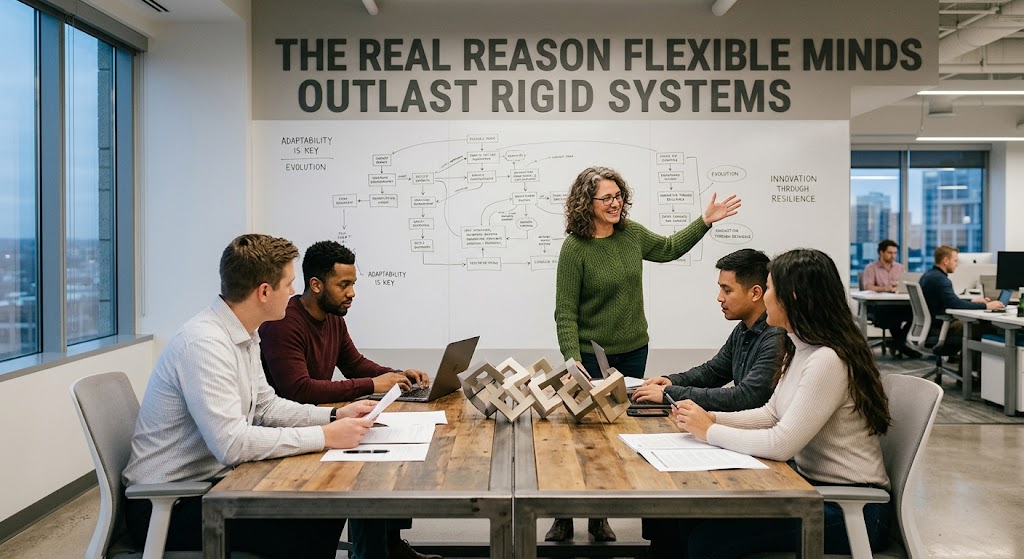
The Real Reason Flexible Minds Outlast Rigid Systems
The world has never stood still. Every generation has witnessed change, but the speed of transformation today is unlike anything humanity has experienced before. Technologies emerge overnight, industries evolve within a few years, consumer preferences shift without warning, and skills that were once considered valuable can become outdated in a surprisingly short period. Amid all this uncertainty, one truth continues to stand the test of time. Flexible minds consistently outlast rigid systems. This principle applies to individuals, businesses, governments, careers, relationships, and even entire civilizations. Those who remain open to learning, adapting, and evolving continue to thrive, while those who cling stubbornly to old methods gradually lose relevance.
Many people assume that success belongs to the strongest, the smartest, or the wealthiest. History repeatedly proves otherwise. Success often belongs to those who adapt the fastest. Being flexible does not mean abandoning principles or lacking conviction. It means understanding that methods can change while values remain constant. A flexible person knows that there are many ways to solve one problem, many paths to achieve one goal, and many opportunities hidden inside unexpected circumstances.
Rigid thinking creates the illusion of certainty. It convinces people that the way something has always been done is automatically the best way to continue doing it. This mindset can become dangerous because the world rarely rewards people who refuse to evolve. Markets change. Technology advances. Customer expectations rise. Social behaviours shift. Economic conditions fluctuate. Those who refuse to adjust eventually find themselves fighting battles that no longer exist while ignoring opportunities that are right in front of them.
One of the greatest examples of this principle can be seen in the history of business. Countless companies once dominated their industries only to disappear because they believed their success would last forever. They ignored innovation because their existing systems seemed to be working. They underestimated new competitors because they trusted old business models. They dismissed emerging technologies because they believed customers would never change their habits. Unfortunately, customers always change when they find something better, faster, cheaper, or more convenient.
On the other hand, organisations that embrace change often reinvent themselves repeatedly. They study new trends instead of resisting them. They invest in research before they are forced to. They listen carefully to customers instead of assuming they already know everything. They encourage employees to think creatively instead of punishing new ideas. These businesses understand that flexibility is not a sign of weakness but a source of long-term strength.
The same principle applies to personal success. Many people spend years mastering one way of doing things. While expertise is valuable, refusing to learn anything new becomes a liability. The most successful professionals constantly update their knowledge. They learn new technologies, develop fresh skills, and stay informed about changes within their industries. They never assume that yesterday’s expertise guarantees tomorrow’s opportunities.
Learning itself requires flexibility. Every new piece of knowledge challenges existing assumptions. Every new experience has the potential to reshape understanding. People who remain curious throughout life continue growing because they accept that there is always something new to discover. Those who believe they already know enough slowly stop progressing, even if they continue working hard.
One reason flexible minds outperform rigid systems is that uncertainty has become the normal condition of modern life. Very few careers remain unchanged for decades. Entire industries have appeared within the last twenty years while others have disappeared completely. Artificial intelligence, automation, remote work, digital commerce, renewable energy, biotechnology, and countless other innovations continue reshaping the global economy. Individuals who adapt to these realities position themselves for future success. Those who ignore them risk becoming irrelevant regardless of previous achievements.
Flexibility also improves decision-making. A rigid thinker often searches for information that confirms existing beliefs while rejecting evidence that challenges them. This creates blind spots that lead to poor decisions. Flexible thinkers approach problems differently. They actively seek different perspectives. They ask questions instead of making assumptions. They recognise that changing one’s opinion in response to better evidence is not weakness but wisdom.
Relationships also benefit from flexibility. Families, friendships, partnerships, and workplaces all involve people with different personalities, backgrounds, and expectations. Rigid individuals often insist that others behave exactly as they expect. Flexible individuals understand that compromise, communication, and understanding strengthen relationships. They adjust without sacrificing their values because they recognise that mutual respect matters more than always being right.
Leadership offers another powerful example. Great leaders rarely possess all the answers. Instead, they surround themselves with capable people, encourage honest feedback, and remain willing to adjust strategies when circumstances change. Poor leaders often become trapped by pride. They refuse to admit mistakes because they fear appearing weak. Ironically, this refusal to change often causes far greater damage than admitting an error early.
Economic success increasingly depends on adaptability. Many traditional career paths no longer provide lifetime security. New professions emerge every year while automation replaces repetitive tasks across multiple industries. Workers who continuously upgrade their skills remain valuable because they evolve alongside technology instead of competing against it. Employers increasingly seek individuals who can learn quickly, solve unfamiliar problems, and adapt to changing environments.
Entrepreneurship demonstrates this reality daily. Every successful business owner eventually encounters unexpected challenges. Consumer demand changes. Competitors enter the market. Regulations evolve. Economic conditions fluctuate. Supply chains become disrupted. Marketing platforms lose effectiveness. Businesses that survive understand that adaptation is part of the entrepreneurial journey rather than an unfortunate interruption.
Flexibility also protects against failure. People often view failure as a permanent event because they become emotionally attached to one particular outcome. Flexible thinkers see failure differently. They view setbacks as information rather than personal defeat. Every unsuccessful attempt reveals something valuable about what needs improvement. This mindset transforms obstacles into learning opportunities rather than reasons to quit.
Psychology supports this perspective. Research consistently shows that individuals with growth-oriented thinking tend to perform better over time because they believe abilities can improve through learning and practice. Fixed mindsets assume talent determines success. Growth mindsets recognise that consistent improvement creates extraordinary results over long periods. This difference influences behaviour every single day.
Technology provides endless examples of why flexibility matters. Consider how communication has evolved over the past few decades. Letters gave way to emails. Emails expanded alongside instant messaging. Social media transformed personal and professional networking. Video conferencing redefined workplace collaboration. Artificial intelligence now assists with tasks once considered impossible for computers. Individuals and businesses that embraced these changes discovered new opportunities. Those who resisted often struggled to remain competitive.
Education itself is changing rapidly. Information is no longer confined to classrooms or libraries. Online courses, digital communities, educational platforms, podcasts, videos, and interactive learning tools have made knowledge more accessible than ever before. Flexible learners recognise these opportunities and continue developing throughout life. Rigid learners often stop growing after formal education ends, believing their learning journey is complete.
One overlooked benefit of flexibility is emotional resilience. Life rarely unfolds exactly as planned. Unexpected events affect everyone. Careers change unexpectedly. Financial circumstances fluctuate. Health challenges arise. Personal relationships evolve. Flexible people recover more quickly because they adjust expectations instead of remaining trapped by disappointment. Their resilience comes not from avoiding hardship but from responding constructively when hardship arrives.
Innovation depends entirely on flexible thinking. Every invention began with someone questioning accepted assumptions. Every scientific breakthrough challenged existing knowledge. Every successful entrepreneur identified possibilities others overlooked. Creativity requires the willingness to imagine alternatives instead of accepting limitations as permanent realities.
Culture itself evolves through flexibility. Societies constantly adjust laws, customs, technologies, and institutions to reflect changing realities. Communities that embrace thoughtful progress often become more prosperous because they respond effectively to new circumstances. Communities that reject every form of change often struggle to solve emerging problems.
Financial success also rewards adaptability. Investment markets fluctuate. Economic conditions shift. Consumer behaviour evolves. Successful investors rarely rely on one strategy forever. They study trends, evaluate risks, diversify wisely, and remain prepared to adjust when necessary. Blindly repeating yesterday’s decisions rarely produces tomorrow’s success.
Communication skills have become another area where flexibility creates advantages. Modern professionals interact with people from different cultures, generations, industries, and educational backgrounds. Effective communicators adjust their style depending on the audience. They simplify complex ideas when necessary, listen carefully before responding, and remain open to feedback. This adaptability strengthens trust and improves collaboration.
Problem-solving becomes significantly easier when people avoid rigid thinking. Many challenges have multiple possible solutions. Flexible thinkers generate alternatives, compare options, and evaluate consequences before deciding. They avoid becoming emotionally attached to one specific method simply because it feels familiar.
One important distinction must be understood. Flexibility should never be confused with inconsistency. Flexible people maintain strong principles while remaining open to better methods. They know the destination but remain willing to change the route. Rigid people often confuse methods with values, protecting outdated processes even when better alternatives clearly exist.
The future belongs to continuous learners. Artificial intelligence will continue transforming industries. Automation will reshape employment. Global competition will increase. New technologies will create opportunities that barely exist today. The individuals who remain curious, adaptable, and committed to lifelong learning will consistently outperform those who rely solely on past knowledge.
Parents also play an important role in developing flexible minds. Children should be encouraged to ask questions, explore ideas, solve problems creatively, and view mistakes as learning opportunities. Memorising facts remains useful, but developing adaptable thinking prepares young people for an unpredictable future far more effectively than simply teaching them fixed answers.
Managers who encourage flexibility build stronger organisations. Employees who feel safe sharing ideas often identify problems before they become crises. Innovation flourishes when curiosity receives encouragement rather than criticism. Organisations that reward experimentation tend to discover new opportunities while competitors remain trapped by routine.
Even personal happiness benefits from adaptability. Expectations often determine emotional wellbeing more than circumstances themselves. Flexible individuals adjust expectations when reality changes instead of remaining permanently frustrated. They recognise that happiness grows through acceptance, gratitude, continuous growth, and meaningful relationships rather than perfect control over every situation.
History repeatedly rewards adaptation. From agriculture to industry, from mechanical invention to digital transformation, every major period of human progress has been driven by individuals willing to challenge existing assumptions. Progress has never belonged exclusively to the strongest or wealthiest. It has consistently favoured those willing to learn, experiment, and improve.
Every individual eventually faces moments requiring adaptation. A changing career, unexpected financial pressure, family responsibilities, technological disruption, or shifting social expectations all demand flexibility. Those moments often determine future success more than talent alone. The willingness to evolve separates temporary achievement from lasting relevance.
The most dangerous phrase anyone can adopt is, “This is how we’ve always done it.” While tradition deserves respect, unquestioning loyalty to outdated methods limits growth. Every improvement begins by asking whether there might be a better way. Every breakthrough starts with curiosity. Every innovation begins with someone refusing to believe that existing systems represent the final answer.
Flexible minds remain valuable because they can function effectively inside changing environments. They recognise patterns quickly, learn continuously, recover from setbacks, and embrace new possibilities without abandoning core values. They understand that adaptation is not surrender but intelligent evolution. Rather than fearing change, they prepare for it.
Ultimately, rigid systems eventually crack under pressure because they cannot bend. Flexible minds absorb pressure, adjust intelligently, and continue moving forward. In an increasingly unpredictable world, adaptability has become one of the most valuable assets any individual, organisation, or society can possess. Knowledge remains important. Experience remains valuable. Discipline remains essential. Yet without flexibility, all these strengths eventually become limitations. The future will continue rewarding those who remain curious, humble, resilient, and willing to grow. The real reason flexible minds outlast rigid systems is simple. The world never stops changing, and neither do those who choose to succeed with it.

EarnSmartOnline.com.ng is dedicated to helping readers make smarter financial decisions through practical guides on online income, personal finance, technology, digital business, and wealth creation. Our goal is to provide reliable, easy-to-understand, and actionable content that empowers individuals to earn smarter, build sustainable income streams and achieve long-term financial success.
Recommended: Start Earning Online
- Ultimate Affiliate Marketing Program — learn affiliate marketing with a done-for-you sales system ($15). Check it out
- The Newbie Affiliate Guide — the beginner-friendly starter guide (~$6.68). Check it out
- Easy Dollar Maker — earn in dollars uploading AI images and videos from your phone ($17). Check it out
Disclosure: These are affiliate links. If you buy through them, I may earn a commission at no extra cost to you.



