
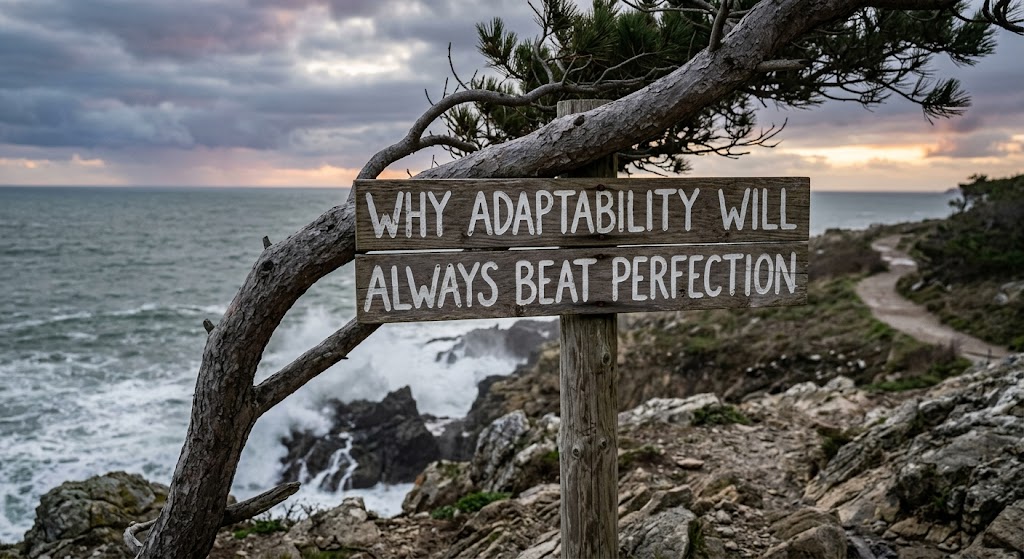
Why Adaptability Will Always Beat Perfection
In a world that changes faster than ever before, many people are still chasing perfection as if it is the ultimate key to success. They spend countless hours trying to make every decision flawless, every plan airtight, every project error free, and every move completely risk free. The belief is simple. If something can be perfected, then it will automatically produce better results. While this idea sounds reasonable on the surface, real life often proves otherwise. Why Adaptability Will Always Beat Perfection.
The truth is that perfection is often an illusion. Conditions change, opportunities appear unexpectedly, markets evolve, technology advances, and people themselves grow and transform. What seems perfect today may become outdated tomorrow. This is why adaptability has become one of the most valuable qualities anyone can possess. The ability to adjust, learn, pivot, and respond to change often delivers far greater rewards than the endless pursuit of perfection.
Understanding Why Adaptability Will Always Beat Perfection can completely transform the way people approach work, business, relationships, personal growth, and life itself. While perfection focuses on creating the ideal situation, adaptability focuses on succeeding regardless of the situation. One depends on conditions being right. The other thrives even when conditions are far from ideal.
Many people never start because they are waiting for the perfect moment. They want the perfect business idea, the perfect website, the perfect equipment, the perfect amount of money, or the perfect level of knowledge before taking action. Unfortunately, that perfect moment rarely arrives. Life moves forward while they remain stuck in preparation mode.
Adaptable people think differently. They understand that action creates clarity. Instead of waiting for everything to align perfectly, they begin with what they have. They learn as they go. They make adjustments along the way. They improve through experience rather than endless planning. As a result, they often move ahead while perfectionists remain trapped in hesitation.
History is filled with examples of individuals and companies that succeeded because they adapted rather than perfected. Many successful businesses started with products that were far from flawless. Their founders launched, gathered feedback, identified weaknesses, and improved continuously. If they had waited until every detail was perfect, they might never have launched at all.
The modern business environment provides countless examples of this principle. Industries change rapidly. Consumer preferences shift. New technologies emerge almost overnight. Companies that insist on maintaining old methods simply because they once worked often struggle to survive. Meanwhile, businesses willing to adapt to new realities continue to grow and thrive.
This principle extends beyond business into everyday life. Relationships require adaptability because people change over time. Careers require adaptability because industries evolve. Financial success requires adaptability because economic conditions fluctuate. Even health and fitness require adaptability because the body responds differently throughout various stages of life.
One of the greatest dangers of perfectionism is that it creates fear. When people become obsessed with perfection, mistakes feel catastrophic. Every error becomes a source of anxiety. Every setback feels like failure. This mindset often leads to stress, procrastination, and self doubt.
Adaptability creates a completely different mindset. Instead of fearing mistakes, adaptable individuals view them as valuable information. They understand that every mistake teaches a lesson. Every obstacle reveals a new approach. Every challenge develops resilience. Rather than seeing failure as a dead end, they see it as part of the learning process.
This shift in perspective is incredibly powerful. When mistakes are no longer viewed as disasters, people become more willing to take action. They become more creative. They become more innovative. They become more confident because they know they can adjust if things do not go according to plan.
Another reason Why Adaptability Will Always Beat Perfection is because perfection often slows progress. People can spend weeks, months, or even years trying to perfect something that could have been launched, tested, and improved during that same period. The pursuit of perfection frequently becomes a form of procrastination disguised as productivity.
Many talented individuals remain unnoticed because they never feel ready to share their work. They keep editing, refining, tweaking, and adjusting. Meanwhile, less talented but more adaptable individuals put their work into the world, receive feedback, improve over time, and gradually build success.
The difference is not necessarily talent. The difference is action.
Progress almost always beats perfection because progress creates momentum. Momentum generates experience. Experience produces improvement. Improvement leads to mastery. This cycle cannot begin until action is taken.
Technology provides a perfect example of this reality. Software developers rarely release products that are completely perfect. Instead, they launch versions, collect user feedback, fix issues, add features, and continue evolving. If they waited for absolute perfection before launching, many of today’s most successful platforms would never have existed.
Adaptability also strengthens resilience. Life rarely follows a predictable script. Unexpected challenges appear without warning. Economic downturns occur. Opportunities disappear. New opportunities emerge. Personal circumstances change. People who depend on perfect conditions often struggle when reality becomes messy.
Adaptable individuals understand that uncertainty is part of life. They prepare themselves mentally to respond rather than resist. When circumstances change, they adjust their plans instead of abandoning their goals. This flexibility allows them to continue moving forward even when others become stuck.
The ability to adapt is particularly important in today’s digital world. Technological innovation is transforming industries at an unprecedented pace. Skills that were valuable a decade ago may no longer be enough today. New tools, platforms, and systems constantly emerge.
Those who embrace lifelong learning position themselves for continued success. They remain curious. They stay open minded. They seek new knowledge. They understand that adaptation is not a one time event but an ongoing process.
Perfectionists often struggle in rapidly changing environments because they prefer certainty. They want clear rules, stable conditions, and predictable outcomes. Unfortunately, modern life rarely offers these guarantees. Adaptable people are more comfortable with uncertainty because they trust their ability to learn and respond.
This confidence creates a significant advantage. While others worry about changes they cannot control, adaptable individuals focus on how they can respond effectively. They direct their energy toward solutions rather than complaints.
Another important aspect of Why Adaptability Will Always Beat Perfection is that adaptability encourages innovation. Innovation rarely emerges from rigid thinking. It often comes from experimentation, curiosity, and a willingness to explore new possibilities.
Some of the greatest breakthroughs in history resulted from unexpected discoveries, failed experiments, or accidental observations. These achievements became possible because people were willing to adapt their understanding when new information appeared.
Perfectionism, on the other hand, can create rigidity. It encourages people to cling to a predetermined vision even when evidence suggests a better path exists. This attachment to being right can limit growth and prevent discovery.
Adaptability also improves decision making. Perfectionists often suffer from analysis paralysis. They gather excessive information, consider endless possibilities, and delay decisions because they fear making the wrong choice. The desire for certainty keeps them trapped.
Adaptable people recognize that most decisions are not permanent. They make informed choices, monitor results, and adjust when necessary. This approach allows them to move faster and learn more quickly.
In leadership, adaptability is often one of the most important qualities a person can possess. Great leaders understand that circumstances evolve. They know that strategies may need adjustment. They listen to feedback, assess changing conditions, and make necessary modifications.
Employees, customers, and stakeholders generally respect leaders who can adapt effectively. These leaders demonstrate resilience, confidence, and practical wisdom. They show that success is not about stubbornly following a fixed plan but about navigating reality as it unfolds.
On a personal level, adaptability contributes significantly to happiness and emotional well being. People who constantly chase perfection often feel dissatisfied because perfection remains perpetually out of reach. No achievement feels good enough. No result feels complete enough. No progress feels sufficient.
Adaptable individuals tend to appreciate growth rather than perfection. They celebrate improvement. They recognize effort. They accept imperfections as part of being human. This mindset creates greater satisfaction and reduces unnecessary stress.
Relationships provide another powerful illustration of this principle. Healthy relationships require flexibility, understanding, and compromise. People grow, circumstances change, and challenges arise. Those who expect perfection from themselves or others often experience disappointment.
Adaptable individuals approach relationships with realistic expectations. They communicate, learn, adjust, and evolve together. Their willingness to adapt strengthens connection and creates lasting bonds.
Education also demonstrates Why Adaptability Will Always Beat Perfection. Memorising information may help in certain situations, but the ability to learn new concepts, solve unfamiliar problems, and adapt to changing circumstances is far more valuable in the long term.
The future belongs to those who can learn, unlearn, and relearn. Knowledge remains important, but adaptability determines how effectively that knowledge can be applied in changing environments.
Young people entering the workforce today will likely experience careers that look very different from those of previous generations. Entire industries may transform multiple times throughout their working lives. Success will depend less on mastering one fixed skill and more on continuously adapting to new opportunities and challenges.
This reality makes adaptability one of the most future proof qualities anyone can develop. Technologies may change. Markets may shift. Trends may come and go. However, the ability to learn and adapt remains valuable in every environment.
Developing adaptability begins with embracing a growth mindset. It requires accepting that learning never ends. It involves becoming comfortable with uncertainty and viewing challenges as opportunities rather than threats.
Adaptability also requires humility. People must be willing to admit when something is not working. They must remain open to new ideas and alternative perspectives. This openness creates room for growth and improvement.
At the same time, adaptability requires courage. Change can be uncomfortable. New situations often involve risk. However, growth rarely occurs within the boundaries of complete comfort. Those who adapt successfully are willing to step into uncertainty because they trust their ability to figure things out along the way.
Perhaps the greatest lesson of all is that perfection is often a destination that does not exist. No matter how much effort is invested, there will always be another improvement to make, another detail to refine, or another standard to pursue. Chasing perfection can become an endless race with no finish line.
Adaptability offers a different path. Instead of seeking flawless conditions, it focuses on continuous growth. Instead of demanding certainty, it embraces learning. Instead of fearing change, it leverages change as an opportunity.
The people who achieve lasting success are rarely those who waited for everything to become perfect. They are usually the ones who started before they felt ready, adjusted when necessary, learned from mistakes, and kept moving forward despite uncertainty.
That is the enduring truth behind Why Adaptability Will Always Beat Perfection. Perfection may look impressive in theory, but adaptability wins in practice. The world rewards those who can evolve, respond, and grow. Circumstances will always change, challenges will always arise, and opportunities will always appear in unexpected forms. Those who can adapt will continue to thrive long after perfectionists are still waiting for the perfect moment that never comes.
In the end, success does not belong to the flawless. It belongs to the flexible. It belongs to the learners. It belongs to the people who understand that progress is more powerful than perfection and that the ability to adapt is one of the greatest advantages anyone can possess in an ever changing world.

EarnSmartOnline.com.ng is dedicated to helping readers make smarter financial decisions through practical guides on online income, personal finance, technology, digital business, and wealth creation. Our goal is to provide reliable, easy-to-understand, and actionable content that empowers individuals to earn smarter, build sustainable income streams and achieve long-term financial success.
Recommended: Start Earning Online
- Ultimate Affiliate Marketing Program — learn affiliate marketing with a done-for-you sales system ($15). Check it out
- The Newbie Affiliate Guide — the beginner-friendly starter guide (~$6.68). Check it out
- Easy Dollar Maker — earn in dollars uploading AI images and videos from your phone ($17). Check it out
Disclosure: These are affiliate links. If you buy through them, I may earn a commission at no extra cost to you.



