
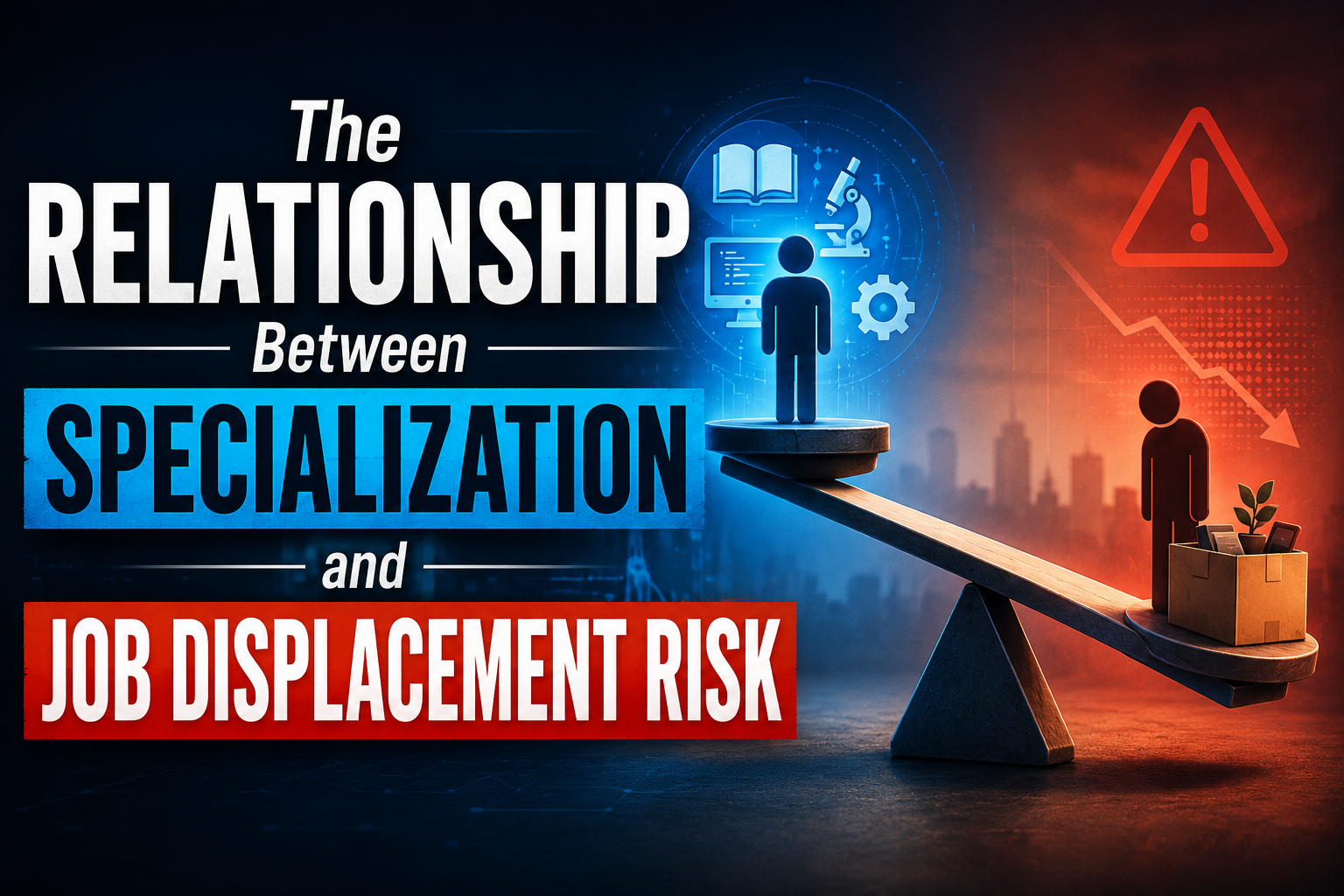
The Relationship Between Specialization and Job Displacement Risk
The relationship between specialization and job displacement risk is one of the most misunderstood dynamics in today’s rapidly evolving labor market. On the surface, specialization is often presented as the safest path to career stability. People are encouraged to become experts in a narrow field, master a specific skill set, and position themselves as indispensable within that niche. However, beneath this widely accepted advice lies a more complex reality. Specialization can either protect a worker from displacement or make them highly vulnerable, depending on how the specialization aligns with technological progress, market demand, and adaptability over time.
To understand this relationship, it is important to first define what specialization means in the modern economy. Specialization refers to the process of focusing deeply on a specific domain, skill, or function rather than maintaining broad general knowledge across multiple areas. A specialist might be a software engineer focused only on backend systems, a radiologist who interprets medical imaging, or a tax accountant who handles only corporate filings. In contrast, a generalist may work across multiple functions, combining skills in a more flexible but less deeply technical way. Historically, specialization has been rewarded because it increases efficiency, productivity, and expertise within a defined system.
The assumption that specialization guarantees job security comes from industrial-era logic. In stable economic environments, where tools and systems change slowly, deep expertise naturally becomes valuable and difficult to replace. A master craftsman, a senior machinist, or a highly trained technician could build a long career doing the same type of work because the underlying technology remained relatively unchanged for decades. In such contexts, specialization acted as insulation against competition because the barrier to entry was high and the rate of change was low.
However, the modern economy operates under very different conditions. Technological acceleration, automation, and artificial intelligence have introduced a new variable into the equation: the speed of skill obsolescence. When systems evolve faster than individuals can retrain, specialization begins to shift from a strength into a potential vulnerability. The more narrowly defined a skill set is, the more exposed it becomes to disruption when that specific task is automated or redesigned by technology.
This is where job displacement risk enters the conversation. Job displacement does not necessarily mean unemployment in a direct sense. It often appears as gradual erosion of value. A role becomes less essential, tasks are absorbed by software, or entire functions are consolidated into automated systems. The specialist, who once held deep expertise in a narrow domain, may find that the demand for that exact expertise is shrinking or evolving beyond recognition. In such cases, the very focus that once created job security becomes a constraint.
Yet specialization is not inherently dangerous. The risk depends heavily on whether the specialization is static or adaptive. Static specialization refers to expertise tied to tools, processes, or systems that do not evolve quickly or that are easily replicated by machines. For example, roles that involve repetitive rule-based decision making are more susceptible to automation. On the other hand, adaptive specialization involves deep expertise combined with continuous learning, allowing the individual to evolve alongside the industry. A cybersecurity specialist, for instance, must constantly update knowledge due to the ever-changing nature of digital threats. In such cases, specialization becomes a moving target rather than a fixed position.
Another key factor is whether a specialization is tightly coupled to a single technology or loosely connected to a broader ecosystem. The more tightly coupled the skill, the higher the displacement risk. For example, someone who specializes exclusively in a single outdated software platform faces higher risk compared to someone whose specialization sits within a broader domain like data analysis or cloud systems, where tools may change but underlying principles remain relevant.
At the same time, it is important to recognize that generalists are not immune to displacement either. While they may be more adaptable, they often lack the depth required to compete in high-value roles. This creates a paradox in modern career development: depth increases value but also increases exposure, while breadth increases flexibility but may limit earning potential. The challenge is not choosing between specialization and generalization but understanding how to balance both strategically.
One emerging solution in the modern workforce is what can be described as layered specialization. This involves developing deep expertise in one core area while maintaining adjacent competencies that allow movement across related fields. For example, a marketing specialist who understands data analytics, consumer psychology, and digital platforms is less vulnerable than someone who only knows one narrow marketing channel. Layered specialization creates optionality, which is one of the most important defenses against job displacement.
Another dimension of this relationship is the concept of human versus machine complementarity. Specializations that rely heavily on creativity, emotional intelligence, complex judgment, and interpersonal communication tend to be more resistant to displacement. Machines excel at pattern recognition, repetition, and structured logic, but they struggle with ambiguity, empathy, and nuanced decision-making. Therefore, specialists who operate in domains where human judgment remains central are less likely to be replaced entirely.
However, even in these domains, parts of the workflow are often automated. This means that specialists must shift their focus from execution alone to interpretation, strategy, and oversight. The value increasingly lies not in performing tasks that machines can replicate, but in guiding, refining, and contextualizing machine outputs. In this sense, specialization is evolving from doing the work to directing the work.
The economic implication of this shift is significant. Labor markets no longer reward static expertise as strongly as they reward adaptive expertise. Employers are increasingly prioritizing individuals who can evolve with tools rather than those who are locked into specific methods. This creates a new form of competition where the most valuable specialists are those who can repeatedly reskill without losing their core identity.
There is also a psychological dimension to consider. Many professionals resist expanding beyond their specialization because expertise creates identity security. People define themselves by what they are good at, and shifting away from that can feel like losing professional identity. This emotional attachment to specialization can increase displacement risk because it discourages adaptation. In contrast, individuals who view their specialization as temporary rather than permanent tend to navigate transitions more effectively.
Education systems also play a role in shaping this dynamic. Many academic structures still encourage early and rigid specialization, pushing students into narrow fields before they fully understand the pace of industry change. While this creates depth, it may also produce professionals who are highly skilled in areas that evolve or decline faster than expected. A more resilient approach involves integrating interdisciplinary learning with specialized training, allowing individuals to pivot more easily as markets shift.
From an economic perspective, industries that experience rapid innovation cycles tend to punish narrow specialization more aggressively. Technology, finance, digital media, and biotechnology are examples where continuous disruption reshapes job roles frequently. In contrast, slower-moving sectors such as certain public services or traditional trades may still reward deep specialization with lower displacement risk, although even these are gradually being affected by modernization.
Ultimately, the relationship between specialization and job displacement risk is not linear. It is dynamic and context-dependent. Specialization increases value when aligned with evolving systems, but it increases vulnerability when tied to static or declining structures. The key determinant is not how specialized a person is, but how relevant that specialization remains over time.
In conclusion, specialization is neither inherently safe nor inherently risky. It is a tool whose outcome depends on adaptability, industry context, and technological change. In a world where disruption is constant, the most resilient professionals are not those who avoid specialization, but those who continuously evolve their specialization. The future belongs to individuals who can maintain depth while embracing change, turning expertise into a living, adaptive asset rather than a fixed position in a rapidly shifting economy.

EarnSmartOnline.com.ng is dedicated to helping readers make smarter financial decisions through practical guides on online income, personal finance, technology, digital business, and wealth creation. Our goal is to provide reliable, easy-to-understand, and actionable content that empowers individuals to earn smarter, build sustainable income streams and achieve long-term financial success.
Recommended: Start Earning Online
- Ultimate Affiliate Marketing Program — learn affiliate marketing with a done-for-you sales system ($15). Check it out
- The Newbie Affiliate Guide — the beginner-friendly starter guide (~$6.68). Check it out
- Easy Dollar Maker — earn in dollars uploading AI images and videos from your phone ($17). Check it out
Disclosure: These are affiliate links. If you buy through them, I may earn a commission at no extra cost to you.



