
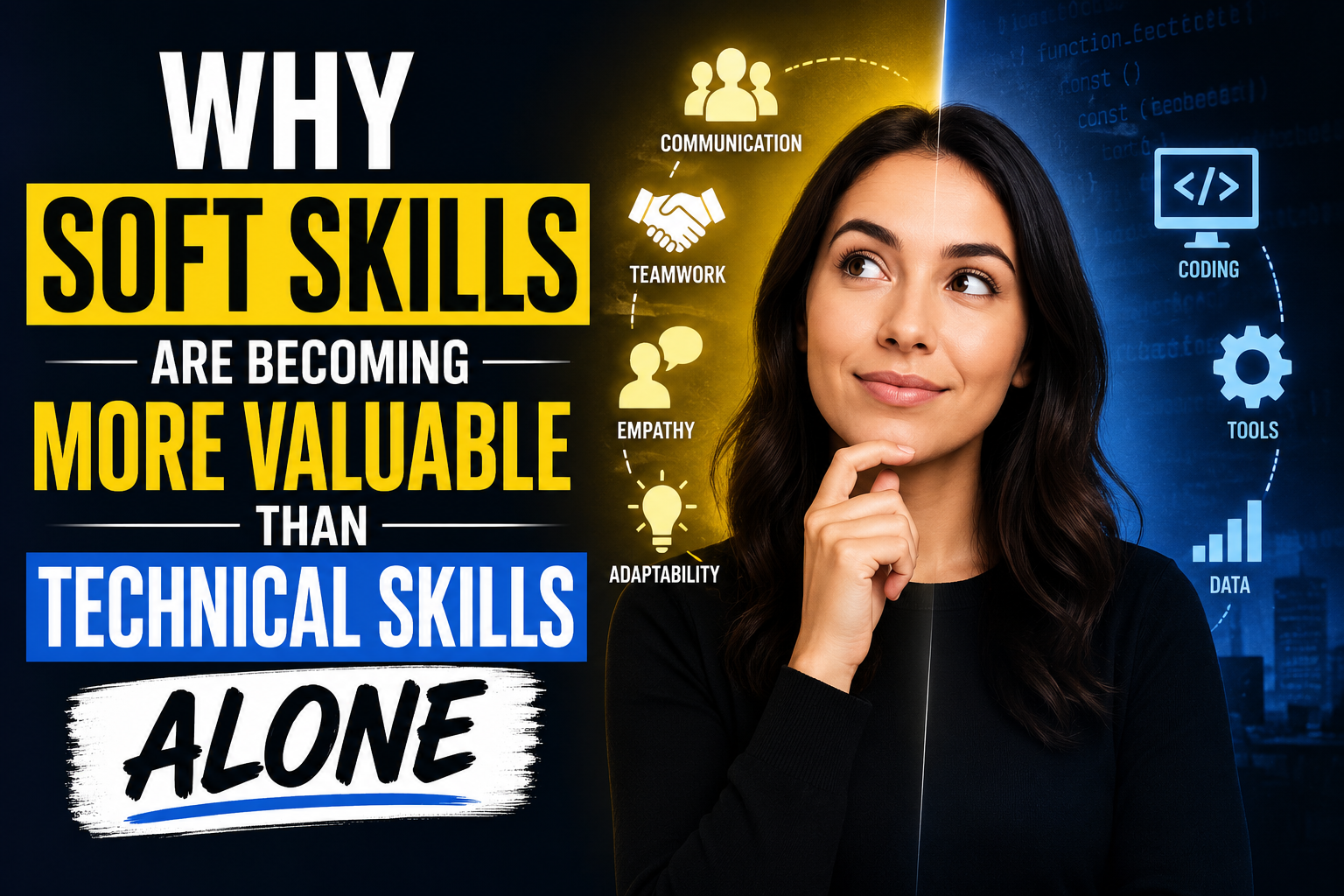
Why Soft Skills Are Becoming More Valuable Than Technical Skills Alone
In today’s rapidly changing world of work, something subtle but powerful is happening beneath the surface of hiring decisions, promotions, and long term career success. For decades, technical skills were treated as the ultimate currency of employability. If you could code, design, analyze data, fix machines, or operate specialized tools, you were considered valuable. That logic made sense in an industrial and early digital economy where tasks were clearly defined and success depended heavily on execution. But the modern economy is no longer built only on execution. It is built on collaboration, adaptability, communication, influence, and continuous learning. This shift is quietly but firmly pushing soft skills into a position of higher long term value than technical skills alone. Why Soft Skills Are Becoming More Valuable Than Technical Skills Alone.
Technical skills still matter, and they always will. No serious organization can function without people who know how to build systems, manage tools, and solve specific problems. However, technical skills are becoming easier to acquire, easier to outsource, and easier to automate. Online platforms, artificial intelligence tools, bootcamps, tutorials, and global knowledge sharing have reduced the barrier to entry for many hard skills. What once took years of formal education can now be learned in months or even weeks. This does not make technical skills useless, but it changes their exclusivity. When more people can access the same knowledge and tools, the differentiating factor shifts elsewhere.
That differentiating factor is increasingly soft skills. These are the human abilities that cannot be easily automated or replicated by software. Communication, emotional intelligence, leadership, teamwork, adaptability, negotiation, problem solving in ambiguous situations, and the ability to build trust have become central to success in almost every industry. Unlike technical skills, which often solve defined problems, soft skills determine how effectively a person operates in uncertain, dynamic, and collaborative environments.
One of the key reasons soft skills are rising in importance is the increasing complexity of modern work. Very few roles today are isolated. Even highly technical jobs require constant interaction with teams, clients, stakeholders, and systems that are interconnected. A software engineer is not just writing code; they are interpreting requirements, communicating with product managers, collaborating with designers, and explaining solutions to non technical stakeholders. A data analyst is not just processing numbers; they are translating insights into decisions that influence business strategy. In every case, the ability to communicate clearly and build understanding often determines whether technical ability actually creates value.
Another major factor is that technical knowledge becomes outdated faster than ever before. Technologies evolve, tools change, frameworks get replaced, and entire industries shift direction within short cycles. Someone who relies only on technical expertise may find themselves constantly chasing new certifications just to stay relevant. Soft skills, however, remain stable across time. The ability to learn quickly, adapt to new environments, manage relationships, and solve unfamiliar problems remains valuable regardless of how technology evolves. In many ways, soft skills act as the foundation that allows technical skills to remain useful over time.
There is also a growing recognition that technical competence alone does not guarantee success in leadership or high responsibility roles. Many organizations promote individuals not just because they are the best at executing tasks, but because they can guide others, resolve conflicts, make decisions under pressure, and align teams toward a shared goal. Leadership is rarely about being the most technically skilled person in the room. It is about understanding people, managing emotions, and creating clarity in situations where there is uncertainty. Without strong soft skills, even the most technically gifted individuals can struggle when placed in leadership positions.
Communication is one of the most powerful soft skills driving this change. In modern workplaces, the ability to explain complex ideas in simple terms is incredibly valuable. It bridges the gap between technical experts and non technical decision makers. Miscommunication can lead to wasted resources, failed projects, and missed opportunities. On the other hand, clear communication accelerates execution and improves alignment. People who can express ideas effectively often become the ones who influence decisions, regardless of their technical depth.
Emotional intelligence is another critical factor. Workplaces are not just systems of tasks; they are environments filled with human behavior, motivation, stress, ambition, and conflict. Understanding how people feel, why they react in certain ways, and how to manage interpersonal dynamics is essential for building productive teams. Emotional intelligence helps individuals navigate disagreements, maintain professional relationships, and create environments where others can perform at their best. Without it, technical skill alone can feel isolated and ineffective in collaborative settings.
Adaptability is also becoming a defining skill of the modern economy. The pace of change means that individuals must constantly adjust to new tools, new expectations, and new ways of working. Those who resist change often struggle, regardless of their technical ability. Adaptable individuals, however, thrive because they see change as an opportunity rather than a threat. They are willing to unlearn outdated methods and embrace new approaches quickly, which makes them valuable in unpredictable environments.
Problem solving in ambiguous situations is another area where soft skills outperform technical expertise alone. Technical skills are often designed for structured problems with clear inputs and outputs. However, real world challenges are rarely that clean. Many problems involve incomplete information, conflicting priorities, and uncertain outcomes. In such cases, the ability to think critically, ask the right questions, and collaborate with others becomes more important than knowing a specific technical solution. People who can navigate ambiguity effectively often become key decision makers in organizations.
Another important dimension is the rise of remote and global work environments. Teams are now distributed across different time zones, cultures, and communication styles. In such environments, trust becomes a critical factor. Trust is not built through technical competence alone but through reliability, clarity, empathy, and consistent communication. Individuals who can build strong relationships in virtual settings often stand out, even if others have similar or greater technical abilities.
Soft skills also play a major role in career growth and income progression. While technical skills may get someone hired, soft skills often determine how quickly they grow within an organization. People who can negotiate effectively, present their ideas persuasively, and build strong professional networks tend to access better opportunities over time. They are often noticed more, trusted more, and given more responsibility, which naturally leads to higher compensation and career advancement.
It is also important to recognize that soft skills influence how technical skills are perceived. Two individuals with identical technical ability can have very different career outcomes based on how they present themselves, how they collaborate, and how they interact with others. One may be seen as difficult to work with despite being highly skilled, while the other may be viewed as a valuable team player who enhances overall productivity. In most organizational environments, the second individual is more likely to progress faster.
The increasing value of soft skills does not mean that technical skills are becoming irrelevant. Instead, it means that technical skills alone are no longer sufficient for long term success. The modern economy rewards individuals who can combine both. Technical skills provide the ability to solve problems, while soft skills determine how effectively those solutions are applied, communicated, and scaled within a system.
As automation and artificial intelligence continue to advance, this balance will become even more important. Machines are becoming increasingly capable of performing structured technical tasks, but they cannot replicate human understanding, empathy, persuasion, or leadership. This means that the most valuable individuals in the future will not necessarily be those who know the most technical information, but those who can connect knowledge with people and apply it in meaningful ways.
In essence, the shift toward soft skills reflects a deeper transformation in how value is created in society. Value is no longer just about performing tasks efficiently. It is about influencing outcomes, building relationships, adapting to change, and navigating complexity. Technical skills open the door, but soft skills determine how far someone can go once they are inside.
The individuals and organizations that recognize this shift early will have a significant advantage. They will invest not only in learning tools and technologies but also in developing communication, leadership, emotional intelligence, and adaptability. In the long run, it is this combination that will define success in an increasingly complex and interconnected world.

EarnSmartOnline.com.ng is dedicated to helping readers make smarter financial decisions through practical guides on online income, personal finance, technology, digital business, and wealth creation. Our goal is to provide reliable, easy-to-understand, and actionable content that empowers individuals to earn smarter, build sustainable income streams and achieve long-term financial success.
Recommended: Start Earning Online
- Ultimate Affiliate Marketing Program — learn affiliate marketing with a done-for-you sales system ($15). Check it out
- The Newbie Affiliate Guide — the beginner-friendly starter guide (~$6.68). Check it out
- Easy Dollar Maker — earn in dollars uploading AI images and videos from your phone ($17). Check it out
Disclosure: These are affiliate links. If you buy through them, I may earn a commission at no extra cost to you.



