
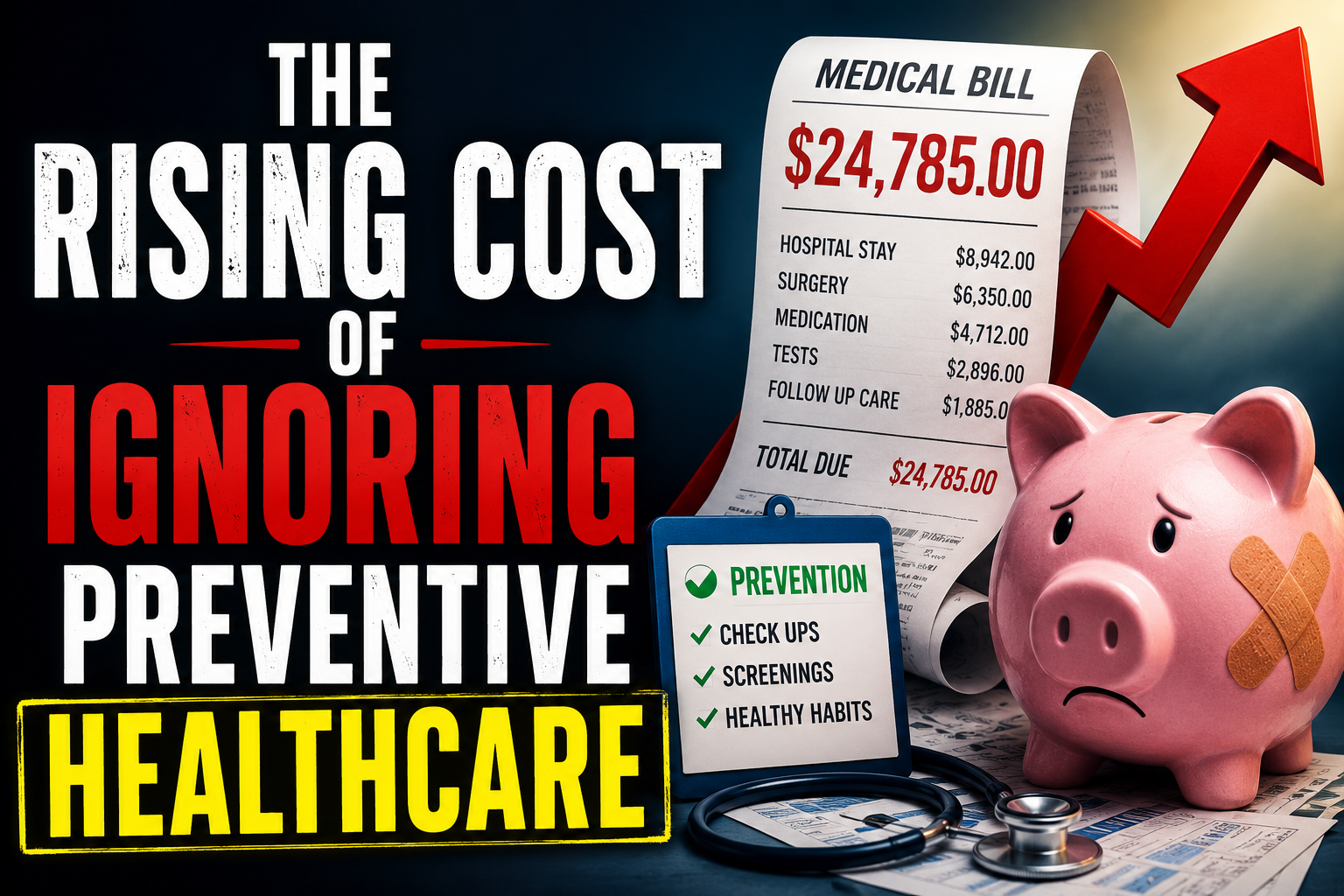
The Rising Cost of Ignoring Preventive Healthcare
Most people think healthcare is something you only deal with when something goes wrong. You feel fine, you work, you eat, you sleep, and life continues, so hospital visits and medical checks feel unnecessary. This mindset seems harmless at first, even logical when money is tight or schedules are busy. But what many fail to realize is that preventive healthcare is not about treating sickness, it is about preventing the financial, physical, and emotional collapse that comes when small health issues are ignored for too long. The real cost is not just medical bills, but the slow erosion of productivity, stability, and quality of life that builds quietly in the background.
One of the biggest problems with ignoring preventive healthcare is that most serious conditions do not appear suddenly. They develop gradually over time, often without obvious symptoms in the early stages. Conditions like high blood pressure, diabetes, hormonal imbalance, and heart disease often start silently. By the time symptoms become noticeable, the condition has usually advanced to a stage where treatment becomes more expensive, more complicated, and less effective. Something that could have been managed with simple lifestyle changes or early medication turns into long term medical dependency. For example, unmanaged blood sugar levels can gradually develop into Type 2 Diabetes, which then requires continuous treatment, dietary restrictions, and regular monitoring. What begins as neglect can turn into a lifelong financial commitment.
The financial impact alone is one of the most underestimated consequences. Preventive care may feel like an extra expense, but curative care is often exponentially more expensive. Routine checkups, basic screenings, and early consultations are relatively affordable compared to hospital admissions, surgeries, or emergency treatments. When people avoid preventive care, they are essentially choosing to pay a much higher price later. The irony is that many individuals who avoid small healthcare costs eventually end up spending far more on treating advanced conditions. This creates a cycle where financial pressure increases precisely because of the earlier attempt to avoid spending money on health.
Beyond direct medical costs, there is also the hidden cost of lost productivity. Poor health does not always show up as complete inability to work. Instead, it often appears as fatigue, low energy, reduced focus, frequent headaches, or recurring minor illnesses. These small disruptions accumulate over time and reduce overall efficiency. A person may still be working, but not at their full capacity. Over months and years, this reduced performance translates into missed opportunities, slower career growth, and lower income potential. Preventive healthcare helps maintain consistent physical and mental performance, which is essential in a world where productivity directly influences financial success.
Another major issue is the emotional and psychological burden that comes with avoidable illness. Chronic health problems do not only affect the body, they affect mood, motivation, and mental clarity. People dealing with ongoing health challenges often experience stress, anxiety, and frustration. The constant awareness of being unwell affects decision-making and long-term planning. Even simple life decisions become harder when someone is dealing with physical discomfort or uncertainty about their health. Preventive healthcare reduces this burden by catching issues early and maintaining overall balance before they escalate into long-term struggles.
There is also a strong behavioral factor involved. Many people delay medical checkups because they assume that no symptoms means no problem. This false sense of security is one of the most dangerous assumptions in personal health management. The human body is highly adaptive, and it often compensates for internal issues until it can no longer do so. By the time warning signs become visible, damage may already be significant. Regular screenings are designed to detect these hidden issues early, long before they become visible or painful. Ignoring this process is similar to ignoring maintenance on a machine and expecting it to function indefinitely without breakdown.
The long-term impact on families is another angle that is often overlooked. When a person becomes seriously ill due to lack of preventive care, the financial and emotional burden does not fall on them alone. Family members often become caregivers, financial supporters, and emotional anchors. This shifts household dynamics and can create long-lasting stress within families. In many cases, families are forced to divert savings, delay major life plans, or take on debt to handle medical emergencies that could have been avoided. Preventive healthcare is therefore not just an individual responsibility, but a collective protection mechanism for families.
Modern lifestyles have also made preventive healthcare more important than ever. Increased screen time, sedentary work, processed food consumption, and high stress levels have created a generation that is more exposed to lifestyle-related illnesses. Many of these conditions do not show immediate effects, which makes them even more dangerous. People often feel healthy while their internal systems are gradually being affected. Regular health monitoring is one of the few ways to stay ahead of these silent risks. Without it, individuals are essentially guessing their health status rather than knowing it.
Another important factor is that healthcare systems are often more effective when problems are caught early. Early-stage conditions are usually easier to treat, require fewer interventions, and have higher success rates. Late-stage treatments, on the other hand, are more complex and uncertain. This means that preventive care not only reduces costs but also improves outcomes significantly. It increases the chances of full recovery and reduces the likelihood of long-term complications. In simple terms, early action gives more control, while late action often reduces options.
The mindset shift required for preventive healthcare is one of long-term thinking. Instead of reacting to problems, it requires anticipating them. This is the same principle that applies in finance, business, and personal development. Those who plan ahead tend to experience fewer crises and more stability over time. Health is no different. Investing in regular checkups, healthy habits, and early detection is essentially building a foundation that supports long-term well-being. It is not about fear, but about responsibility and awareness.
Ultimately, the rising cost of ignoring preventive healthcare is not just measured in money, but in lost time, reduced quality of life, and avoidable suffering. What seems like a small decision today can become a major burden in the future. The challenge is that the consequences are not immediate, which makes it easy to ignore. However, health does not reward delay. It rewards consistency, attention, and early action. The real cost is not what you pay at the clinic, but what you lose when you choose not to go early enough.

EarnSmartOnline.com.ng is dedicated to helping readers make smarter financial decisions through practical guides on online income, personal finance, technology, digital business, and wealth creation. Our goal is to provide reliable, easy-to-understand, and actionable content that empowers individuals to earn smarter, build sustainable income streams and achieve long-term financial success.
Recommended: Start Earning Online
- Ultimate Affiliate Marketing Program — learn affiliate marketing with a done-for-you sales system ($15). Check it out
- The Newbie Affiliate Guide — the beginner-friendly starter guide (~$6.68). Check it out
- Easy Dollar Maker — earn in dollars uploading AI images and videos from your phone ($17). Check it out
Disclosure: These are affiliate links. If you buy through them, I may earn a commission at no extra cost to you.



