
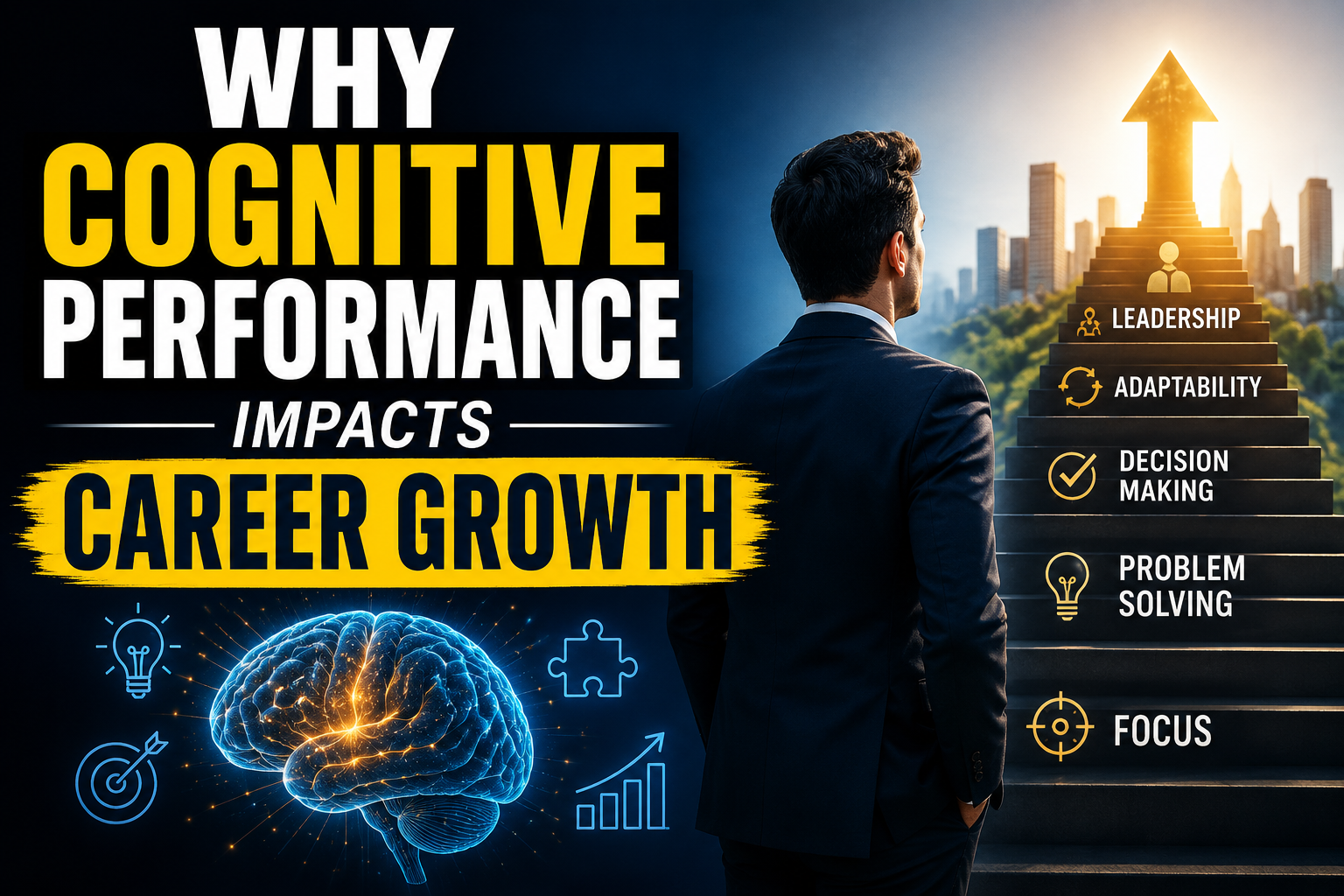
Why Cognitive Performance Impacts Career Growth
Cognitive performance has become one of the most underrated drivers of career growth in modern society. While many people focus on formal education, networking, or years of experience, they often ignore the mental engine that powers all of these advantages. Cognitive performance refers to how well the brain processes information, maintains attention, solves problems, learns new skills, and makes decisions under pressure. In today’s fast changing world of work, this mental capacity has quietly become a major factor that determines who progresses and who remains stagnant in their careers.
At its core, every job involves thinking. Whether someone is writing code, managing clients, analyzing data, selling products, or leading a team, the quality of their thinking directly affects the quality of their output. Employers and markets reward results, not effort. This means that two individuals can spend the same number of hours working, but the one with sharper cognitive performance will consistently produce better decisions, faster solutions, and fewer costly mistakes. Over time, this difference compounds into promotions, salary increases, and leadership opportunities.
One of the clearest ways cognitive performance impacts career growth is through learning speed. The modern workplace evolves rapidly, with new tools, systems, and expectations emerging constantly. Individuals who can quickly understand new information and apply it effectively naturally become more valuable. They require less supervision, adapt faster to change, and can take on more complex responsibilities. On the other hand, those who struggle to process new information tend to fall behind, not necessarily due to lack of effort, but due to slower mental adaptation. In competitive environments, learning speed often matters more than initial knowledge.
Decision making is another critical area where cognitive performance plays a defining role. Careers are built on a series of decisions, both big and small. Choosing the right strategy, responding to challenges, prioritizing tasks, or handling workplace conflicts all require mental clarity and sound judgment. Individuals with strong cognitive performance are better at evaluating risks, identifying patterns, and predicting outcomes. This leads to more effective decisions that benefit not only their personal performance but also the organizations they work for. Over time, such individuals are trusted with greater responsibility because their judgment proves reliable.
Attention and focus also play a major role in career advancement. In an age filled with distractions, the ability to concentrate deeply on a task has become a rare advantage. People with strong cognitive focus can complete complex work with fewer errors and higher quality. They are able to stay mentally engaged long enough to solve difficult problems rather than constantly switching between shallow tasks. This depth of focus leads to mastery, and mastery is one of the strongest predictors of long term career success. Employers naturally gravitate toward individuals who can produce consistent, high quality output without constant supervision.
Memory function further influences how quickly someone progresses in their career. Strong cognitive performance allows individuals to retain and recall information efficiently. This is especially important in roles that require technical knowledge, client history, procedures, or strategic understanding. When someone does not have to repeatedly relearn information, they become faster and more efficient in their work. This efficiency translates into higher productivity, and productivity is one of the key metrics used to evaluate promotions and professional growth.
Problem solving is another area where cognitive performance creates a clear divide between average and exceptional professionals. Every workplace is filled with unexpected challenges, from operational issues to human conflicts and market changes. People with strong cognitive abilities tend to break down problems more effectively, identify root causes faster, and generate practical solutions. They are not easily overwhelmed by complexity because their minds are trained to organize information logically. As a result, they become the individuals others rely on during critical situations, which naturally accelerates their career advancement.
Emotional regulation, which is closely linked to cognitive control, also affects career growth. High cognitive performance allows individuals to manage stress, control impulsive reactions, and maintain rational thinking even in difficult situations. In professional environments, emotional stability is highly valued because it leads to better teamwork, clearer communication, and fewer conflicts. People who can remain calm and think clearly under pressure are often seen as leaders, regardless of their formal title. This perception plays a major role in promotions and leadership selection.
Another often overlooked factor is strategic thinking. Cognitive performance enables individuals to think beyond immediate tasks and understand long term implications. Instead of focusing only on daily responsibilities, they begin to see how their actions fit into larger organizational goals. This ability to think strategically makes them more valuable because they contribute not just as workers, but as contributors to direction and growth. Organizations consistently promote individuals who demonstrate this kind of higher level thinking because it directly impacts success at scale.
Communication is also deeply influenced by cognitive performance. Clear thinking leads to clear expression. When individuals can organize their thoughts efficiently, they communicate ideas more persuasively and accurately. This reduces misunderstandings, improves collaboration, and increases influence within teams. People who communicate well are often perceived as more competent, even if their technical skills are similar to others. Over time, this perception contributes significantly to career advancement opportunities.
Finally, cognitive performance shapes adaptability, which is essential in uncertain economic environments. Industries change, job roles evolve, and entire career paths can shift due to technology or market forces. Individuals with strong cognitive flexibility can adjust their thinking, learn new systems, and reposition themselves when necessary. This adaptability ensures long term career survival and growth, even when external conditions are unstable. Those who lack this mental flexibility often struggle when their industry changes, regardless of their past experience.
In conclusion, cognitive performance is not just an academic concept but a practical force that influences every stage of career growth. It affects how fast people learn, how well they decide, how deeply they focus, how effectively they solve problems, and how strategically they think. While many external factors contribute to success, the internal quality of thinking remains one of the most powerful determinants of professional advancement. Improving cognitive performance through better habits, continuous learning, rest, and mental discipline is therefore not just a personal development goal, but a career strategy.

EarnSmartOnline.com.ng is dedicated to helping readers make smarter financial decisions through practical guides on online income, personal finance, technology, digital business, and wealth creation. Our goal is to provide reliable, easy-to-understand, and actionable content that empowers individuals to earn smarter, build sustainable income streams and achieve long-term financial success.
Recommended: Start Earning Online
- Ultimate Affiliate Marketing Program — learn affiliate marketing with a done-for-you sales system ($15). Check it out
- The Newbie Affiliate Guide — the beginner-friendly starter guide (~$6.68). Check it out
- Easy Dollar Maker — earn in dollars uploading AI images and videos from your phone ($17). Check it out
Disclosure: These are affiliate links. If you buy through them, I may earn a commission at no extra cost to you.



