
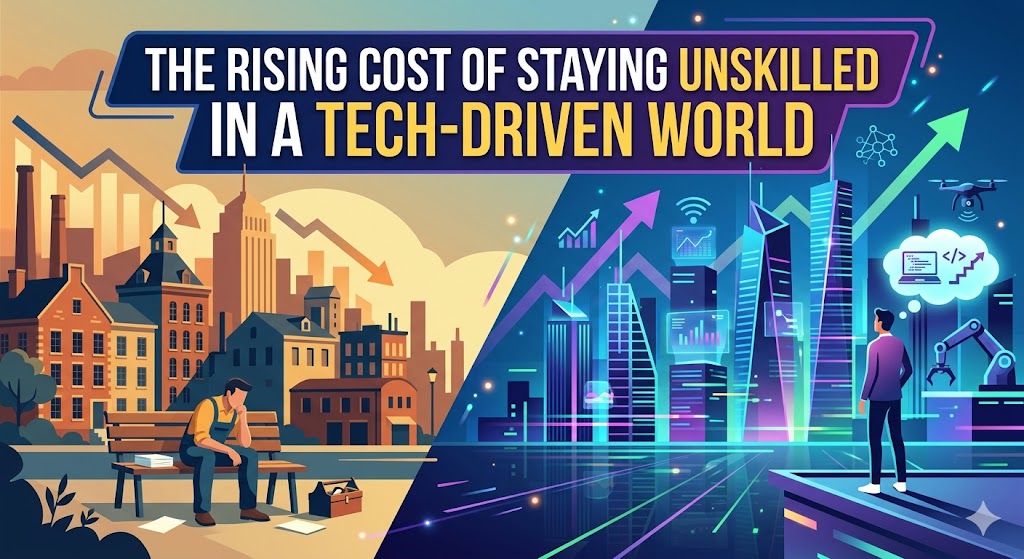
The Rising Cost of Staying Unskilled in a Tech-Driven World
In today’s rapidly evolving world, one of the most expensive positions a person can find themselves in is not debt, unemployment, or lack of opportunity, but the state of being unskilled while technology advances around them. Unlike previous generations where a stable skill set could last for decades, the modern economy is reshaping itself at a speed that quietly punishes stagnation. The cost of not upgrading your abilities is no longer just missed opportunities, it is gradual irrelevance.
Technology is no longer a separate industry that only affects engineers or tech workers. It has become the environment in which every industry operates. From agriculture to healthcare, education to entertainment, retail to finance, every sector is being redefined by automation, artificial intelligence, data systems, and digital platforms. This means that staying in the same level of skill today is not neutral, it is a backward movement. While you remain still, systems around you are improving, optimizing, and replacing manual effort with automated intelligence.
One of the most overlooked realities is that skill value is not absolute, it is relative. A skill is only valuable as long as it solves a problem better, faster, or cheaper than available alternatives. In a tech-driven world, those alternatives are constantly improving. What required human effort yesterday may be handled by software today. What required expertise last year may be handled by a tool this year. This constant shift means that people are not competing against others alone, but also against machines, systems, and evolving digital solutions.
The rising cost of staying unskilled is most visible in the job market. Entry-level roles that once served as stepping stones into careers are disappearing or being transformed into automated processes. Tasks like data entry, basic customer service, simple bookkeeping, and even content creation are increasingly handled by artificial intelligence systems. For individuals who have not developed adaptable or higher-level skills, the number of accessible opportunities shrinks over time. What remains often becomes highly competitive, underpaid, or temporary.
There is also a psychological cost that comes with skill stagnation. As the world advances, individuals who do not evolve begin to feel a growing gap between themselves and the opportunities they observe. This gap often manifests as frustration, anxiety, or a sense of being left behind. The uncomfortable truth is that this feeling is not just emotional, it reflects an economic reality. The market rewards adaptability, and it quietly withdraws rewards from those who fail to adapt.
Another dimension of this cost is income stagnation. In a tech-driven economy, income growth is closely tied to skill growth. When skills remain static, income tends to plateau regardless of effort or hours worked. Many people mistakenly believe that working harder will compensate for lack of new skills, but modern systems reward efficiency and value creation more than raw effort. This is why two individuals working similar hours can experience drastically different financial outcomes, depending entirely on the relevance and scalability of their skills.
The rise of automation further intensifies this gap. Machines do not get tired, do not demand salaries, and continuously improve through updates and data feedback. When a task can be performed by an automated system at a fraction of the cost, the economic incentive to retain human labor for that task diminishes. This does not mean humans become useless, but it does mean that humans who do not upgrade their capabilities become economically vulnerable. The most secure position in such a system is not resistance to technology, but alignment with it.
Education systems also struggle to keep pace with this transformation. Many people enter the workforce with skills that were relevant at the time of learning, but become outdated within a few years. The gap between what is taught and what is required in the real world continues to widen. As a result, self-learning becomes not just an advantage but a necessity. Those who rely solely on formal education without continuous upgrading often find themselves at a disadvantage in dynamic markets.
The cost of staying unskilled also appears in the form of limited mobility. Skilled individuals have options. They can switch industries, work remotely, freelance, or build independent ventures. Unskilled individuals often depend heavily on a narrow range of roles, locations, or employers. This lack of flexibility creates vulnerability, because any disruption in that narrow path can lead to financial instability. In contrast, skill diversity creates resilience, allowing individuals to adapt to changes in demand.
There is a strong connection between skill level and decision-making power. People with higher skill sets tend to have more control over how, when, and where they work. They are not only paid for their labor but for their judgment, expertise, and problem-solving ability. Those with limited skills are more likely to operate under strict instructions, limited autonomy, and lower bargaining power. Over time, this difference compounds into significant disparities in lifestyle, income, and opportunity access.
One of the silent dangers of remaining unskilled is that it often feels comfortable in the short term. Routine requires less mental effort than learning new systems. Familiar tasks feel safer than unfamiliar challenges. However, this comfort gradually becomes costly. While it protects short-term stability, it reduces long-term relevance. The world does not pause for comfort, and systems do not slow down for hesitation. What feels stable today may become restrictive tomorrow.
Digital transformation has also changed how value is distributed. In the past, value was often tied to physical labor or location-based work. Today, value is increasingly tied to digital presence, data understanding, and scalable output. A single individual with the right digital skill can reach millions, automate income streams, or build systems that operate independently of time and geography. Those without these skills remain tied to traditional structures that scale slowly and pay proportionally less.
The most important shift required in this environment is mindset. Skills are no longer static achievements, they are ongoing assets that require maintenance and expansion. The idea of learning once and relying on that knowledge for life is outdated. Instead, continuous learning has become the foundation of economic survival. The ability to learn, unlearn, and relearn is now more valuable than any single skill itself.
Interestingly, the cost of staying unskilled is not always immediate. It often accumulates slowly, almost invisibly. A missed opportunity here, a stagnant salary there, a rejected application somewhere else. Over time, these small gaps form a larger divide that becomes harder to close. This is why many people only realize the impact when they are already far behind, not because they failed in a single moment, but because they failed to evolve over time.
At the same time, the opportunities created by a tech-driven world are enormous for those willing to adapt. The same systems that replace outdated skills also create entirely new industries. Roles in artificial intelligence, digital marketing, cybersecurity, data analysis, software development, content strategy, and automation are expanding rapidly. These are not limited to traditional tech experts alone, but are accessible to anyone willing to invest time in learning.
The real cost of staying unskilled, therefore, is not just financial limitation, but loss of participation in the future economy. It is being present in a world that no longer operates on the same rules you learned. It is watching opportunities evolve while your capabilities remain static. It is gradually becoming a spectator in systems that reward builders, learners, and adapters.
Ultimately, the tech-driven world does not punish people for being unskilled, it simply rewards those who are skilled more aggressively. The gap between both groups widens not because one group is actively pushed down, but because the other is continuously moving forward. In such a system, standing still is the most expensive decision a person can make.
The path forward is not complicated, but it requires intention. It requires accepting that skills are living assets, not permanent possessions. It requires curiosity, discipline, and a willingness to engage with change instead of resisting it. In a world where technology keeps advancing, the greatest risk is not being replaced by machines, but being outpaced by your own refusal to grow.

EarnSmartOnline.com.ng is dedicated to helping readers make smarter financial decisions through practical guides on online income, personal finance, technology, digital business, and wealth creation. Our goal is to provide reliable, easy-to-understand, and actionable content that empowers individuals to earn smarter, build sustainable income streams and achieve long-term financial success.
Recommended: Start Earning Online
- Ultimate Affiliate Marketing Program — learn affiliate marketing with a done-for-you sales system ($15). Check it out
- The Newbie Affiliate Guide — the beginner-friendly starter guide (~$6.68). Check it out
- Easy Dollar Maker — earn in dollars uploading AI images and videos from your phone ($17). Check it out
Disclosure: These are affiliate links. If you buy through them, I may earn a commission at no extra cost to you.



