
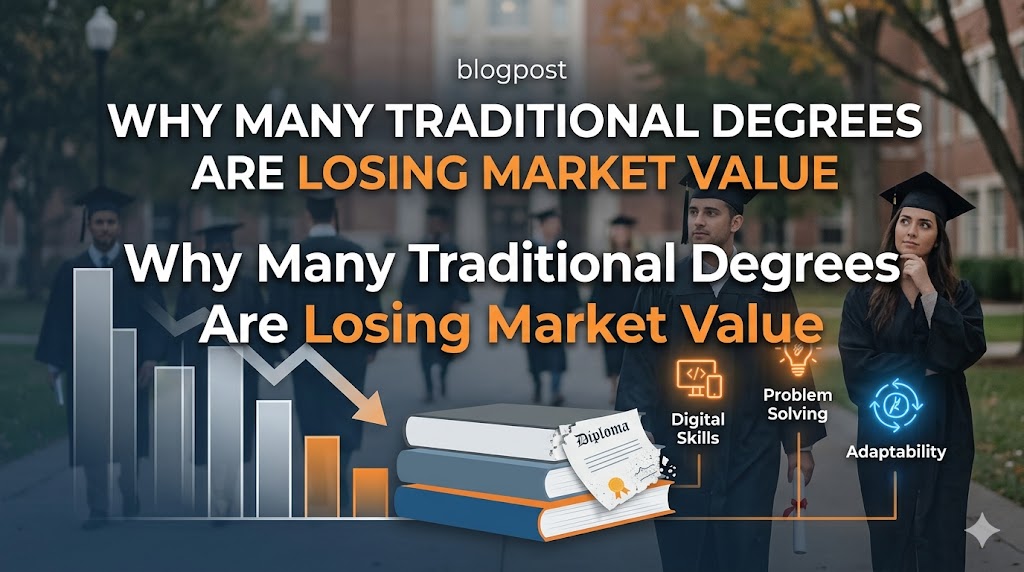
Why Many Traditional Degrees Are Losing Market Value
For decades, a traditional degree was treated like a guaranteed ticket into financial stability. It was almost unquestioned advice: go to school, get a degree, and your future is secured. That belief shaped families, education systems, and entire economies. But today, that promise is being challenged in ways that are hard to ignore. Many graduates are discovering that their certificates do not automatically translate into jobs, income growth, or career security. The value of traditional degrees has not disappeared completely, but it is clearly shifting, and in many cases, declining in practical market relevance.
One major reason for this shift is the speed at which industries now evolve compared to how slowly academic institutions adapt. Universities often operate on fixed curricula that take years to update. Meanwhile, industries change in real time due to technology, automation, and global competition. Skills that were highly relevant five or ten years ago may already be outdated in today’s job market. This creates a gap between what students are taught and what employers actually need. As a result, many graduates enter the workforce with knowledge that is theoretically solid but practically insufficient.
Another important factor is the rise of skill based hiring. More employers are prioritizing what a candidate can actually do over the certificate they hold. In fields like technology, digital marketing, design, and even finance, practical ability often outweighs formal education. A person who can demonstrate real results, such as building applications, managing campaigns, analyzing data, or growing a business, is often preferred over someone who only has academic qualifications. This shift has been accelerated by digital platforms where portfolios, not degrees, are visible proof of competence.
The internet has also democratized learning in a way that was unimaginable in previous generations. Today, almost any skill can be learned online through structured courses, tutorials, communities, and real world practice. Many of these learning paths are faster, cheaper, and more focused than traditional degree programs. While universities still provide foundational knowledge and structure, they are no longer the only gateway to expertise. This has reduced the monopoly that formal education once had over knowledge acquisition.
Another reason traditional degrees are losing market value is the growing mismatch between education and job availability. In many regions, universities produce far more graduates in certain fields than the economy can absorb. This oversupply creates intense competition for limited roles, driving down the perceived value of the degree itself. When thousands of people hold the same qualification but only a fraction can secure relevant employment, the certificate becomes less of an advantage and more of a basic entry requirement.
At the same time, employers are facing pressure to reduce hiring risks. Hiring someone based purely on a degree is no longer seen as reliable. Companies now prefer candidates who have proven experience, internships, freelance work, or project based achievements. This is because real world experience reduces training costs and improves productivity. In contrast, a degree often signals potential rather than proven performance. In a competitive business environment, potential alone is no longer enough.
Technology has also played a major role in reshaping the value of degrees. Automation and artificial intelligence are changing the nature of work itself. Many tasks that once required formal education are now being assisted or replaced by software tools. This reduces the demand for certain traditional roles and increases demand for new hybrid skills that combine technical understanding with adaptability. Unfortunately, many degree programs are not designed to keep pace with these rapid technological shifts.
There is also a growing recognition that soft skills and adaptability matter more than static knowledge. The ability to communicate, solve problems, think critically, and adapt to change is becoming more valuable than memorizing information. Traditional degrees often emphasize theoretical understanding over practical adaptability. While this does not make them useless, it does reduce their dominance as the primary measure of employability.
Another overlooked factor is the rising cost of education. In many parts of the world, obtaining a degree requires significant financial investment, often leading to student debt. When graduates enter the job market and find that their income does not justify the cost of their education, the perceived value of the degree drops sharply. People begin to question whether the return on investment is still worth it compared to alternative learning paths that are more affordable and directly skill focused.
Globalization has also intensified competition in the job market. Employers are no longer limited to local talent pools. Remote work and digital collaboration mean that companies can hire skilled individuals from anywhere in the world. This increases competition for graduates holding traditional degrees, especially when others without degrees but with stronger practical skills are competing globally. The advantage of simply having a certificate is therefore reduced in a borderless labor market.
Despite all these changes, it is important to understand that degrees have not become meaningless. They still hold value in certain professions such as medicine, law, engineering, and academia, where structured education and certification are essential. However, outside these regulated fields, the degree is no longer the dominant factor determining career success. It has become one of many possible pathways rather than the only respected route.
Another subtle but powerful change is how employers now evaluate continuous learning. In fast moving industries, what matters is not what you learned years ago, but what you are learning now. Someone who continuously upgrades their skills, adapts to new tools, and stays updated with industry trends is often more valuable than someone who stopped learning after graduation. Traditional degrees represent a fixed point in time, while modern careers demand continuous evolution.
The rise of entrepreneurship and digital income opportunities has also shifted perceptions. Many individuals are building successful careers through freelancing, content creation, online businesses, and remote services without relying on formal degrees. These paths reward execution, creativity, and problem solving rather than academic credentials. As more success stories emerge outside traditional systems, the perceived necessity of degrees continues to weaken.
It is also worth noting that information is no longer scarce. In the past, universities were primary gatekeepers of structured knowledge. Today, knowledge is widely available and often free or low cost. The true challenge is no longer access to information but the ability to apply it effectively. This shift reduces the exclusive advantage that degrees once provided in controlling access to knowledge.
However, the decline in market value of traditional degrees should not be misunderstood as the end of education. Instead, it reflects a transformation in what education means in the modern world. Education is becoming more decentralized, more practical, and more aligned with real world application. The focus is shifting from credentials to competence, from theory to execution, and from static learning to continuous growth.
In this new environment, individuals who combine formal education with practical skills tend to perform best. A degree alone is no longer enough, but it can still be powerful when paired with experience, adaptability, and strong skill development. The key is not to reject traditional education, but to understand its limitations and supplement it with real world capability.
Ultimately, the market is sending a clear message. Value is no longer defined by certificates but by contribution. What matters most is not where you studied, but what you can do, how well you can adapt, and how effectively you can solve problems in a constantly changing world. Traditional degrees are not disappearing, but their role is being redefined. They are no longer the final destination of success, but just one step in a much larger and more dynamic journey.

EarnSmartOnline.com.ng is dedicated to helping readers make smarter financial decisions through practical guides on online income, personal finance, technology, digital business, and wealth creation. Our goal is to provide reliable, easy-to-understand, and actionable content that empowers individuals to earn smarter, build sustainable income streams and achieve long-term financial success.
Recommended: Start Earning Online
- Ultimate Affiliate Marketing Program — learn affiliate marketing with a done-for-you sales system ($15). Check it out
- The Newbie Affiliate Guide — the beginner-friendly starter guide (~$6.68). Check it out
- Easy Dollar Maker — earn in dollars uploading AI images and videos from your phone ($17). Check it out
Disclosure: These are affiliate links. If you buy through them, I may earn a commission at no extra cost to you.



