
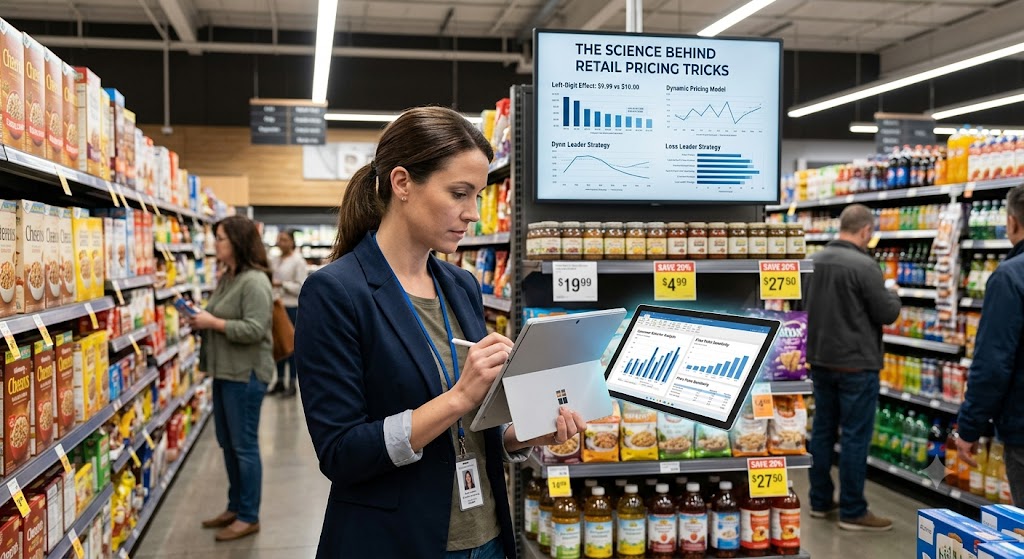
The Science Behind Retail Pricing Tricks is one of the most fascinating parts of modern consumer psychology because the price you see on a product is rarely just a number. Retailers understand that people do not always make purchasing decisions based purely on logic. We respond to presentation, comparison, urgency, familiarity, perceived value and even the way numbers are written. A product priced at £9.99 can feel significantly cheaper than one priced at £10, even though the difference is only one penny. A £100 product displayed next to a £200 alternative can suddenly appear affordable. A “limited time offer” can make someone purchase something they never planned to buy. These reactions are not necessarily signs of poor judgement. They are examples of predictable psychological responses that retailers have studied and refined for decades.
The science behind retail pricing tricks begins with a simple reality about human decision making. Consumers rarely know the exact economic value of every product they encounter. When you walk into a supermarket, browse an online shop or enter a clothing store, you usually do not have perfect information about what everything should cost. Instead, your brain looks for shortcuts. Psychologists call these shortcuts heuristics. They allow us to make decisions quickly without analysing every piece of information. Retailers understand these shortcuts and use pricing strategies designed to influence how customers perceive value.
One of the most famous examples is charm pricing, where products are priced at figures such as £4.99, £19.99 or £99.99 instead of £5, £20 or £100. This may appear insignificant, but the first digit can have a powerful influence on perception. When people see £19.99, their minds often process the price beginning with 19 rather than 20. The product therefore feels psychologically closer to £19 than £20, even though the actual difference is just one penny. This is sometimes called the left digit effect. The brain tends to give disproportionate attention to the first number because it is processed earlier.
The effectiveness of prices ending in 9 has been studied extensively in marketing and consumer behaviour. While the impact is not identical in every situation, the strategy can work particularly well when consumers are looking for bargains or comparing several similar products. A retailer selling a shirt for £29.99 may create a stronger perception of affordability than another retailer selling a similar shirt for £30. The difference is financially tiny, but psychologically meaningful.
Another powerful technique is price anchoring. This happens when a retailer presents a higher price first, creating a reference point against which another price is judged. Imagine seeing a television originally priced at £1,500 and now available for £999. The £999 price may appear attractive because your brain has already encountered £1,500 as an anchor. Without that comparison, you might consider £999 expensive. With the anchor, the same price can suddenly feel like a bargain.
Anchoring is not limited to discounts. Retailers can place several products together so that one expensive product influences how customers perceive the others. Suppose a shop sells three coffee machines for £80, £150 and £300. The £300 machine may not sell frequently, but its presence can make the £150 machine appear reasonably priced. Without the £300 option, customers might consider £150 expensive. The expensive product becomes a psychological reference point.
This is one reason businesses sometimes deliberately offer premium products that appear overpriced compared with their main products. The purpose may not be to sell large numbers of the premium option. Instead, the premium product can change the perceived value of the middle option. This is commonly associated with the decoy effect, where an additional choice influences consumers towards a particular option.
Imagine a subscription service offering a basic plan for £8, a standard plan for £15 and a premium plan for £30. If the standard plan offers considerably more features than the basic plan while remaining much cheaper than premium, customers may feel that standard represents excellent value. The retailer has effectively designed the choice architecture to make one option stand out.
The science behind retail pricing tricks also involves the way consumers compare prices. People rarely evaluate a price in isolation. Instead, they ask whether the price seems cheap or expensive compared with something else. This is why retailers frequently display “was” and “now” prices, competitor comparisons, bundle prices and savings percentages.
Percentage discounts are particularly powerful because consumers can react differently to the same numerical information depending on how it is presented. Saying that a product has been reduced from £100 to £80 communicates a £20 saving. Saying “20 percent off” communicates the same mathematical reality. Yet different customers may respond differently depending on which representation feels more significant.
The Science Behind Retail Pricing Tricks
Retailers also use bundles to influence perceived value. A customer may hesitate to spend £60 on a single product but feel comfortable spending £60 on a package containing five related products. The total amount of money leaving the customer’s account is the same, but the perceived value is different. Bundling changes the mental calculation from “How much am I paying?” to “How much am I getting?”
This connects to the concept of perceived value. Price is only one part of the purchasing decision. Consumers constantly weigh price against benefits, convenience, status, quality, emotional satisfaction and expected usefulness. A £200 pair of shoes may seem expensive to one person and completely reasonable to another. The difference may have nothing to do with the shoes themselves. It may come from income, personal preferences, previous experiences and the value the customer associates with the brand.
Retailers therefore attempt to influence not only the price but also the story surrounding the price. A product described as “premium”, “professional”, “handcrafted” or “limited edition” can command a higher price because those words create associations with quality and exclusivity. Consumers often use price itself as a signal of quality. If two products appear similar but one costs significantly more, some shoppers may assume the expensive one must be better.
This creates an interesting psychological phenomenon known as the price quality relationship. In situations where consumers cannot easily evaluate quality before purchasing, price can become a shortcut for judging quality. A £50 bottle of perfume may be perceived as more luxurious than a £10 bottle, even before anyone smells either product. A £2,000 watch may communicate status in a way that a £100 watch does not. The higher price becomes part of the product’s psychological appeal.
Retailers also understand the importance of scarcity. When customers believe that an opportunity may disappear, they often assign greater value to it. Messages such as “only three left”, “sale ends tonight” or “limited stock available” can create urgency. Scarcity can reduce the amount of time consumers spend considering whether they actually need the product.
Urgency is particularly powerful online because digital retailers can display countdown timers, stock indicators and temporary promotions. A customer who might have thought about buying something tomorrow may purchase it immediately because the website suggests that waiting could mean losing the opportunity.
However, consumers should distinguish between genuine scarcity and artificial urgency. Real limited stock can be useful information. But when scarcity messages are exaggerated or repeatedly reset, they can become psychological pressure rather than meaningful information. Understanding the science behind retail pricing tricks helps consumers recognise this distinction.
Another strategy involves placing products in the right physical location. Retailers know that product placement affects what customers notice. Items positioned at eye level often receive more attention than products placed on lower shelves. High margin products may be positioned where shoppers are most likely to see them. Supermarkets can also place attractive or convenient items near checkout areas because customers are already in a purchasing mindset.
This is closely connected to impulse buying. An impulse purchase occurs when someone buys something without having planned to do so. The product may be inexpensive enough that the customer does not feel the need to think carefully about the decision. Chocolate, chewing gum, drinks, small accessories and other convenience items are frequently positioned in areas where customers are waiting.
The psychology becomes even more interesting when retailers use “small” prices to encourage larger purchases. A customer may enter a store intending to spend £20 and leave having spent £70 because several individual purchases felt insignificant. A £4 accessory does not seem financially threatening. Another £6 item may also feel harmless. Then another £8 purchase gets added. Individually, each decision appears small. Collectively, they create a substantial bill.
This is partly related to mental accounting. People mentally organise money into categories and may treat different amounts differently. Someone who would never consciously decide to spend £50 on a random item may nevertheless spend £5 ten times without feeling that they have made a £50 decision.
Retailers also use payment methods to reduce the psychological pain associated with spending. When customers pay with cash, they physically hand over money and can see it disappear. Digital payments can feel less tangible. Buy now, pay later services can reduce the immediate psychological impact even further because the consumer focuses on the instalment rather than the total cost.
This is why understanding the total price remains important. A product advertised as “only £25 per month” may sound affordable, but the consumer should calculate the full amount payable over the entire agreement. The smaller monthly number can become an anchor that hides the larger financial commitment.
Another retail pricing technique involves the use of round numbers. Interestingly, prices ending in .99 are not always the most effective option. The emotional context of the purchase matters. Research in consumer psychology suggests that round prices can sometimes work better for products associated with feelings, luxury or simplicity, while precise prices can be more persuasive in situations involving careful evaluation. A £100 luxury experience may feel elegant and straightforward, whereas £99.99 can communicate a bargain.
This demonstrates an important principle: pricing psychology is not a single trick that works everywhere. The effectiveness of a pricing strategy depends on the product, customer, purchasing environment and emotional state of the buyer.
Retailers also use reference prices that customers bring with them from previous experiences. If you regularly buy a certain brand of cereal for £3, you may consider £5 expensive. But if you normally purchase premium cereal for £6, the same £5 price could feel reasonable. Your previous experience creates an internal reference point.
This is why discounts can become less impressive when customers become accustomed to them. If a retailer constantly advertises products as 30 percent off, customers may eventually stop seeing the original price as meaningful. The discounted price becomes the expected price. In some cases, the consumer may even suspect that the “original” price exists mainly to make the sale price look attractive.
Another psychological factor is loss aversion. Humans tend to experience losses more strongly than equivalent gains. Losing £20 can feel worse than gaining £20 feels good. Retailers can use this tendency by framing promotions around what customers might lose if they do not act. A message saying “Save £30 today” communicates a gain. A message suggesting “Don’t miss your £30 saving” introduces the possibility of loss. Both may refer to the same promotion, but the second can create greater urgency for some consumers.
Retailers also understand the power of social proof. When a product is labelled “best seller”, “most popular” or “customer favourite”, shoppers may become more comfortable choosing it. The price can seem more reasonable because other people appear to have accepted it. Online reviews, sales rankings and popularity indicators can therefore influence the perceived value of a product.
The same principle appears in restaurant menus. Restaurants often use menu design to influence how customers perceive prices. Expensive dishes can establish an anchor, while strategically positioned dishes can attract attention. The presentation of prices may also affect how strongly customers focus on the cost. When the price becomes visually dominant, consumers may become more price conscious. When attention is directed towards descriptions and experiences, they may focus more heavily on value.
The science behind retail pricing tricks is ultimately about understanding how humans perceive value rather than simply how businesses calculate costs. A retailer may know exactly how much it costs to manufacture, transport and display an item, but the final selling price depends heavily on what customers believe the item is worth.
This is why two businesses can sell similar products at dramatically different prices. One may compete primarily on affordability while another sells the same basic function through branding, packaging, customer experience and perceived status. Consumers are not simply buying physical objects. They are often buying convenience, confidence, identity, emotion and expectation.
Branding can therefore make pricing psychology even more powerful. When customers trust a brand, they may require less evidence before accepting a higher price. Familiarity reduces uncertainty. A shopper may willingly pay more for a familiar brand because they believe the risk of disappointment is lower.
Retailers also take advantage of comparison shopping. Online marketplaces make it easier than ever to compare prices, but they have also created more sophisticated pricing environments. Algorithms can adjust prices based on demand, inventory, timing and market conditions. Consumers may therefore encounter different prices at different times.
Dynamic pricing is particularly common in industries where demand changes rapidly. Travel, accommodation, entertainment and online services may use variable pricing. A price that appears today may not be available tomorrow. This makes it even more important for consumers to distinguish between genuine market changes and psychological pressure.
The good news is that understanding pricing psychology does not mean you must avoid every sale or assume every retailer is manipulating you. These techniques are simply tools. Some are perfectly legitimate ways of communicating value, while others can be used in ways that encourage unnecessary spending. The key is awareness.
One of the simplest ways to protect yourself is to decide your budget before entering a shopping environment. Once you have established how much you are prepared to spend, pricing tricks become less powerful because you have already created your own reference point. Instead of allowing the retailer to determine your anchor, you establish one yourself.
Another useful strategy is to compare the final price rather than the advertised discount. A product being “50 percent off” does not automatically make it good value. Ask what the product costs elsewhere, whether you actually need it and whether you would have bought it without the discount.
It is also useful to calculate bundle prices individually. A package can look attractive because it contains several products, but sometimes you are paying for items you would never have purchased separately. The number of things included does not automatically determine value.
When faced with countdown timers or limited stock messages, pause before buying. If the product is genuinely valuable to you, it will still be valuable after you take a few minutes to think. Creating a short pause can break the emotional momentum that retailers deliberately create.
You should also pay attention to subscription pricing. A low introductory price may become much higher after the promotional period. Always check renewal prices, cancellation requirements and the total cost over time. The cheapest price today may not be the cheapest arrangement overall.
The deeper lesson from the science behind retail pricing tricks is that shopping decisions are influenced by psychology long before money changes hands. The number itself is only one part of the message. The surrounding information tells your brain how to interpret that number.
A £99 product can feel cheap when compared with £200. The same £99 product can feel expensive when compared with £50. A £30 product can feel luxurious when surrounded by £10 products, or ordinary when surrounded by £100 products. The meaning of a price depends heavily on context.
Once you understand this, you become a more deliberate consumer. You begin asking better questions. Is this actually cheap, or does it only look cheap next to a higher price? Am I buying because I need the product, or because I am afraid of missing the offer? Is this genuinely good value, or am I being influenced by the number of items in the bundle? Would I still buy this if the countdown timer disappeared?
These questions are powerful because they shift control back towards the customer.
The science behind retail pricing tricks is therefore not simply a story about businesses persuading people to spend money. It is a lesson in human behaviour. Retailers study attention, perception, emotion, comparison, memory and decision making because these factors influence purchasing behaviour. Once consumers understand those same principles, they can make better decisions.
The next time you see £19.99 instead of £20, a huge percentage discount, a premium option beside a standard product, a countdown timer or a “limited stock” message, take a moment to recognise what is happening. You are not merely looking at a price. You are looking at a carefully constructed piece of psychological communication.
The smartest consumer is not necessarily the person who always buys the cheapest product. It is the person who understands why a price feels attractive before deciding whether it actually represents value. Retail pricing tricks become far less powerful when you know how they work. And in a marketplace designed to capture your attention, influence your emotions and encourage you to spend, awareness may be one of the most valuable forms of financial intelligence you can develop.

EarnSmartOnline.com.ng is dedicated to helping readers make smarter financial decisions through practical guides on online income, personal finance, technology, digital business, and wealth creation. Our goal is to provide reliable, easy-to-understand, and actionable content that empowers individuals to earn smarter, build sustainable income streams and achieve long-term financial success.
Recommended: Start Earning Online
- Ultimate Affiliate Marketing Program — learn affiliate marketing with a done-for-you sales system ($15). Check it out
- The Newbie Affiliate Guide — the beginner-friendly starter guide (~$6.68). Check it out
- Easy Dollar Maker — earn in dollars uploading AI images and videos from your phone ($17). Check it out
Disclosure: These are affiliate links. If you buy through them, I may earn a commission at no extra cost to you.



