
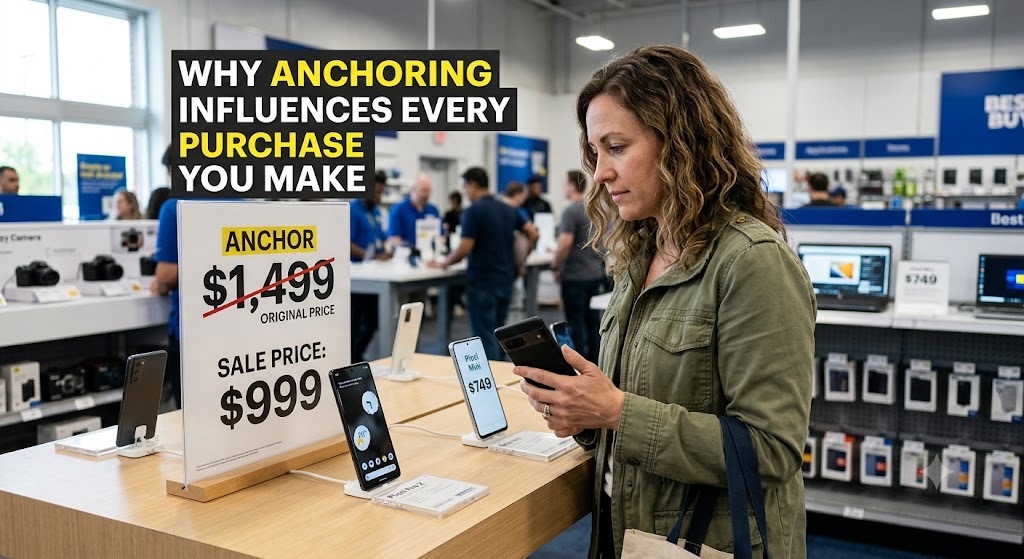
Why Anchoring Influences Every Purchase You Make is a question that reveals something fascinating about the way human beings think about money. Most people believe they make purchasing decisions by comparing products, checking quality, considering their budgets and deciding whether something is genuinely worth the price. In reality, the mind often makes that decision long before the logical evaluation begins. One of the strongest psychological forces behind this behaviour is anchoring.
Anchoring is a psychological bias that occurs when people rely heavily on the first piece of information they encounter when making a decision. When it comes to money, that first piece of information is frequently a price. Once a price becomes established in your mind, it can influence how you perceive every price that comes afterwards. A product originally presented as £500 may suddenly seem inexpensive when reduced to £300, even if £300 is still far more than you intended to spend. The original £500 has become the anchor.
This is one reason retailers carefully think about the prices they display. A customer may walk into a shop with no clear idea of what a particular product should cost. The retailer then presents a product at £1,000 and immediately places another similar product beside it for £700. The £700 product may suddenly feel affordable. Without the £1,000 reference point, the customer might have considered £700 extremely expensive. The first price changed the way the second price was interpreted. Why Anchoring Influences Every Purchase You Make
This explains why understanding why anchoring influences every purchase you make is important for anyone who wants to become more financially conscious. Anchoring does not necessarily mean that businesses are manipulating customers dishonestly. Pricing, discounts and comparisons are normal parts of commerce. The problem occurs when consumers fail to recognise how strongly their perception of value can be shaped by an arbitrary reference point.
Imagine seeing a jacket marked at £250 with a large sign showing that it has been reduced to £120. Your immediate reaction might be that you are getting a bargain. You may even feel that failing to buy the jacket means missing an opportunity. But stop and ask a different question. If the jacket had been displayed at £120 from the beginning, would you still consider it a good purchase? That question removes the anchor and forces you to evaluate the product based on its actual usefulness and quality.
The original £250 price may have little relevance to the actual value of the jacket. It could have been a genuine previous selling price, a recommended retail price or simply a reference price designed to establish a comparison. Yet your brain may treat the £250 as evidence that the jacket is worth £250. Consequently, £120 feels like a victory.
Anchoring becomes particularly powerful because human beings rarely have unlimited time, information or mental energy. Every day, we make countless decisions. We cannot research every product, compare every alternative and calculate the perfect price before buying something. The brain therefore uses shortcuts. Anchoring is one of those shortcuts.
When you see a number first, your mind often uses it as a starting point. Any subsequent number is judged in relation to it. This happens even when the original number has little logical connection to the decision you are making. Why Anchoring Influences Every Purchase You Make
Consider a restaurant menu. You open the menu and see a premium steak priced at £90. You then notice another steak at £45. Suddenly, £45 may seem reasonable. If the £90 steak were absent, you might have looked at the £45 meal and considered it expensive. The expensive item may never have been intended to become your choice. Its presence can establish a reference point that makes another option appear more attractive.
This is why menus frequently contain premium options. They can influence the perceived value of the alternatives around them. The customer does not necessarily need to purchase the most expensive item. The expensive item can simply change the psychological landscape of the decision.
Anchoring can also influence how you perceive sales. Retailers frequently display an original price beside a discounted price because the difference between the two numbers creates a powerful psychological signal. Seeing £200 crossed out beside £99 can make £99 feel dramatically cheaper. Your brain immediately focuses on the apparent saving.
The danger is that people sometimes become more interested in the size of the discount than the value of the product itself. Saving £101 on something you do not need is not the same as making £101. Yet the emotional excitement of getting a discount can make unnecessary spending feel financially responsible.
This is one of the most important lessons about anchoring and personal finance. A discount does not automatically create value. A lower price is only financially beneficial when the product is useful to you and the price is reasonable compared with realistic alternatives. Why Anchoring Influences Every Purchase You Make
Anchoring can influence purchases long before you reach the checkout. Advertisements often establish prices in advance. A company may tell you that a product normally costs £1,500 and is currently available for £999. By the time you begin comparing products, £999 has already been framed as a bargain.
Why Anchoring Influences Every Purchase You Make
Another company might offer a similar product for £750 without advertising a dramatic discount. Which one feels cheaper? Many consumers instinctively choose the £999 product because the comparison is not simply £999 versus £750. Instead, the mind may process the first product as £1,500 versus £999 and the second as £750 versus £750. The first product appears to offer a larger financial victory even though it costs more.
Anchoring is not limited to physical shopping. It appears everywhere money is involved.
When negotiating a salary, the first number mentioned can become an anchor. If an employer says the position pays £35,000, that number can influence the rest of the negotiation. If the candidate had intended to ask for £45,000, the £35,000 anchor might make £40,000 feel ambitious. Conversely, if the candidate states £50,000 first and has strong justification, the employer may begin negotiating around that figure.
The same principle appears when buying property. A house may initially be listed for £500,000 and later reduced to £450,000. Potential buyers may perceive £450,000 as attractive because they are comparing it with £500,000. However, the more useful question is whether the property is actually worth £450,000 based on location, condition, comparable properties and market conditions.
The £500,000 figure may have influenced the buyer’s expectations before the buyer ever investigated those factors.
Car dealerships provide another familiar example. A vehicle may have a manufacturer’s suggested retail price of £40,000 but be advertised at £34,000. The buyer sees £6,000 in apparent savings. Yet another vehicle offering similar functionality might cost £28,000. The £34,000 car may still feel like the better deal because the discount creates a strong anchor.
This is why financially intelligent consumers need to separate price comparison from value assessment. Price tells you how much money leaves your pocket. Value asks what you receive in return.
Anchoring can also influence everyday purchases that appear too small to matter. A coffee originally priced at £5 and reduced to £3 may seem like a bargain. A subscription originally shown at £20 per month and temporarily reduced to £12 may seem inexpensive. A mobile phone accessory displayed at £30 and reduced to £18 may feel like an opportunity.
Individually, these purchases may seem insignificant. Collectively, however, they can become a serious source of unnecessary spending.
Anchoring can become especially dangerous when combined with scarcity and urgency. A customer sees a product originally priced at £200, now available for £100, with a message saying only two remain. The mind is confronted with three psychological signals at once. The original price establishes the anchor. The discount creates the perception of a gain. The scarcity message creates fear of losing the opportunity.
The result can be an emotional decision rather than a financial one.
This is why one of the most effective ways to protect yourself from anchoring is to create your own reference point before shopping. Instead of allowing the seller to tell you what something should cost, research the typical market price before making the purchase. Check several sellers. Look at comparable products. Consider the features you actually need. Decide what you are willing to pay before you become emotionally attached to the product.
Once you establish your own reference point, external anchors become less powerful.
Suppose you need a laptop. Instead of browsing randomly and allowing every advertised price to influence you, determine what you actually need. Perhaps you decide that you need a reliable laptop for work, browsing and basic software. You research several models and discover that similar specifications commonly fall between £500 and £700. Now, when you see a laptop advertised as £1,200 reduced to £750, your perception changes. The £750 price no longer automatically feels like a bargain because your independent reference point is between £500 and £700.
This simple process can save money because it changes the question from “How much am I saving?” to “How much should I reasonably pay?”
Another effective strategy is to delay purchases when you notice yourself feeling unusually excited about a discount. Emotional urgency often strengthens the effect of anchoring. When your brain sees a large apparent saving, it wants to act quickly. Waiting gives the emotional response time to weaken.
Ask yourself whether you would still buy the item tomorrow if the discount disappeared. If the answer is no, you may be responding more strongly to the discount than to the product.
It is also useful to remove the original price mentally. Look only at the amount you are actually being asked to pay. Then ask whether you would consider that amount reasonable if no previous price were displayed.
A £90 shirt does not become a good purchase simply because someone tells you it used to cost £180. A £500 television does not automatically become affordable because its original price was £800. A £30 meal does not become cheap because another meal on the menu costs £60.
The original number is information, but it is not necessarily evidence of value.
Anchoring can even affect how people evaluate financial success. Someone may believe they are doing well because they increased their income from £25,000 to £40,000. Someone else earning £80,000 may feel unsuccessful because they previously earned £120,000. In both cases, the reference point influences the emotional interpretation of the current situation.
This demonstrates that anchoring is not only a shopping phenomenon. It is part of a broader psychological pattern in which people evaluate present circumstances against previously established numbers.
The same thing happens with investments. An investor may buy a share at £50 and watch it fall to £30. The investor might refuse to sell because £30 feels cheap compared with the £50 purchase price. But the original £50 may be irrelevant to the company’s current prospects. The investor’s purchase price has become an anchor.
This can lead to poor decisions because the investor may ask, “How can I sell at £30 when I bought at £50?” instead of asking, “If I had £30 in cash today, would I buy this investment?”
That distinction is powerful.
The past price is not necessarily the current value. Money already spent is gone. Decisions should generally be based on what is likely to happen from this point forward, not simply on the emotional desire to return to an old number.
Anchoring can therefore affect both spending and investing because humans naturally compare the present with something that came before.
Businesses understand this psychological tendency, which is why pricing strategy is such an important part of marketing. Companies can influence perceived value by carefully choosing which products, prices and comparisons customers see first.
This does not mean every discount is fake or every premium product exists merely to manipulate consumers. It means that consumers should understand the psychological environment in which purchasing decisions occur.
The more aware you become of anchoring, the easier it becomes to pause before buying.
One practical technique is to establish three numbers before making an important purchase. Determine what you ideally want to pay, what you consider a reasonable maximum and what price would make you walk away. This gives you your own anchors. Why Anchoring Influences Every Purchase You Make
For example, you might decide that you would ideally pay £600 for a particular product, that £700 is your maximum and that anything above £700 is unacceptable. If a seller tells you that the product was previously £1,000 but is now £750, the £1,000 figure becomes much less powerful because you already established your own limit.
This approach is especially valuable when negotiating. Instead of allowing someone else’s opening offer to determine the entire conversation, you enter with your own research and expectations.
Understanding why anchoring influences every purchase you make does not mean you should become suspicious of every price tag. The goal is not to eliminate psychological influences from shopping because that would be unrealistic. The goal is to become aware of them.
Every consumer is influenced by context. The colour of a sale sign, the position of a product on a shelf, the words used in an advertisement, the first price displayed and the number of alternatives available can all affect perception.
Financial intelligence therefore involves more than knowing how to earn, save and invest money. It also involves understanding how your own mind behaves around money.
A person can have a good income and still make poor financial decisions if they consistently fall for psychological triggers. Someone earning less may actually build greater financial security by carefully questioning purchases, resisting emotional discounts and evaluating value independently.
The next time you see something advertised as £100 reduced to £60, do not immediately celebrate the £40 saving. Ask whether you would willingly spend £60 if there were no £100 price attached.
The next time a restaurant presents a £100 meal beside a £50 meal, ask whether the £50 meal is genuinely worth £50.
The next time a salesperson tells you that a product normally costs £2,000 but you can have it today for £1,200, ask what comparable products cost elsewhere.
The next time you negotiate a salary, contract or purchase, consider who introduced the first number and whether that number deserves to influence you.
These small questions can dramatically improve financial decision making.
Ultimately, why anchoring influences every purchase you make comes down to one simple reality: human beings rarely judge numbers in isolation. We judge them relative to something. The first number we encounter can quietly become the standard against which everything else is measured.
Once you understand this, you begin to see shopping differently. A discount is no longer automatically a bargain. A high original price is no longer automatic proof of value. A low price is not automatically affordable. And an expensive alternative may not necessarily be expensive simply because it is positioned beside an even more expensive option.
The strongest consumer is not necessarily the person who always finds the lowest price. It is the person who can decide what something is worth without allowing someone else to decide that value on their behalf.
Anchoring will continue to influence consumers because it is deeply connected to the way the human mind processes information. Businesses will continue to use prices, comparisons and reference points because they are effective tools for communicating value and encouraging purchases. The difference is that once you understand the psychology, you have a better chance of recognising when your judgement is being influenced.
Your goal is not to stop buying things. Your goal is to stop letting the first number you see make the decision for you.
Before you buy, pause. Ignore the excitement. Ignore the giant discount sign for a moment. Ignore the crossed out price. Ignore the pressure to act immediately. Look at the actual product, the actual price and the actual usefulness to your life.
Then ask the question that can protect your wallet from one of the oldest tricks of human decision making: “If I had never seen the original price, would I still believe this is worth buying?”
That single question can turn an impulsive shopper into a more conscious consumer. It can help you recognise the difference between a genuine bargain and a carefully constructed perception of one. More importantly, it can remind you that the value of your money should not be determined by the first number placed in front of your eyes.
Understanding anchoring is therefore not simply about becoming better at shopping. It is about becoming more aware of your own mind. And when you understand how your mind reacts to money, prices and perceived bargains, you become much harder to persuade into spending money on something simply because somebody else told you what it was worth.

EarnSmartOnline.com.ng is dedicated to helping readers make smarter financial decisions through practical guides on online income, personal finance, technology, digital business, and wealth creation. Our goal is to provide reliable, easy-to-understand, and actionable content that empowers individuals to earn smarter, build sustainable income streams and achieve long-term financial success.
Recommended: Start Earning Online
- Ultimate Affiliate Marketing Program — learn affiliate marketing with a done-for-you sales system ($15). Check it out
- The Newbie Affiliate Guide — the beginner-friendly starter guide (~$6.68). Check it out
- Easy Dollar Maker — earn in dollars uploading AI images and videos from your phone ($17). Check it out
Disclosure: These are affiliate links. If you buy through them, I may earn a commission at no extra cost to you.



