
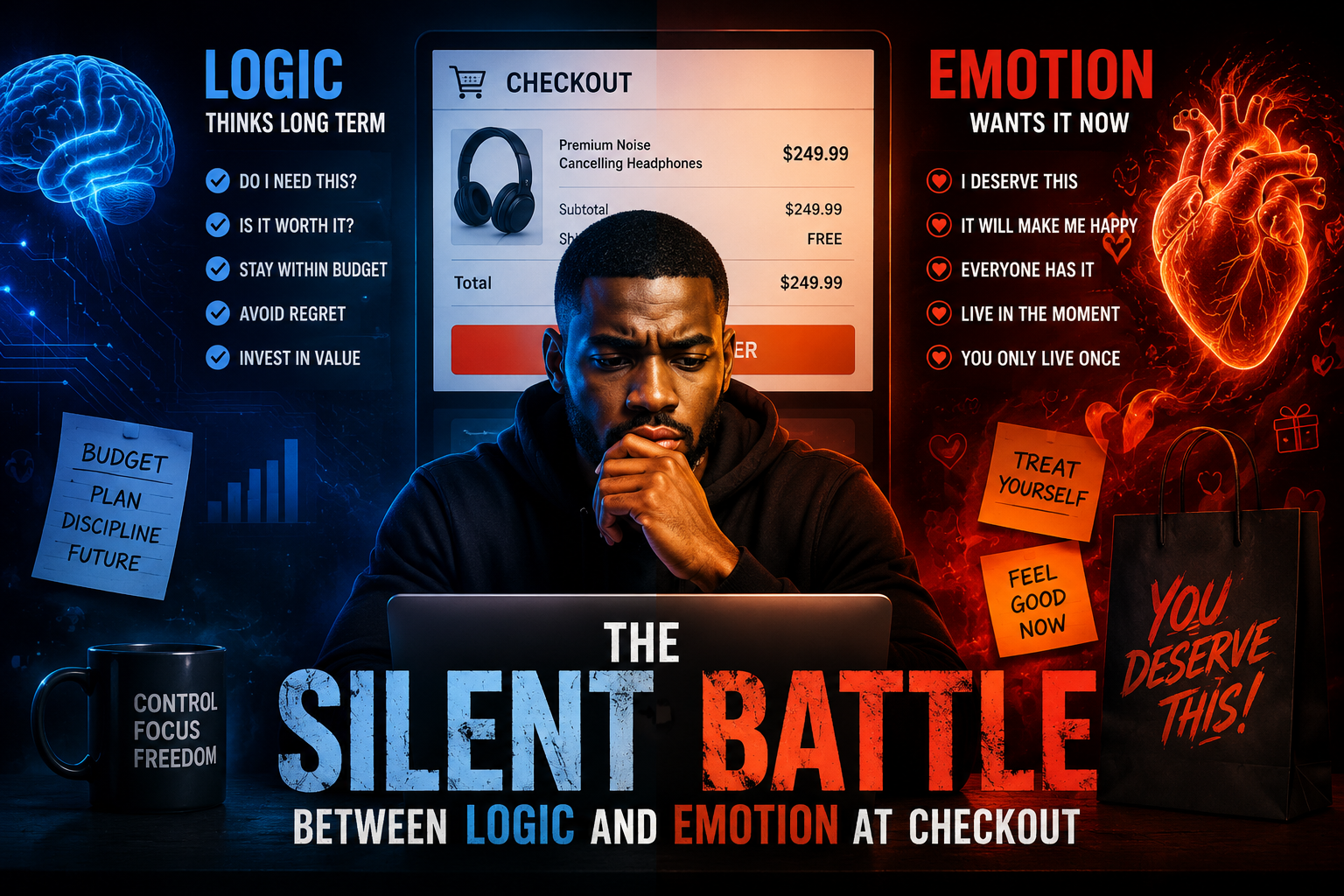
The Silent Battle Between Logic and Emotion at Checkout
There is a battle that takes place every single day in supermarkets, shopping malls, online stores, car dealerships, electronics shops, fashion boutiques, and even at roadside markets. It is a battle so quiet that most people never realize it is happening. It lasts only a few seconds, yet it has the power to determine whether someone builds wealth or remains trapped in financial frustration. It is the silent battle between logic and emotion at checkout.
Every purchase you have ever made has been influenced by one of these two forces. Logic asks questions. Emotion gives answers. Logic wants evidence. Emotion wants satisfaction. Logic considers the future. Emotion lives in the present. Logic calculates value. Emotion chases feelings. While both have important roles in human life, problems begin when emotion consistently defeats logic every time money is involved.
This hidden conflict explains why intelligent people sometimes make surprisingly poor financial decisions. It explains why someone who understands budgeting still overspends. It explains why individuals who promise themselves they will only buy what they need often leave stores carrying far more than they intended. It explains why people regret purchases just hours after making them. The issue is rarely a lack of intelligence. More often, it is the simple reality that emotions are faster than logic.
Modern businesses understand this better than consumers do. Entire industries spend billions of dollars studying how people think, feel, react, hesitate, and eventually make purchasing decisions. Every colour, every product placement, every discount banner, every countdown timer, every carefully chosen word has one purpose: to encourage emotion to make the final decision before logic has enough time to object.
Consider how online shopping has transformed buying behaviour. Years ago, purchasing something required planning. People travelled to stores, compared prices, carried cash, and often thought carefully before spending. Today, a single tap completes a transaction within seconds. The easier purchasing becomes, the less opportunity logic has to intervene. Convenience has become one of the strongest emotional triggers ever created.
This explains why impulse buying continues to rise despite greater access to financial education. Information alone cannot defeat emotion. A person may know everything about budgeting, saving, investing, and wealth creation, yet still purchase unnecessary items because knowledge and behaviour are not always connected. Human beings rarely buy based solely on facts. They buy based on feelings and later justify those feelings with facts.
One of the strongest emotions influencing purchases is excitement. New products create anticipation. Limited editions create urgency. Exclusive offers create excitement. The emotional brain begins imagining ownership before money has even been exchanged. The consumer starts picturing themselves using the product, receiving compliments, enjoying greater comfort, or feeling happier. By the time they reach checkout, the emotional purchase has already happened internally. Paying simply completes the process.
Fear is another powerful emotional driver. Retailers frequently use scarcity because fear influences action more effectively than comfort. Messages such as “Only three left,” “Sale ends tonight,” or “Limited stock available” trigger fear of missing out. Suddenly, the question changes from “Do I need this?” to “What if I never get this opportunity again?” Fear quietly replaces rational evaluation.
Social comparison adds another layer to this invisible battle. Humans naturally compare themselves with others. Social media has amplified this tendency beyond anything previous generations experienced. Every day, people see friends purchasing cars, travelling abroad, renovating homes, wearing expensive clothing, or showing luxury lifestyles. Even when those lifestyles are financed through debt, the emotional impact remains the same. Comparison quietly creates dissatisfaction with one’s current situation, making unnecessary purchases feel emotionally necessary.
The checkout counter often represents the final stage of a carefully designed psychological journey. Long before customers arrive there, they have already experienced attractive displays, persuasive advertising, emotional storytelling, product demonstrations, promotional pricing, attractive packaging, and carefully planned store layouts. None of these exist by accident. They exist because businesses understand human behaviour remarkably well.
Emotions also influence spending differently depending on personal circumstances. Someone feeling lonely may purchase luxury items to experience temporary happiness. Someone feeling stressed may shop simply to escape emotional pressure. Someone celebrating success may reward themselves excessively. Someone recovering from disappointment may believe buying something expensive will improve their mood. In each situation, the product becomes less important than the emotion attached to it.
Unfortunately, emotional purchases rarely solve emotional problems. They simply postpone them. The excitement fades. The product becomes ordinary. The financial consequences remain. Credit card bills arrive. Savings decrease. Financial goals become delayed. The emotional relief lasts hours or days while the financial impact may last months or years.
One fascinating aspect of consumer psychology is that people often confuse desire with necessity. The emotional brain quietly changes internal language. Instead of saying, “I want this,” people begin saying, “I need this.” This subtle shift removes internal resistance. Once something becomes labelled a necessity, spending feels justified regardless of actual importance.
Advertising depends heavily upon this psychological principle. Very few advertisements focus exclusively on product features. Instead, they sell identity, confidence, status, beauty, belonging, security, freedom, convenience, success, happiness, or prestige. The actual product becomes secondary. Consumers believe they are purchasing emotional experiences rather than physical objects.
Luxury brands understand this exceptionally well. The value of many luxury products cannot be explained entirely by materials or manufacturing costs. Much of their value comes from emotional meaning. Ownership communicates success, exclusivity, achievement, or social position. Consumers willingly pay premiums because emotions frequently outweigh logical cost analysis.
Children provide interesting insight into this behaviour because emotional decision-making appears naturally from an early age. Children often want toys immediately because emotional gratification dominates logical thinking. Adults may smile at children’s impatience while unknowingly behaving similarly when purchasing expensive electronics, fashionable clothing, or luxury vehicles. Age alone does not eliminate emotional spending. Awareness does.
The rise of digital payments has further shifted this balance between logic and emotion. Physical cash creates psychological awareness because people visibly see money leaving their hands. Digital payments reduce that sensation. Swiping cards, tapping phones, or clicking buttons creates less emotional discomfort than handing over physical cash. Spending feels less painful, making emotional decisions easier.
Subscription services illustrate another interesting psychological phenomenon. Individually, monthly charges often appear insignificant. Ten dollars here. Fifteen dollars there. Twenty dollars elsewhere. Logic sees small numbers. Emotion enjoys convenience. Months later, consumers discover they are paying substantial amounts for services they rarely use. Small emotional decisions quietly accumulate into significant financial commitments.
Many shoppers believe discounts automatically create savings. This belief deserves careful examination. Buying something unnecessary simply because it is discounted does not save money. It spends money. True savings occur only when purchasing items already planned and genuinely needed. Otherwise, discounts merely encourage additional spending disguised as financial wisdom.
The emotional brain loves bargains because they create feelings of achievement. Consumers often feel victorious after purchasing discounted products regardless of whether the purchase was necessary. Businesses understand this perfectly. That is why sales events continue attracting enormous crowds year after year.
Impulse purchases near checkout counters are another example of behavioural psychology. Small snacks, batteries, magazines, chewing gum, and inexpensive accessories appear near payment areas because shoppers experience decision fatigue after making numerous purchasing choices throughout the store. Mental energy decreases, making emotional decisions easier and logical resistance weaker.
Time pressure also reduces logical thinking. Flash sales, countdown timers, and limited-time offers intentionally create urgency because rushed decisions favour emotion. Logic requires time. Emotion acts quickly. Whenever consumers feel pressured to decide immediately, emotional influence usually increases.
Another overlooked emotional trigger is identity. People often buy products supporting how they see themselves or how they wish others to see them. Someone who views themselves as successful may purchase expensive accessories reinforcing that identity. Someone wanting to appear fashionable may continuously buy clothing beyond practical needs. Someone hoping to appear technologically advanced may frequently upgrade perfectly functional devices.
Financial maturity develops when individuals separate personal identity from material possessions. A person’s worth cannot be measured by what they purchase. Unfortunately, modern consumer culture frequently encourages the opposite belief. Expensive possessions become symbols of achievement even when financed through debt.
Delayed gratification remains one of the strongest weapons logic possesses. Waiting twenty-four hours before making non-essential purchases often dramatically changes decisions. Emotional intensity naturally declines with time. Products appearing absolutely essential today frequently become far less attractive tomorrow. Time allows logic to regain influence.
Successful investors apply this principle consistently. Rather than reacting emotionally to market excitement or fear, they follow predetermined strategies based on evidence. Their financial success often comes not from superior intelligence but from superior emotional control.
This same principle applies to everyday spending. Before completing significant purchases, logical questions become extremely valuable. Do I genuinely need this? Will this purchase improve my life next year? Am I buying because of usefulness or because of temporary emotion? Could this money create greater value elsewhere? What opportunity am I sacrificing by spending this today? These questions interrupt emotional momentum and invite rational thinking.
Budgeting itself is not merely a mathematical exercise. It is psychological preparation. A budget makes decisions before emotions appear. Instead of negotiating with temptation inside the store, consumers have already established boundaries while calm and objective. This dramatically reduces emotional spending.
Another powerful strategy involves defining personal financial priorities. Every pound, dollar, naira, or euro spent represents a decision not to use that same money elsewhere. Buying unnecessary items today may delay home ownership, business investment, emergency savings, education, retirement planning, or family security tomorrow. Logic evaluates these invisible trade-offs while emotion focuses only on immediate satisfaction.
Interestingly, emotional spending is not always harmful. Celebrating important milestones, purchasing thoughtful gifts, supporting meaningful experiences, or investing in memorable family occasions often creates lasting happiness. The problem is not emotion itself. The problem arises when emotion consistently overrides wisdom, planning, and long-term wellbeing.
Healthy financial decision-making combines emotion and logic rather than allowing either to dominate completely. Emotion gives life meaning. Logic provides direction. Emotion inspires generosity. Logic maintains sustainability. Emotion encourages enjoyment. Logic protects stability. Together they create balanced financial behaviour.
The wealthiest individuals are not necessarily those who never spend emotionally. Rather, they understand when emotion deserves influence and when logic must take control. They recognise that money is not simply a tool for consumption but a resource creating future freedom, security, opportunity, and independence.
Perhaps the greatest financial lesson hidden within every checkout experience is that the purchase itself rarely determines financial success. Instead, repeated purchasing habits shape long-term outcomes. One emotional purchase may seem insignificant. Hundreds of emotional purchases accumulated over years quietly transform financial futures. Likewise, hundreds of thoughtful, logical purchasing decisions gradually build savings, investments, assets, and financial peace.
Every checkout counter therefore becomes more than a place where money changes hands. It becomes a reflection of personal values, priorities, discipline, and self-awareness. The receipt may show products purchased, but invisible beneath those numbers lies something much deeper. It reveals whether logic or emotion won the battle.
The next time you stand at a checkout counter, whether in a physical store or on an online payment page, remember that you are participating in one of the most important financial decisions of your day. The battle may be silent, but its consequences echo for years. Logic whispers. Emotion shouts. Learning which voice deserves the final decision may be one of the most valuable financial skills anyone can ever develop.

EarnSmartOnline.com.ng is dedicated to helping readers make smarter financial decisions through practical guides on online income, personal finance, technology, digital business, and wealth creation. Our goal is to provide reliable, easy-to-understand, and actionable content that empowers individuals to earn smarter, build sustainable income streams and achieve long-term financial success.
Recommended: Start Earning Online
- Ultimate Affiliate Marketing Program — learn affiliate marketing with a done-for-you sales system ($15). Check it out
- The Newbie Affiliate Guide — the beginner-friendly starter guide (~$6.68). Check it out
- Easy Dollar Maker — earn in dollars uploading AI images and videos from your phone ($17). Check it out
Disclosure: These are affiliate links. If you buy through them, I may earn a commission at no extra cost to you.



