
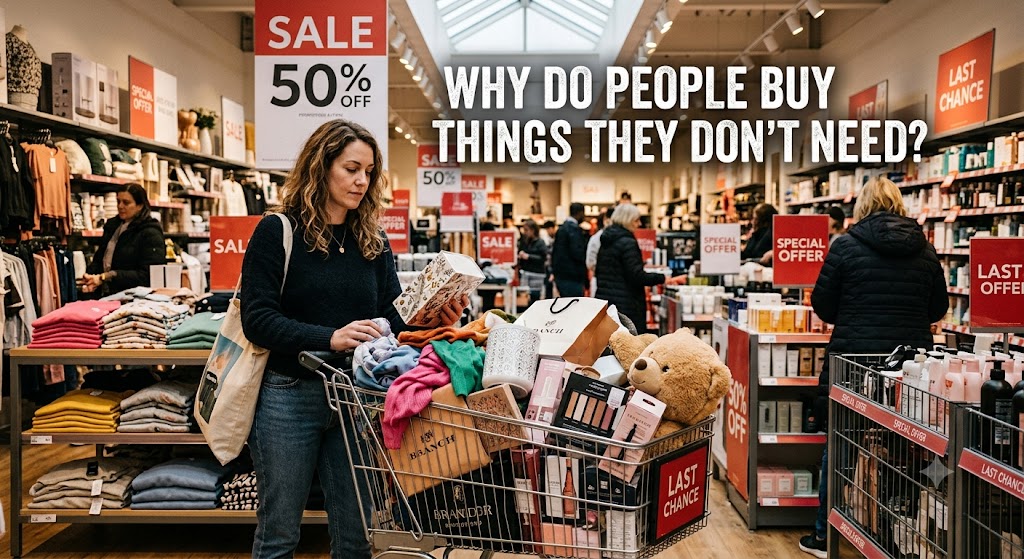
Why do people keep buying things they don’t need, even when they know they should be saving money? Why does someone complain about being broke today and still find a way to order something unnecessary tomorrow? Why do people walk into a shop intending to buy one item and leave with five? Why does receiving a salary sometimes create an irresistible urge to spend rather than an opportunity to build financial security?
The answer is more complicated than simply saying that people are irresponsible with money. Consumer behaviour is influenced by emotions, habits, social pressure, advertising, convenience, insecurity, boredom and the desire to feel successful. In many cases, people are not buying products because they genuinely need them. They are buying feelings. They are buying excitement, comfort, status, acceptance, confidence or temporary relief from stress. This is one of the reasons why understanding why people keep buying things they don’t need is so important for anyone who wants to improve their personal finances.
Buying things you do not need can appear harmless when each purchase is small. A snack here, a new outfit there, a subscription you barely use, another pair of shoes, a new phone accessory, an expensive meal, an unnecessary upgrade or an impulsive online purchase may not seem financially dangerous on its own. The problem becomes obvious when these small decisions are repeated over weeks, months and years. Money that could have been saved, invested or used to build an emergency fund slowly disappears through hundreds of decisions that seemed insignificant at the time.
One of the biggest reasons people buy unnecessary things is emotional spending. People do not always spend money because they need something. Sometimes they spend because they are angry, stressed, lonely, bored, tired or unhappy. Shopping can provide a temporary emotional reward. The act of purchasing something can create excitement and make someone feel better for a short period. Unfortunately, the emotional relief usually does not last as long as the financial consequences.
Someone may have a difficult day at work and decide to order an expensive meal because they feel they deserve it. Another person may feel lonely and start shopping online simply because there is nothing else to do. Someone who feels unsuccessful may buy expensive clothing to appear more successful. A person dealing with financial pressure may purchase something new because they want to forget about their problems for a few hours. The purchase becomes a form of emotional escape.
This is why financial discipline is not only about mathematics. Knowing how much you earn and how much you spend is important, but understanding why you spend can be even more powerful. If someone does not understand the emotional triggers behind their spending habits, creating a budget may not be enough. They may create a beautiful financial plan on Monday and completely ignore it by Friday because an emotional trigger takes over.
Another powerful reason people keep buying things they don’t need is advertising. Modern advertising is designed to make consumers feel that their lives are incomplete without certain products. Advertisements rarely simply say, “Here is a product. Buy it if you need it.” Instead, they often sell an identity, lifestyle or emotion. They tell people that a particular phone represents success, a particular car represents achievement, a particular perfume represents confidence and a particular fashion trend represents belonging.
The message is subtle but powerful. You are not simply buying a product. You are buying the person you believe you could become after purchasing it.
Social media has made this even more powerful. People are constantly exposed to images of expensive holidays, designer clothing, new cars, beautiful homes, restaurants, gadgets and lifestyles that appear perfect. Even when people understand that social media does not show the complete reality, repeated exposure can still influence their expectations.
Someone sees a friend posting pictures from a luxury restaurant and suddenly feels that they should experience the same thing. Another person sees an influencer showing a new smartphone and starts wondering whether their current phone is outdated. Someone watches videos of people renovating their homes and begins feeling dissatisfied with their own surroundings. Without realising it, comparison turns into consumption.
Why People Keep Buying Things They Don’t Need
This creates a dangerous cycle. People compare their lives with others, feel dissatisfied with what they have, buy something to close the perceived gap and then discover that the satisfaction does not last. Soon, another comparison appears, creating another desire and another purchase.
The problem is that there will always be someone with something newer, bigger, faster or more expensive. If your happiness depends on keeping up with other people’s possessions, you will never reach the finish line.
Another reason people buy things they don’t need is the desire for status. Human beings naturally care about how others perceive them. There is nothing inherently wrong with wanting to look good or enjoy quality possessions. The problem begins when appearance becomes more important than financial reality.
Someone may purchase an expensive phone while struggling to pay bills because they do not want others to think they are struggling. Someone may borrow money to attend an expensive event because they fear being left out. Someone may buy designer clothing on credit because they want to appear wealthy. Another person may purchase an expensive car even though the monthly payments are putting enormous pressure on their income.
The irony is that trying to look wealthy can prevent someone from actually becoming wealthy.
Real financial progress is often invisible. Saving money does not look impressive on social media. Building an emergency fund does not attract attention. Paying off debt does not necessarily generate admiration. Investing consistently can be incredibly boring from the outside. But these quiet financial decisions can create much more security than constantly purchasing things designed to impress other people.
Impulse buying is another major reason people purchase unnecessary items. An impulse purchase happens when someone buys something without giving themselves enough time to consider whether they genuinely need it. Retailers understand this behaviour extremely well.
Stores place attractive products near checkout areas. Online shops display recommendations based on previous purchases. E commerce platforms use limited time offers, countdowns and personalised promotions. “Only a few left” can create urgency. “Sale ends tonight” can make people afraid of missing out. “Buy now and save” can make spending money feel like saving money.
This is where the psychology of scarcity becomes powerful. People often react more strongly when they believe an opportunity may disappear. A product that someone would happily ignore today can suddenly seem essential when they are told that only three remain.
The fear of missing out can make people buy things they never planned to purchase.
Discounts can also be psychologically dangerous. A person may spend ₦20,000 on something they do not need because it was reduced from ₦30,000. They may feel that they saved ₦10,000. But if they would never have spent ₦20,000 on the item in the first place, they did not really save ₦10,000. They spent ₦20,000.
This distinction is important because many people confuse spending less with saving money. A discount only represents genuine savings when the purchase was necessary or already planned.
Convenience also encourages unnecessary spending. Modern technology has made it incredibly easy to spend money. With a few taps on a smartphone, someone can order food, buy clothes, subscribe to entertainment, purchase gadgets and transfer money. The physical pain of handing over cash has disappeared for many transactions. Why People Keep Buying Things They Don’t Need
When spending becomes effortless, people may become less conscious of how much they are actually spending.
This is why financial awareness requires deliberate effort. Checking your bank statements, reviewing subscriptions and tracking discretionary spending can reveal patterns that are difficult to notice when purchases happen individually.
Subscriptions are particularly dangerous because they often operate in the background. A person may subscribe to several streaming services, applications, online platforms, memberships and digital tools. Each individual payment may appear small, but together they can become a significant monthly expense.
The problem is not necessarily subscriptions themselves. The problem is paying for services that no longer provide enough value. People often continue paying because cancelling requires action. The subscription becomes part of the background of their financial life. Why People Keep Buying Things They Don’t Need
Another reason people buy things they don’t need is boredom. Spending can become entertainment. Someone may browse online stores simply because they are bored. They may scroll through social media and eventually find themselves looking at products. The product becomes interesting because the browsing experience itself provides stimulation.
This can create a habit where boredom automatically leads to consumption.
Instead of asking, “What do I need to buy?” people need to learn to ask, “Why do I suddenly want to buy something?”
That simple question can interrupt an automatic behaviour.
Sometimes the answer will be legitimate. Perhaps the item genuinely solves a problem. Other times the answer may reveal that the person is simply bored, stressed or responding to an advertisement.
People also buy unnecessary things because of learned behaviour. Spending habits are often developed gradually. Someone who grew up in an environment where shopping was used as a reward may naturally continue the same pattern as an adult. Someone who watched family members spend money whenever they received income may develop the belief that earning money should immediately lead to consumption.
This does not mean people are permanently trapped by their upbringing. It means financial behaviour is often learned before people become consciously aware of it.
Changing financial habits therefore requires more than deciding to “spend less.” It requires replacing old behaviours with better ones.
For example, instead of immediately buying something after receiving a salary, someone could create a rule that savings and investments happen first. Instead of shopping whenever they feel stressed, they could develop alternative ways to manage stress. Instead of purchasing something immediately, they could wait twenty four hours before making the decision.
A waiting period can be surprisingly effective.
If something is genuinely necessary, it will probably still be worth buying tomorrow. If the desire disappears after a few hours or days, the person may have avoided an unnecessary purchase.
Another major reason people buy things they don’t need is the belief that possessions will create happiness. There is nothing wrong with enjoying nice things. Money can certainly improve quality of life when it is used wisely. The problem is believing that constantly acquiring more possessions will permanently increase happiness.
The excitement of a new purchase usually fades. This is partly because people adapt to what they own. A new phone may feel incredible during the first week. After several months, it becomes normal. A new outfit may generate compliments when first worn. Eventually, it becomes another item in the wardrobe.
This cycle can cause people to continually chase the next purchase.
The solution is not to stop enjoying life. It is to understand the difference between consumption and fulfilment. Some purchases genuinely improve life. Others simply provide a temporary emotional high.
Financial maturity involves learning the difference.
One of the most powerful ways to reduce unnecessary spending is to create financial goals that are more exciting than impulse purchases. Saving money becomes easier when the money has a purpose.
Saving ₦100,000 simply because someone says they should save may feel boring. Saving ₦100,000 towards starting a business, paying for education, building an emergency fund, buying land or achieving another meaningful goal can feel completely different.
Purpose changes the emotional value of money.
When people understand what they are trying to build, unnecessary spending becomes easier to recognise. A purchase is no longer simply “Can I afford this?” The question becomes, “Is this more important than what I am building?”
That is a much stronger financial question.
Another important lesson is that being able to afford something does not necessarily mean you should buy it. Many people use income as the only measure of affordability. If they have money in their account, they assume they can spend it.
But financial affordability should also consider future obligations, savings, investments, emergencies and long term goals.
Someone might technically be able to afford a new phone today but regret the purchase when an unexpected expense appears next month. Financial security requires thinking beyond the present moment.
This is particularly important when using credit. Buy now, pay later services and credit cards can make unnecessary purchases feel affordable because the full financial consequence is delayed. The consumer gets the emotional reward immediately while the payment arrives later.
Delayed consequences can encourage irresponsible spending.
People may also underestimate the cumulative effect of small purchases. Spending ₦2,000 here and ₦3,000 there may not feel significant. But repeated daily spending can become hundreds of thousands of naira over a year.
The lesson is not that every small pleasure should be eliminated. Life is meant to be enjoyed. The goal is conscious spending rather than unconscious spending.
There is a major difference between buying something because you genuinely value it and buying something because you were manipulated, pressured or emotionally triggered into purchasing it.
Financial freedom does not mean never spending money. It means having enough control over your money that your spending reflects your priorities.
People keep buying things they don’t need because spending is rarely just about products. It is often about emotions, identity, comparison, habits, convenience, advertising, status and the desire for immediate gratification.
Once people understand this, they can begin changing their behaviour.
Before making an unnecessary purchase, pause and ask yourself a few simple questions. Do I genuinely need this? Would I still want it if nobody could see me using it? Was this purchase planned? Am I buying this because I am stressed, bored or unhappy? Does this purchase move me closer to my financial goals or further away from them? What else could this money accomplish?
These questions may appear simple, but they can completely change the way someone interacts with money.
The goal is not to become someone who refuses to spend. The goal is to become someone who spends intentionally.
You should be able to enjoy a good meal without feeling guilty. You should be able to buy clothes you like. You should be able to enjoy entertainment and occasionally purchase something simply because it makes you happy. Financial discipline is not punishment.
The real objective is to ensure that today’s spending does not destroy tomorrow’s possibilities.
Every naira has an opportunity cost. Money spent on something unnecessary cannot simultaneously be saved, invested, used to reduce debt or directed towards another important goal. Every financial decision is therefore a choice between different possibilities.
This is why learning to control unnecessary spending is one of the most important steps towards building wealth.
The wealthy mindset is not necessarily about refusing to buy nice things. It is about refusing to let nice things control your financial future.
The next time you feel the urge to buy something you don’t need, do not immediately ask whether you have enough money to purchase it. Ask whether the purchase deserves a place in your financial priorities.
Sometimes the best purchase is the one you decide not to make.
And sometimes, the money you keep in your account today is worth far more than the temporary excitement you would have received from spending it.
The uncomfortable truth is this: many people are not broke because they earn too little. They are broke because too much of what they earn is constantly being converted into things they never truly needed.
People often think overspending is about poor mathematics. It is not always. It is frequently about psychology. People buy to feel better, look successful, fit in, escape boredom, reward themselves, impress others or temporarily forget financial problems. The product is often just the excuse.
That makes unnecessary spending one of the most dangerous financial habits because it can disguise itself as normal life.
The person buying the latest phone may say, “I deserve it.”
The person ordering expensive food every weekend may say, “Life is too short.”
The person buying clothes they already have may say, “It was on sale.”
The person financing a lifestyle they cannot comfortably afford may say, “I have to look successful.”
And the person constantly comparing themselves with others may say, “Everybody is doing it.”
Eventually, all those small justifications become a lifestyle.
The real question is not whether you can afford something.
The real question is what you are sacrificing every time you buy it.
That ₦50,000 purchase could have been part of an emergency fund. That ₦100,000 spent trying to impress people could have gone towards an investment. That ₦200,000 wasted on things you barely use could have helped fund a business idea. Why People Keep Buying Things They Don’t Need
Money is not just something you spend.
Money is stored opportunity.
And when you repeatedly spend it on things that do not matter, you are not simply losing money. You are selling pieces of your future for temporary satisfaction.
That is why understanding why people keep buying things they don’t need is not merely a topic about shopping.
It is a topic about freedom.
The person who learns to control their desires eventually gains control over their money. And the person who gains control over their money has a much better chance of controlling where their life goes.

EarnSmartOnline.com.ng is dedicated to helping readers make smarter financial decisions through practical guides on online income, personal finance, technology, digital business, and wealth creation. Our goal is to provide reliable, easy-to-understand, and actionable content that empowers individuals to earn smarter, build sustainable income streams and achieve long-term financial success.
Recommended: Start Earning Online
- Ultimate Affiliate Marketing Program — learn affiliate marketing with a done-for-you sales system ($15). Check it out
- The Newbie Affiliate Guide — the beginner-friendly starter guide (~$6.68). Check it out
- Easy Dollar Maker — earn in dollars uploading AI images and videos from your phone ($17). Check it out
Disclosure: These are affiliate links. If you buy through them, I may earn a commission at no extra cost to you.



