
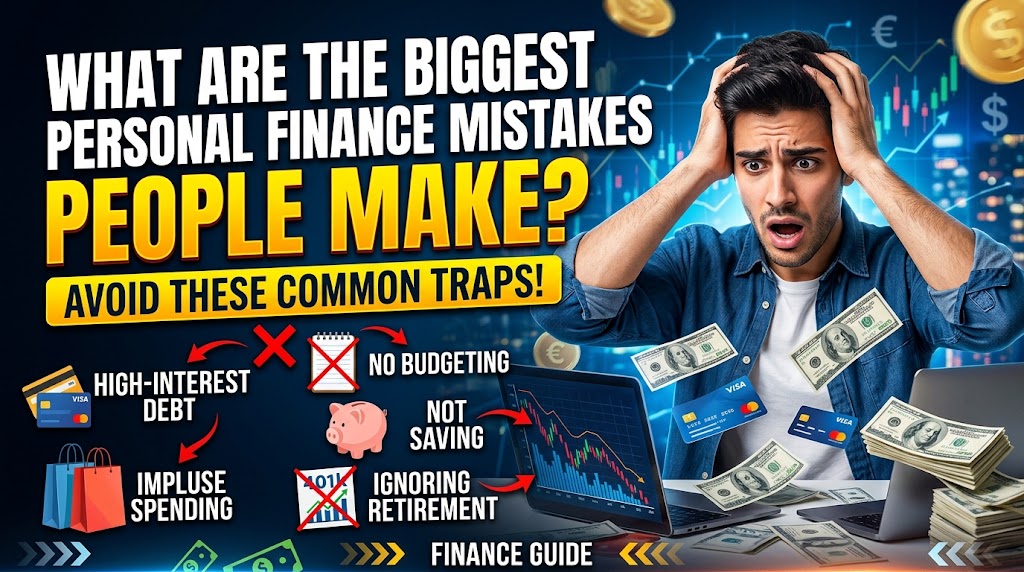
What are the biggest personal finance mistakes people make?
What are the biggest personal finance mistakes people make? I have asked myself this question several times, especially whenever I look back at some of the financial decisions I made when I had less money, less experience and plenty of confidence.
The funny thing about money is that most people think their biggest financial problem is not having enough of it. I used to think the same way. If only I could earn more, I thought, everything would automatically become easier. If my salary increased, I would save more. If business brought in more money, I would invest more. If I got that extra income, I would finally become financially responsible.
Then reality started teaching me something different.
Sometimes the problem is not how much money enters your account. The problem is what happens to the money after it enters.
You can earn a lot of money and still remain financially confused. You can receive a salary increase and somehow become poorer. You can make more sales and still have nothing meaningful to show for it. You can even have several sources of income and still live from one financial emergency to another.
That is why understanding the answer to “What are the biggest personal finance mistakes people make?” is important. Personal finance is not simply about making money. It is about knowing what to do with the money you make.
One of the biggest mistakes people make is spending first and thinking later.
I have seen how easy this can happen. Money enters the account and suddenly there are plenty of things that need attention. Someone needs help. There is something you have wanted to buy for months. A friend invites you somewhere. Your phone needs an upgrade. You see a nice shoe. There is a new restaurant everybody is talking about. Your favourite online store announces a discount.
Suddenly, money that looked like plenty in the morning starts looking like a visitor who has already packed his bags.
The problem is that spending feels more urgent than saving. Spending gives immediate satisfaction. Saving gives future satisfaction. Human beings naturally tend to favour what they can enjoy today.
That is why financial discipline requires intentionality.
If I receive money without already having an idea of what that money is supposed to accomplish, there is a very good chance that the money will find something to do by itself.
Another major mistake is confusing wants with needs.
This sounds simple until you actually have money in your account.
Food is a need. But eating at an expensive restaurant every weekend may be a want. A phone can be a need, especially if you depend on it for work. Buying the newest model simply because another model has been released is different.
The dangerous thing about wants is that they often disguise themselves as needs.
“I need this.”
“I deserve this.”
“I have worked hard.”
“Everybody has it.”
“I may never see this price again.”
These statements can empty an account faster than an obvious financial emergency.
I have learnt that one of the easiest ways to improve personal finance is to become brutally honest about why you are buying something.
Do I actually need this?
Will this purchase improve my financial position?
Can I afford it without affecting something more important?
Am I buying it because I need it or because I want people to notice that I can afford it?
That last question can be uncomfortable, but it is important.
Another serious personal finance mistake is failing to have an emergency fund.
Many people plan for enjoyment but do not plan for emergencies.
We plan birthdays. We plan weddings. We plan holidays. We plan new clothes. We plan parties. We plan gadgets. But when something unexpected happens, we suddenly start looking for someone to borrow money from.
Life does not respect your budget.
Your car can develop a fault. Your laptop can stop working. Your business can experience a slow period. Your income can reduce. A family responsibility can appear without warning. An important piece of equipment can suddenly need replacement.
An emergency fund does not mean you expect bad things to happen. It simply means you understand that unexpected things are part of life.
Another mistake is depending entirely on one source of income without developing additional financial capacity.
There is nothing wrong with having a salary. A stable job can be extremely valuable. The problem begins when someone assumes that their current income will remain unchanged forever.
The world changes.
Companies change.
Industries change.
Technology changes.
People lose jobs. Businesses experience difficult periods. Contracts end. Customers disappear. Expenses increase.
I have become more interested in building skills and assets because of this reality. An additional income stream does not necessarily have to mean starting five businesses at once. It could mean developing a valuable skill, creating digital assets, investing responsibly, offering a service or building something that can generate value beyond your immediate working hours.
This is particularly important because time is also a financial resource.
Many people understand money as capital but completely ignore time as capital. They may spend years consuming entertainment without using some of their spare time to develop a skill, build a business asset or improve their financial knowledge.
Another huge mistake is lifestyle inflation.
This one can be very deceptive.
Imagine someone earning ₦200,000 monthly. They manage somehow. Then their income increases to ₦350,000. Instead of becoming financially stronger, their lifestyle expands.
They move into a more expensive apartment.
They start eating more expensive meals.
They increase transportation expenses.
They upgrade their wardrobe.
They buy a more expensive phone.
Their social activities increase.
Eventually, they are earning ₦350,000 and somehow feeling just as broke as when they were earning ₦200,000.
Then the income rises again.
The lifestyle rises again.
This cycle can continue for years.
The goal of increasing your income should not simply be to increase your expenses. Some of the additional income should improve your financial position.
Another mistake people make is failing to track where their money goes.
There was a period when I realised that money could disappear without doing anything dramatic.
You do not necessarily lose money through one massive purchase. Sometimes it disappears through dozens of small decisions.
A little transfer here.
A snack there.
Transport.
Subscriptions.
Data.
Impulse purchases.
Unplanned outings.
Small loans.
Random online purchases.
None of these individually looks powerful enough to destroy your finances. Put them together for twelve months and you may be surprised.
Tracking expenses creates awareness.
You cannot effectively control what you refuse to observe.
Another major mistake is borrowing money for things that do not generate value.
Debt itself is not automatically bad. Borrowing can sometimes help someone acquire an asset, fund a productive activity or handle a genuine emergency.
The problem is borrowing simply to maintain an appearance.
Borrowing money to buy a luxury item you cannot afford can turn one financial problem into two.
You now have the original financial limitation plus a repayment obligation.
The same applies to borrowing repeatedly to fund a lifestyle that your income cannot support.
One of the most expensive financial mistakes is trying to look rich before becoming financially stable.
Social media has made this even more difficult.
You can open your phone and see people travelling, buying cars, building houses, wearing expensive clothes and displaying successful businesses.
What you do not see is the full financial story behind the picture.
You do not know whether the person owns the car.
You do not know whether the trip was sponsored.
You do not know whether the business is profitable.
You do not know whether the person is heavily indebted.
You are looking at somebody’s highlight reel and comparing it with your behind the scenes.
That is a dangerous financial strategy.
Another mistake is ignoring financial education.
I have realized that making money and understanding money are two different skills.
Someone can be very intelligent academically and still make terrible financial decisions.
You can have a university degree and still misunderstand interest.
You can be a successful professional and still have no emergency fund.
You can run a profitable business and still mix business money with personal spending.
You can earn a high income and still have no investment strategy.
Financial education does not guarantee wealth, but financial ignorance can make wealth extremely difficult to retain.
Another common mistake is failing to separate business money from personal money.
This is particularly common among small business owners.
The business makes ₦500,000 and the owner starts thinking, “I have ₦500,000.”
No.
The business may have revenue of ₦500,000, but revenue is not necessarily profit. There may be expenses, inventory costs, transportation, salaries, taxes, marketing costs and other obligations.
If every amount that enters the business account is treated as personal income, the business can appear successful while quietly dying.
I have learnt that numbers need names.
Money for stock should be identified as money for stock.
Money for operating expenses should be separated.
Personal spending should have its own allocation.
Savings should not be treated like spare change.
This simple separation can completely change the way someone sees their finances.
Another mistake is saving without a purpose.
People are often told to save money, but saving becomes easier when you know what the money is for.
You can save for emergencies.
You can save for education.
You can save for business expansion.
You can save for a property.
You can save for a major purchase.
You can save for retirement.
You can save for opportunities.
Without a clear purpose, savings can become the first thing you attack whenever you want something.
Another major mistake is waiting until you earn more before becoming financially responsible.
This is probably one of the most dangerous beliefs around money.
“I will start saving when I earn more.”
“I will invest when my salary increases.”
“I will budget when my business becomes bigger.”
“I will become disciplined when I start making serious money.”
The problem is that financial habits usually grow with you.
If you cannot manage ₦100,000 responsibly, receiving ₦1 million does not automatically give you financial wisdom.
It simply gives your existing habits more money to work with.
If your spending habits are unhealthy at a lower income, a higher income can sometimes make the consequences larger.
Another mistake is putting all your money into one financial opportunity simply because somebody promised quick returns.
This is where desperation and greed can become expensive teachers.
Whenever someone promises extraordinary returns with little or no risk, I become cautious.
Money attracts stories.
Everybody has a cousin who supposedly turned ₦100,000 into millions.
Everybody knows someone who entered an opportunity at the perfect time.
Everybody has heard about the investment that supposedly cannot fail.
But responsible personal finance requires understanding risk before chasing returns.
Do not invest money you cannot afford to lose simply because somebody made the opportunity sound easy.
Another mistake is neglecting insurance and protection.
People often think financial planning is only about making money. Protection matters too.
A person can spend years building savings and assets and then experience a major financial setback because they were not adequately prepared for certain risks.
The exact protection someone needs depends on their circumstances, but the general principle is simple.
Building wealth is important. Protecting what you build is also important.
Another mistake is giving money away without financial boundaries.
Helping people is good. Supporting family can be important. Giving to people in genuine need can be meaningful.
But helping everybody while destroying your own financial foundation is not sustainable.
I have learnt that sometimes saying “I cannot afford this right now” is not wickedness.
It is financial honesty.
If helping someone today means you cannot pay your own essential bills tomorrow, the situation needs careful consideration.
Another mistake is failing to set financial goals.
Without goals, money tends to become reactive.
You earn.
You spend.
You repeat.
A financial goal creates direction.
It can be as simple as building an emergency fund, paying off expensive debt, saving a certain amount, investing consistently, acquiring a skill or starting an additional income stream.
The amount may be small at first. What matters is that the money has somewhere to go.
Perhaps the biggest lesson I have learnt from personal finance is that financial success is rarely one dramatic decision.
It is usually a collection of small decisions repeated over time.
The decision not to buy something unnecessary.
The decision to save before spending.
The decision to learn before investing.
The decision to track expenses.
The decision to separate business money from personal money.
The decision to develop a valuable skill.
The decision to avoid unnecessary debt.
The decision to prepare for emergencies.
The decision to stop competing financially with people whose circumstances you do not understand.
When I think about the question, “What are the biggest personal finance mistakes people make?”, I no longer think only about people spending too much money.
I think about people failing to understand what their money is supposed to do.
Money needs direction.
Without direction, income can become consumption.
With direction, even a modest income can begin building a stronger financial foundation.
This does not mean everyone can become wealthy simply by budgeting harder. Income levels, responsibilities, economic conditions and opportunities are different for different people. Personal finance is not a magic formula where everyone follows five steps and becomes financially comfortable.
But there are mistakes that almost anybody can learn to recognise.
Spending without planning.
Living beyond your means.
Ignoring emergencies.
Depending entirely on one income source.
Allowing lifestyle inflation to consume every increase in income.
Borrowing for appearances.
Ignoring financial education.
Mixing business and personal money.
Chasing quick returns.
Failing to protect what you have.
Waiting for a higher income before developing better financial habits.
The interesting thing is that most of these mistakes do not look dangerous when you make them once.
That is why they are mistakes.
They become dangerous through repetition.
One unnecessary purchase is not going to destroy your financial future. One bad month does not define your financial life. One financial mistake does not mean you are financially hopeless.
The real danger is turning the mistake into a habit.
I have come to see personal finance less as a competition to see who can make the most money and more as a discipline of making money behave.
Because honestly, earning money is only half of the story.
You also need to know how to keep it, protect it, allocate it, grow it and use it to create options for your future.
That is why asking “What are the biggest personal finance mistakes people make?” is more useful than simply asking, “How can I make more money?”
Making more money can improve your situation.
But learning how to manage the money you already have can prevent you from constantly returning to the same financial problems.
And sometimes, the biggest financial breakthrough is not getting more money.
Sometimes, it is finally stopping the money you already have from disappearing.

EarnSmartOnline.com.ng is dedicated to helping readers make smarter financial decisions through practical guides on online income, personal finance, technology, digital business, and wealth creation. Our goal is to provide reliable, easy-to-understand, and actionable content that empowers individuals to earn smarter, build sustainable income streams and achieve long-term financial success.
Recommended: Start Earning Online
- Ultimate Affiliate Marketing Program — learn affiliate marketing with a done-for-you sales system ($15). Check it out
- The Newbie Affiliate Guide — the beginner-friendly starter guide (~$6.68). Check it out
- Easy Dollar Maker — earn in dollars uploading AI images and videos from your phone ($17). Check it out
Disclosure: These are affiliate links. If you buy through them, I may earn a commission at no extra cost to you.



