
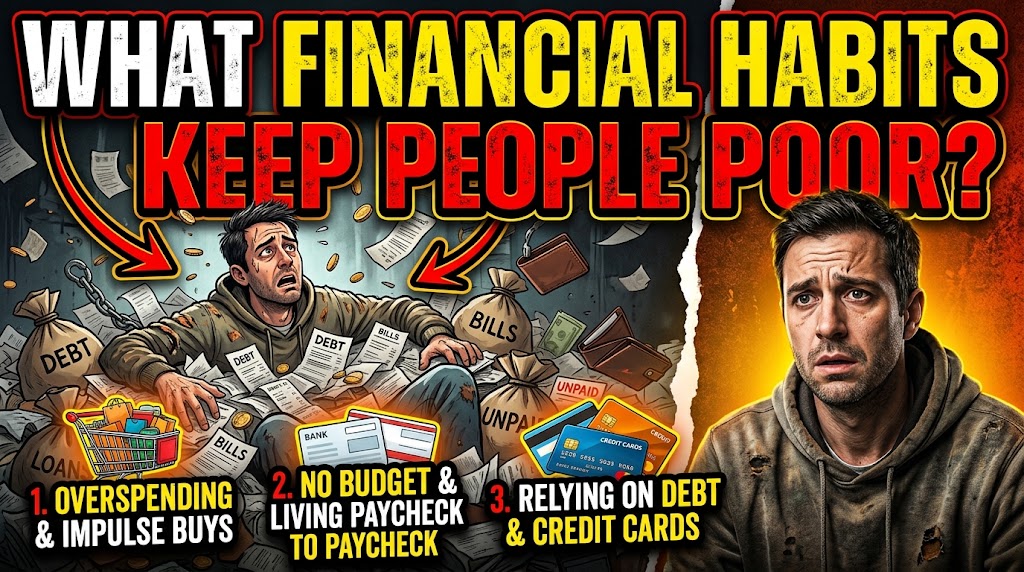
What financial habits keep people poor?
What financial habits keep people poor? This is a question I started taking seriously when I realized that earning more money does not automatically make someone financially better off. I used to think that the major difference between people who struggle financially and people who seem comfortable was simply the amount of money they earned. The more you earn, I thought, the easier life should become. But experience has a funny way of correcting assumptions.
I have seen people increase their income and somehow remain in exactly the same financial situation. They earn more, spend more, borrow more, upgrade their lifestyle and then complain that money still disappears too quickly. I have also seen people with relatively modest incomes manage their money carefully, build useful assets, avoid unnecessary debt and gradually improve their financial position.
That made me ask a more uncomfortable question. What financial habits keep people poor?
The answer is not always low income. Sometimes, poverty or persistent financial struggle is reinforced by the things we repeatedly do with the money we already have.
One of the biggest financial habits that can keep people poor is spending everything immediately after getting paid. This habit can feel completely normal because there are always bills to pay, family members to support, food to buy and things we want. The problem begins when every naira that enters your account already has somewhere to go.
I have learnt that there is a major difference between earning money and controlling money. If your entire income disappears before you have deliberately allocated anything towards savings, investments, skill development or productive assets, you may be working hard without making meaningful financial progress.
Imagine someone earning ₦300,000 every month but spending ₦300,000 every month. Another person earns ₦200,000 but deliberately saves and invests part of it while controlling unnecessary expenses. After some years, their financial situations can look completely different.
This is why income alone cannot explain financial progress.
Another habit that keeps people financially stuck is increasing their lifestyle every time their income increases. You receive a salary increase and immediately increase your rent, change your phone, upgrade your wardrobe, eat more expensive meals and begin spending money on things you previously considered unnecessary.
Then another increase comes and the process repeats.
There is nothing wrong with enjoying the fruits of your labour. The problem is allowing every increase in income to become an increase in expenses.
I have come to understand that sometimes the best thing you can do when your income increases is to allow your lifestyle to remain almost the same for a while. Use the difference to strengthen your financial foundation. Build savings. Pay down expensive debt. Learn a valuable skill. Start a small business. Build a website. Create content. Invest in productive opportunities you understand.
If you increase your income by ₦100,000 and immediately create ₦100,000 worth of new monthly expenses, you have not really increased your financial freedom. You have simply increased the size of your financial responsibilities.
Another dangerous habit is borrowing money to maintain an appearance.
This one is particularly interesting because social media has made it easier to confuse appearance with financial success. Someone can look extremely successful online while owing several people offline.
You can buy the latest phone on credit. Wear expensive clothes. Attend expensive events. Drive a car you cannot comfortably maintain. Take photographs in beautiful locations. Post everything online and give people the impression that you are doing extremely well.
But your bank account knows the truth.
I have realized that one of the most expensive things a person can try to maintain is an image of wealth without the financial foundation to support it.
There is no prize for looking rich while being financially exhausted.
A related habit is buying things simply because other people have them. This is where comparison becomes expensive.
Your friend buys a new phone, so you want one. Someone moves into a better apartment, so you start feeling that your own place is embarrassing. Someone buys a car, so you start calculating how you can get one even though your current transportation arrangement is still working.
The danger is that you begin making financial decisions based on other people’s lives.
What makes this particularly dangerous is that you rarely know the complete story behind another person’s lifestyle. The person driving an expensive car may have inherited money, taken a loan, received help from family, built a successful business or simply be heavily indebted.
You are looking at the car.
You are not looking at the financial statement.
Another habit that can keep people poor is failing to budget because you believe budgeting is only for people who do not earn enough.
I used to think budgeting was mainly about restricting yourself. But budgeting is actually about telling your money where to go before circumstances decide for you.
Without a budget, small expenses can become invisible. ₦2,000 here. ₦5,000 there. Transport. Food delivery. Subscriptions. Impulse purchases. Unplanned outings. Random transfers. Before you know it, a significant amount of money has disappeared.
The individual expense may not look dangerous. The accumulation is the problem.
This is why I believe everyone should know where their money goes.
You do not necessarily need a complicated spreadsheet. Even a simple record of income and expenses can reveal patterns you were previously ignoring.
Another financial habit that keeps people poor is refusing to learn about money.
People spend years learning how to earn money but almost no time learning how to manage it.
Someone can spend years studying for a profession but never learn about emergency savings, interest, inflation, taxes, insurance, investing, debt management, budgeting or building additional income streams.
Money does not become easier to manage simply because you have more of it.
In fact, earning more money can expose poor financial habits even more clearly.
If someone cannot manage ₦100,000 responsibly, earning ₦1 million does not automatically give them financial wisdom. It simply gives their financial mistakes a larger budget.
Another habit worth mentioning is relying completely on a single source of income without developing additional skills.
A salary can be valuable, but depending entirely on one source of income can create vulnerability. If that income stops, everything stops.
This does not mean everybody needs to start five businesses at once. That can create another problem. Instead, it means developing skills and assets that can potentially create additional income over time.
A person might learn website development, writing, graphic design, digital marketing, photography, programming, consulting, sales or another useful skill.
The internet has also created opportunities to build digital assets. A website, for example, can become more than an online brochure. Depending on the business model, it can become a platform for selling products, generating leads, publishing content, attracting advertisers or building an audience.
This is one reason I increasingly see time as a form of capital.
People often say, “I don’t have enough money to start.”
Sometimes that is true. Capital matters.
But money is not the only resource available to you.
You also have time, knowledge, attention, creativity, relationships and skills.
The financial habit that keeps someone poor may therefore be refusing to invest anything into becoming more valuable.
Another problem is constantly choosing short term pleasure over long term progress.
There is nothing wrong with enjoying yourself. The issue is when every decision is based on what feels good today.
You receive money and immediately think about what you can buy.
You receive a bonus and immediately think about where you can travel.
You get extra income and immediately upgrade your lifestyle.
But when do you use money to improve your future earning capacity?
Financial progress often requires delayed gratification. Sometimes you have to say, “I could buy this, but I would rather use the money to build something.”
That decision may not look exciting today, but it can become very important later.
Another habit that keeps people poor is ignoring small debts because they seem insignificant.
A small debt can become a big financial problem when combined with interest, penalties and repeated borrowing. The bigger issue is the habit of using future income to finance present consumption.
If every month you are already spending part of next month’s income before it arrives, your financial freedom becomes smaller.
Credit can be useful when used responsibly, but borrowing simply to maintain consumption can create a cycle that becomes difficult to escape.
Another financial habit is not having an emergency fund.
Life does not ask permission before creating expenses.
Your phone can break. Your laptop can develop a fault. A business opportunity can require unexpected capital. A family emergency can arise. You may experience a period without income.
Without any financial buffer, every unexpected event becomes an emergency loan.
Building an emergency fund may seem boring when everything is going well. But financial preparation often looks boring until you need it.
Another habit that keeps people financially stuck is confusing saving with investing.
Saving money is important, but saving and investing serve different purposes. Savings can provide liquidity and security, while investing is generally about putting money into assets with the potential to grow or generate returns, alongside the risks involved.
The important point is to understand what you are doing rather than throwing money into something simply because someone promised you quick returns.
This brings me to another dangerous habit: chasing quick money.
Whenever people are desperate for financial improvement, they become vulnerable to unrealistic promises.
“Double your money.”
“Guaranteed returns.”
“Make millions overnight.”
“Invest today and become rich tomorrow.”
These promises are attractive because they speak directly to financial frustration.
But wealth creation generally requires some combination of time, skill, discipline, productive assets, business activity and sensible risk taking. Anything that sounds too easy deserves careful investigation.
Another habit that can keep people poor is failing to distinguish between assets and expenses.
This does not mean every purchase needs to generate money. You are allowed to buy things for enjoyment.
However, it is useful to understand whether something is consuming your resources or potentially helping you build them.
A business website that consistently generates customers can potentially be an asset. A useful professional skill can potentially increase your earning capacity. A productive business can potentially create income. A depreciating luxury purchase may simply create another expense.
The more you understand this distinction, the more intentional your financial decisions can become.
Another habit is refusing to review your financial life.
Imagine driving a car without checking the fuel gauge, engine condition or destination. You might eventually arrive somewhere, but you have no idea whether you are making progress.
Money works similarly.
Every few months, you should be able to answer simple questions.
How much did I earn?
How much did I spend?
What did I save?
What did I invest?
What debt did I reduce?
What new skill did I develop?
What asset did I build?
What financial mistake did I repeat?
Those questions can reveal more about your financial direction than simply checking your bank balance.
Perhaps the most important lesson I have learnt is that financial habits compound.
A bad habit repeated once may not destroy your finances. A bad habit repeated for ten years can.
The same applies to good habits.
Saving a small amount may not look impressive today. Learning a useful skill may not produce immediate money. Creating content may feel pointless when nobody is watching. Building a website may seem insignificant when it has not generated its first customer.
But consistent actions can accumulate.
This is why the question “What financial habits keep people poor?” should not only be used to criticise other people. It should be used as a personal audit.
Am I spending money to impress people?
Am I borrowing for unnecessary consumption?
Am I increasing my lifestyle every time I earn more?
Do I know where my money goes?
Do I have any emergency savings?
Am I developing valuable skills?
Am I building assets?
Do I understand the investments I am making?
Am I constantly chasing quick money?
Am I using all my income today and leaving nothing for tomorrow?
These questions can be uncomfortable, but they are useful.
Being financially successful is not simply about earning a huge amount of money. It is also about what happens after the money arrives.
Two people can receive the same income and create completely different futures because of their habits.
One spends everything.
The other saves.
One borrows to impress.
The other borrows carefully, if at all.
One upgrades every time income increases.
The other increases their financial capacity first.
One waits for a large amount of money before taking action.
The other starts with the resources already available.
That is why I no longer believe the entire financial conversation should be reduced to “How much do you earn?”
A better question is, “What are you doing with what you earn?”
Your income matters. Your environment matters. Economic conditions matter. Unexpected circumstances matter. Not every financial struggle is caused by irresponsible behaviour, and people should not be blamed for circumstances beyond their control.
But where we have control, our habits matter.
Money is not only something we receive. It is something we direct.
Every naira you spend is a decision. Every naira you save is a decision. Every skill you develop is an investment in your future earning capacity. Every unnecessary debt you avoid protects future income. Every productive asset you build gives your future self another opportunity.
So, what financial habits keep people poor?
Spending everything you earn, increasing your lifestyle whenever your income rises, borrowing to maintain appearances, comparing yourself with people online, refusing to budget, ignoring financial education, depending completely on one income source, choosing constant short term pleasure over long term progress, accumulating unnecessary debt, failing to prepare for emergencies, chasing unrealistic quick money and refusing to build valuable skills and productive assets can all contribute to long term financial difficulty.
The goal is not to become obsessed with money.
The goal is to become intentional with it.
Because sometimes the biggest financial breakthrough is not earning more money.
Sometimes it is finally stopping the habits that keep making the money you already earn disappear.

EarnSmartOnline.com.ng is dedicated to helping readers make smarter financial decisions through practical guides on online income, personal finance, technology, digital business, and wealth creation. Our goal is to provide reliable, easy-to-understand, and actionable content that empowers individuals to earn smarter, build sustainable income streams and achieve long-term financial success.
Recommended: Start Earning Online
- Ultimate Affiliate Marketing Program — learn affiliate marketing with a done-for-you sales system ($15). Check it out
- The Newbie Affiliate Guide — the beginner-friendly starter guide (~$6.68). Check it out
- Easy Dollar Maker — earn in dollars uploading AI images and videos from your phone ($17). Check it out
Disclosure: These are affiliate links. If you buy through them, I may earn a commission at no extra cost to you.



