
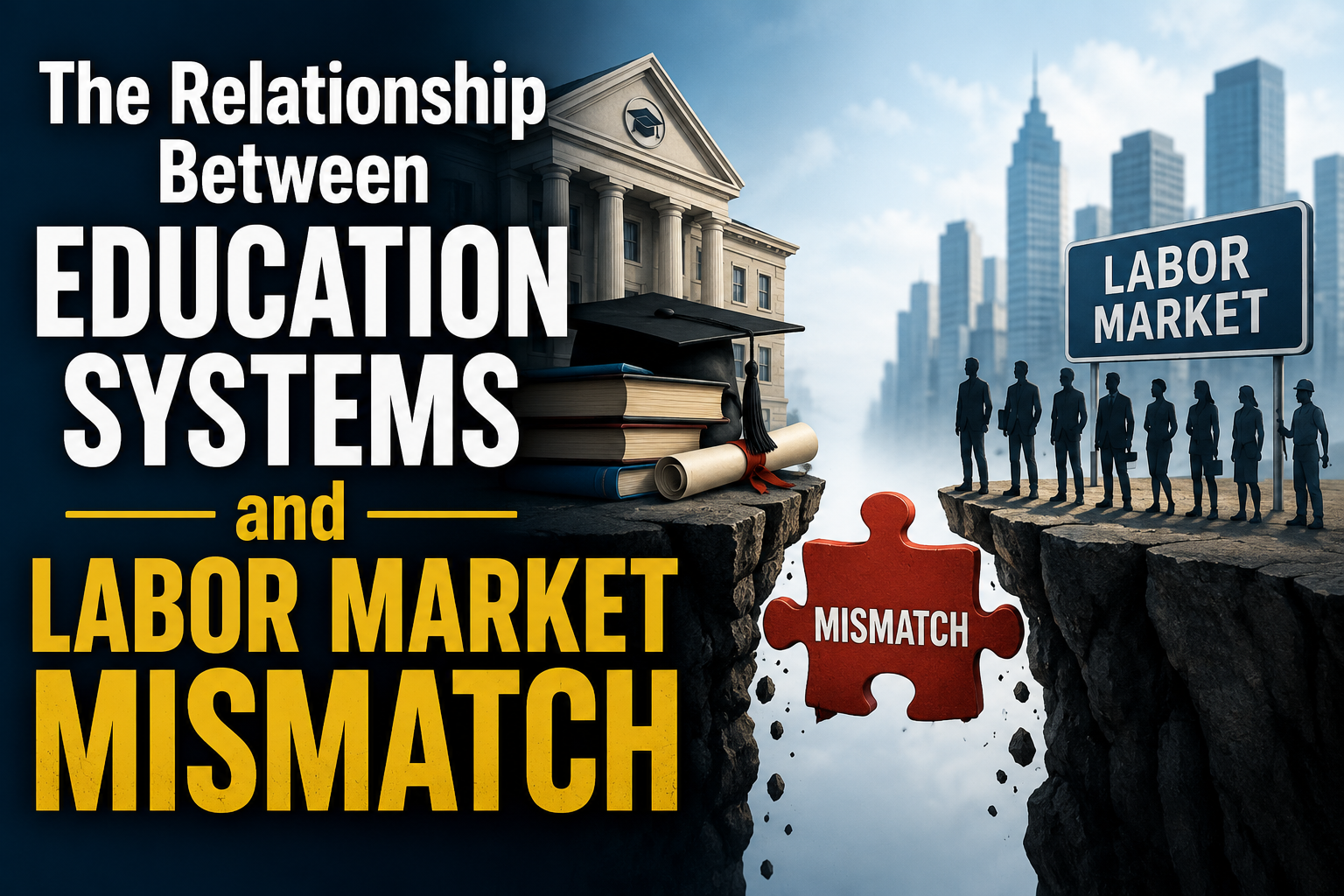
The Relationship Between Education Systems and Labor Market Mismatch
The relationship between education systems and labor market mismatch has become one of the most important economic and social issues in the modern world. Education is widely regarded as the foundation of personal development, career growth, and national progress. Governments invest billions in schools, colleges, universities, and training institutions with the expectation that graduates will acquire the skills necessary to contribute meaningfully to the economy. However, despite increasing access to education, many countries continue to face a growing disconnect between what students learn and what employers actually need. This gap is commonly known as labor market mismatch.
Labor market mismatch occurs when the skills, qualifications, knowledge, or experience possessed by workers do not align with the requirements of available jobs. In some cases, graduates may possess degrees but lack practical skills demanded by employers. In other situations, industries may desperately need workers with specialized expertise while educational institutions continue producing graduates in oversaturated fields. The result is a paradox where unemployment and job vacancies exist simultaneously.
One of the primary causes of labor market mismatch is the slow pace at which educational systems adapt to economic changes. The modern economy evolves rapidly due to technological innovation, globalization, automation, and changing consumer preferences. New industries emerge while traditional occupations decline. However, many educational institutions continue to teach outdated curricula that were designed years or even decades ago. Students often spend several years acquiring knowledge that may no longer be relevant by the time they graduate.
Technology provides a clear example of this challenge. Fields such as artificial intelligence, cybersecurity, cloud computing, data analytics, and digital marketing have experienced explosive growth in recent years. Employers actively seek professionals with expertise in these areas. Yet many educational institutions struggle to update their programs quickly enough to meet these emerging demands. As a result, businesses face talent shortages while graduates struggle to find suitable employment.
Another significant factor contributing to labor market mismatch is the excessive emphasis on theoretical knowledge over practical application. Traditional education systems often prioritize academic achievement, examinations, and memorization. While theoretical understanding is important, employers increasingly value practical skills, problem solving abilities, communication skills, teamwork, adaptability, and real world experience. Graduates who excel academically may still find themselves unprepared for workplace realities if they have not developed these competencies.
Internships, apprenticeships, work based learning, and industry partnerships can help bridge this gap. Unfortunately, such opportunities remain limited in many regions. Students frequently complete their education without substantial exposure to professional environments. When they enter the labor market, they discover that employers prefer candidates with experience, creating a difficult cycle where experience is required to obtain a job but a job is needed to gain experience.
The rapid expansion of higher education has also contributed to labor market mismatch. In many countries, obtaining a university degree has become the default path to success. While increased educational access offers numerous benefits, it has also led to an oversupply of graduates in certain disciplines. Fields such as business administration, social sciences, and general studies often produce more graduates than the labor market can absorb. Meanwhile, sectors such as skilled trades, engineering, healthcare, manufacturing, and information technology may face persistent shortages of qualified workers.
This imbalance creates underemployment, where individuals work in positions that do not fully utilize their education or skills. A university graduate employed in a role requiring minimal qualifications represents a loss of human potential and economic efficiency. Underemployment can also reduce job satisfaction, limit career growth, and contribute to lower productivity across the economy.
Career guidance deficiencies further worsen labor market mismatch. Many students make educational decisions without sufficient information about labor market trends, employment prospects, or future industry demands. They may select courses based on personal preference, social pressure, family expectations, or outdated perceptions of job opportunities. Without accurate career counseling, students may unknowingly pursue paths that offer limited employment prospects while ignoring fields experiencing strong demand.
The mismatch between education and employment is not solely the responsibility of educational institutions. Employers also play a crucial role. Some companies maintain unrealistic hiring requirements, demanding extensive experience for entry level positions or prioritizing formal qualifications over practical skills. Such practices can exclude capable candidates and contribute to workforce shortages. Employers who collaborate with educational institutions, provide training opportunities, and invest in workforce development are often better positioned to address talent gaps.
Globalization has introduced additional complexities into the relationship between education systems and labor market needs. Businesses increasingly operate across borders and compete in international markets. This environment requires workers who possess not only technical expertise but also cultural awareness, language skills, adaptability, and digital competence. Educational institutions that fail to prepare students for a globalized economy may leave graduates at a competitive disadvantage.
Automation and artificial intelligence are reshaping labor markets in unprecedented ways. Many routine and repetitive tasks are becoming automated, reducing demand for certain occupations while increasing demand for others. Future workers will need strong analytical thinking, creativity, emotional intelligence, and continuous learning capabilities. Education systems that focus exclusively on traditional content without fostering adaptability risk producing graduates who struggle to remain relevant in changing labor markets.
The economic consequences of labor market mismatch are substantial. Businesses may experience reduced productivity, increased recruitment costs, delayed growth, and difficulty filling critical positions. Governments may face higher unemployment rates, lower tax revenues, and increased social welfare expenditures. Individuals affected by mismatch often encounter reduced earnings, slower career progression, and financial instability.
From a societal perspective, labor market mismatch can contribute to frustration and disillusionment among young people. Graduates who invest years in education only to face unemployment or underemployment may question the value of their educational experiences. This dissatisfaction can erode trust in institutions and create broader social challenges.
Addressing labor market mismatch requires a collaborative approach involving governments, educational institutions, employers, and students. Educational systems must become more responsive to labor market developments. Regular curriculum reviews, stronger industry engagement, and increased emphasis on practical learning can help ensure that students acquire relevant skills. Schools and universities should actively monitor labor market trends and adapt programs accordingly.
Vocational and technical education deserve greater recognition as valuable pathways to career success. Many societies place excessive emphasis on university education while undervaluing skilled trades and technical professions. Yet these occupations often offer strong employment prospects, competitive salaries, and significant economic contributions. Promoting vocational education can help reduce skill shortages and create more balanced labor markets.
Lifelong learning is becoming increasingly important in addressing mismatch challenges. The traditional model of completing education early in life and relying on that knowledge throughout a career is becoming less viable. Workers must continuously update their skills to remain competitive. Educational institutions, employers, and governments can support lifelong learning through flexible training programs, online courses, professional certifications, and continuous development opportunities.
Data driven decision making can also improve alignment between education and employment. Governments and institutions can use labor market information systems to identify emerging skill demands, forecast workforce needs, and guide educational planning. Accurate data enables policymakers to make informed decisions about funding, program development, and workforce strategies.
Students themselves must take an active role in preparing for labor market realities. Academic qualifications remain important, but they should be complemented by practical experience, networking, communication skills, adaptability, and continuous self improvement. Understanding industry trends and developing transferable skills can significantly enhance employability in an uncertain labor market.
The relationship between education systems and labor market mismatch highlights a critical challenge facing modern economies. Education remains one of the most powerful tools for individual advancement and national development, but its effectiveness depends on its ability to prepare learners for real world opportunities. When educational outcomes align with labor market needs, businesses gain access to skilled workers, individuals enjoy meaningful careers, and societies benefit from stronger economic growth. Achieving this alignment requires ongoing adaptation, collaboration, and innovation. As technology continues to transform industries and reshape workforce demands, the ability of education systems to evolve alongside these changes will play a decisive role in determining future economic prosperity and social well being.

EarnSmartOnline.com.ng is dedicated to helping readers make smarter financial decisions through practical guides on online income, personal finance, technology, digital business, and wealth creation. Our goal is to provide reliable, easy-to-understand, and actionable content that empowers individuals to earn smarter, build sustainable income streams and achieve long-term financial success.
Recommended: Start Earning Online
- Ultimate Affiliate Marketing Program — learn affiliate marketing with a done-for-you sales system ($15). Check it out
- The Newbie Affiliate Guide — the beginner-friendly starter guide (~$6.68). Check it out
- Easy Dollar Maker — earn in dollars uploading AI images and videos from your phone ($17). Check it out
Disclosure: These are affiliate links. If you buy through them, I may earn a commission at no extra cost to you.



