
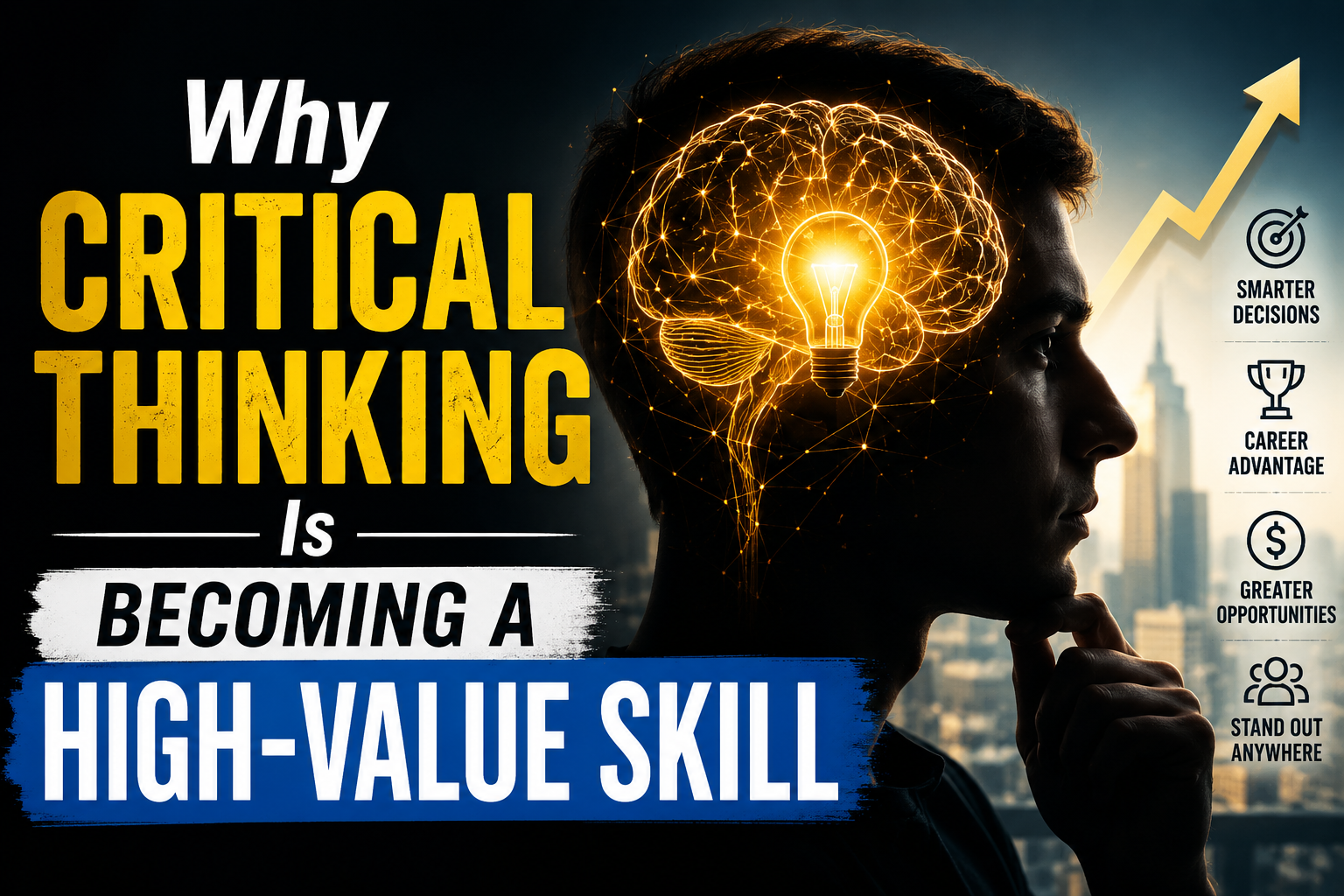
Why Critical Thinking Is Becoming a High-Value Skill
In a world where information moves faster than most people can process it, critical thinking is quietly becoming one of the most valuable skills a person can develop. Not because it is trendy, but because it is now directly tied to how people make decisions, solve problems, and avoid being misled in environments filled with noise. Every day, individuals are exposed to an overwhelming amount of content, opinions, claims, and suggestions. Without the ability to analyze and filter this information properly, it becomes easy to accept ideas that are incomplete, biased, or entirely false. Critical thinking is what separates reaction from reasoning, and in today’s environment, that difference carries real consequences.
The rise of digital platforms has made information more accessible than at any point in human history. However, access has not automatically translated into understanding. In fact, the abundance of information has created a new challenge, which is the difficulty of identifying what is accurate and what is misleading. Many people now consume information in fragments, often shaped by algorithms designed to maximize engagement rather than truth. This means individuals are frequently exposed to emotionally charged content that may not reflect reality. Critical thinking becomes essential in such a landscape because it allows a person to question sources, evaluate evidence, and separate fact from persuasion.
Another reason critical thinking is gaining value is the increasing complexity of modern problems. In earlier times, many tasks and decisions were straightforward, with clear instructions and predictable outcomes. Today, however, most challenges involve multiple layers of uncertainty. Whether it is in business, technology, education, or personal decision making, problems are rarely simple. They require analysis from different perspectives, consideration of long term consequences, and the ability to identify hidden assumptions. People who can think critically are better equipped to navigate this complexity because they do not rush to conclusions. Instead, they break problems down, examine relationships, and look for underlying patterns.
The workplace is also undergoing rapid transformation, driven largely by automation and artificial intelligence. As machines take over repetitive and rule based tasks, human value is shifting toward skills that cannot easily be automated. Critical thinking stands out in this regard because it involves judgment, interpretation, and reasoning in situations that are often ambiguous. Employers increasingly value individuals who can evaluate information, make informed decisions, and adapt to changing conditions. It is no longer enough to simply follow instructions. The ability to question instructions, improve processes, and identify better alternatives is becoming a defining trait of high performing professionals.
In addition to workplace changes, the rise of misinformation has made critical thinking a form of protection. People are constantly exposed to persuasive narratives, whether in news, social media, advertising, or even conversations. Not all of these narratives are designed with honesty in mind. Some are meant to influence opinions, shape behavior, or drive emotional reactions. Without critical thinking, it becomes easy to accept information based on how it feels rather than how accurate it is. This can lead to poor decisions, wasted resources, and misplaced trust. Critical thinking provides a defense mechanism by encouraging individuals to ask questions such as who benefits from this message, what evidence supports it, and whether there are alternative explanations.
Education systems have traditionally focused on memorization and repetition, but the modern world demands more than stored knowledge. Information can now be accessed instantly, which reduces the value of simply remembering facts. What matters more is the ability to interpret and apply knowledge effectively. Critical thinking allows learners to go beyond surface level understanding and engage deeply with concepts. It encourages curiosity, skepticism, and reflection, which are essential for true learning. Students and professionals who develop this skill are better able to connect ideas across disciplines and generate innovative solutions rather than relying solely on established methods.
Critical thinking also plays a significant role in personal decision making. Everyday life is filled with choices that have long term consequences, from financial decisions to relationships and career paths. Without careful thought, people often rely on emotion, habit, or external pressure to guide their actions. While emotions are important, they can sometimes cloud judgment. Critical thinking helps balance emotion with logic by encouraging individuals to slow down, evaluate options, and consider outcomes before making decisions. This leads to more stable and intentional life choices, reducing regret and increasing long term satisfaction.
Another important factor is that modern society rewards those who can solve problems independently. With so much information available, value is no longer concentrated in knowing answers, but in knowing how to find and evaluate them. Critical thinkers are able to approach unfamiliar situations with confidence because they trust their ability to analyze and reason through uncertainty. This independence is highly valuable in entrepreneurship, leadership, and innovation, where clear instructions are often unavailable. People who rely solely on external guidance may struggle in environments that require initiative and adaptability.
The development of artificial intelligence has also highlighted the importance of human judgment. While AI systems can process vast amounts of data and generate recommendations, they still depend on human input to define goals, interpret results, and make final decisions. Critical thinking ensures that individuals do not blindly accept machine outputs without questioning their validity or relevance. It helps people recognize limitations, biases, and errors in automated systems. As technology continues to evolve, the partnership between human reasoning and machine intelligence will become increasingly important, making critical thinking a key skill in managing that relationship effectively.
On a broader level, societies that encourage critical thinking tend to be more innovative, stable, and resilient. When individuals are able to question assumptions and challenge outdated systems, progress becomes possible. Innovation rarely comes from blind acceptance of existing structures. It emerges from the ability to see problems differently and propose better solutions. Critical thinking fosters this mindset by encouraging exploration and intellectual independence. It reduces conformity and promotes diversity of thought, which are essential ingredients for social and economic development.
Ultimately, the growing value of critical thinking reflects a deeper shift in how success is defined in the modern world. It is no longer enough to work hard or accumulate information. The ability to think clearly, question intelligently, and decide wisely is becoming the real differentiator. In an environment filled with complexity, speed, and uncertainty, those who can slow down their thinking and analyze situations carefully will consistently outperform those who react impulsively. Critical thinking is not just a skill for academic or professional settings, but a life skill that influences every decision, every outcome, and every opportunity.

EarnSmartOnline.com.ng is dedicated to helping readers make smarter financial decisions through practical guides on online income, personal finance, technology, digital business, and wealth creation. Our goal is to provide reliable, easy-to-understand, and actionable content that empowers individuals to earn smarter, build sustainable income streams and achieve long-term financial success.
Recommended: Start Earning Online
- Ultimate Affiliate Marketing Program — learn affiliate marketing with a done-for-you sales system ($15). Check it out
- The Newbie Affiliate Guide — the beginner-friendly starter guide (~$6.68). Check it out
- Easy Dollar Maker — earn in dollars uploading AI images and videos from your phone ($17). Check it out
Disclosure: These are affiliate links. If you buy through them, I may earn a commission at no extra cost to you.



