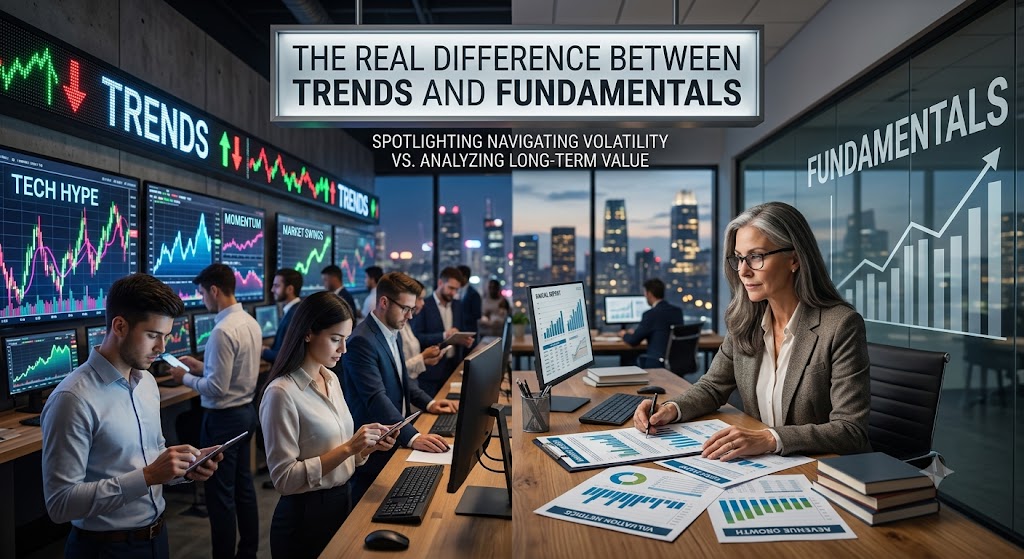
The Real Difference Between Trends and Fundamentals
Every generation is surrounded by trends that promise faster success, easier money, quicker fame, and a simpler path to the life people dream about. Open any social media platform, watch a few videos, read a handful of headlines, or spend a few minutes in online communities, and it quickly becomes obvious that trends dominate conversations. One week everyone is talking about artificial intelligence. The next week it is cryptocurrency. After that it becomes affiliate marketing, dropshipping, short form videos, digital products, personal branding, remote work, or another exciting opportunity that captures public attention. Trends come and go, often at incredible speed. They create excitement because they make people believe they have found the next big thing before everyone else. Unfortunately, while trends receive most of the attention, fundamentals continue doing most of the work behind every lasting success.
Understanding the real difference between trends and fundamentals is one of the most valuable lessons anyone can learn, whether you are building a business, starting a blog, learning technology, investing money, growing a career, or developing yourself as a person. People who spend their lives chasing trends often find themselves constantly starting over. People who master fundamentals usually move slower at the beginning, but they build a foundation that keeps producing results long after the excitement around a particular trend has disappeared.
The biggest mistake many people make is confusing popularity with importance. Something can be popular today without being important tomorrow. Something can dominate conversations without creating lasting value. Social media algorithms reward whatever attracts attention in the present moment. They do not necessarily reward what builds permanent skills or sustainable businesses. This creates an illusion that whatever everyone is talking about must automatically be the best opportunity available. In reality, popularity and usefulness are not always the same thing.
Think about the construction of a skyscraper. Most people admire the beautiful glass walls, the modern design, and the impressive height. Very few people admire the concrete foundation hidden beneath the ground because nobody can see it. Yet without that invisible foundation, the entire building would collapse. Fundamentals are like that hidden foundation. They rarely receive applause because they are not exciting. They require patience, repetition, discipline, and consistency. Trends, on the other hand, are like fresh paint on the outside of the building. They may attract attention, but they cannot hold the structure together.
This explains why so many people appear successful for a short period before disappearing completely. They build on excitement instead of stability. They focus on what is fashionable instead of what is dependable. Every time the market changes, they must reinvent themselves because their success depended entirely on temporary conditions rather than timeless principles.
One of the clearest examples appears in blogging. Every few years people announce that blogging is dead. Then another trend appears claiming that short videos have replaced written content. A few years later another trend suggests newsletters are the future. After that podcasts become the centre of attention. Then artificial intelligence enters the conversation. Amid all these changing trends, one fundamental has never changed. People continue searching for valuable information. As long as human beings continue asking questions, quality content that answers those questions will remain valuable. The format may evolve, but the fundamental human need remains exactly the same.
Search engine optimisation provides another excellent example. Many beginners waste countless hours searching for secret ranking tricks because they want instant traffic. They jump from one SEO strategy to another every month because someone online claims to have discovered a shortcut. Meanwhile, experienced professionals continue focusing on the same fundamentals that have worked for years. They publish useful content, understand user intent, improve website speed, organise their sites properly, earn genuine backlinks, and create an excellent user experience. Search engines may update their algorithms regularly, but their long term objective remains consistent. They want to deliver the best possible answers to users.
Business follows the same pattern. Every few years a new business model becomes fashionable. Thousands of people rush into it expecting instant wealth. Some make money because they enter early or execute well. Many others lose money because they enter late without understanding the underlying business principles. The fundamentals of business remain remarkably stable regardless of changing trends. Businesses survive by solving real problems, creating value, understanding customers, managing cash flow, building trust, and maintaining consistent quality. These principles existed decades ago and will probably continue existing decades from now.
The world of investing offers another lesson. Markets constantly experience new trends. At different times investors become excited about technology companies, renewable energy, electric vehicles, artificial intelligence, biotechnology, or digital currencies. These trends create enormous opportunities for some people. They also create enormous losses for others who mistake excitement for certainty. Experienced investors often remind beginners that understanding company value, risk management, diversification, patience, and emotional discipline matters far more than chasing whatever investment everyone else is discussing today.
Education has also become heavily influenced by trends. New learning platforms appear every year. New programming languages gain popularity. New software tools become fashionable. New certifications emerge. While these developments are valuable, the fundamentals of learning remain unchanged. People still need curiosity, disciplined practice, critical thinking, problem solving, communication skills, and the willingness to keep improving. Technology changes rapidly, but the process of mastering knowledge changes much more slowly.
Consider someone learning graphic design. Every year new design software introduces impressive features powered by artificial intelligence. Beginners often become obsessed with learning every new tool while ignoring colour theory, typography, composition, visual hierarchy, and user psychology. As a result, they own powerful software but produce weak designs. An experienced designer who understands the fundamentals can often create excellent work using older software because the principles matter more than the tools.
The same reality exists in photography. Cameras become more advanced every year. Smartphones now contain features that professional photographers could only dream about years ago. Yet owning an expensive camera does not automatically create beautiful photographs. Understanding lighting, composition, storytelling, timing, perspective, and emotion remains more important than purchasing the latest equipment. Technology changes. Visual storytelling remains fundamental.
Health and fitness demonstrate this principle perfectly. Every year new diet trends become popular. New exercise routines promise miraculous transformations. New supplements claim extraordinary benefits. Despite these changing trends, the fundamentals rarely change. Eating nutritious food, exercising consistently, sleeping well, managing stress, and maintaining healthy habits continue producing better long term results than constantly chasing the latest health craze.
Relationships also reveal the difference between trends and fundamentals. Communication platforms continue evolving. Dating applications introduce new features. Social expectations shift over time. Yet healthy relationships still depend on trust, honesty, respect, empathy, patience, forgiveness, and commitment. Technology may change how people meet, but it cannot replace the timeless qualities required to build meaningful human connections.
The workplace has experienced tremendous transformation over recent years. Remote work, hybrid work, artificial intelligence, automation, and digital collaboration have changed how organisations operate. Despite these changes, employers continue valuing dependable employees who communicate clearly, solve problems effectively, learn continuously, take responsibility, and work well with others. Software skills may help someone secure an interview, but fundamental professional qualities often determine long term career success.
One reason trends attract so much attention is psychological. Human beings naturally fear missing opportunities. Nobody wants to be left behind while others appear to become successful overnight. This fear creates urgency. Urgency often weakens judgement. Instead of asking whether an opportunity creates lasting value, people ask whether everyone else is already participating. They begin making decisions based on emotion rather than careful analysis.
Social media intensifies this behaviour because platforms reward visibility rather than depth. Short success stories spread faster than detailed explanations. Viral content rarely shows years of preparation behind overnight success. Someone may suddenly become famous, but audiences often fail to see the decade of practice, failure, experimentation, and persistence that made the breakthrough possible. Fundamentals remain hidden because they develop quietly over time.
There is nothing inherently wrong with trends. In fact, trends often create incredible opportunities for people who understand them properly. Problems begin when trends replace fundamentals instead of building upon them. A wise entrepreneur uses new technology while maintaining excellent customer service. A successful blogger embraces emerging content formats while continuing to produce valuable information. A skilled programmer learns new programming languages while strengthening logical thinking and software engineering principles.
The strongest professionals usually combine timeless fundamentals with carefully selected trends. They understand that trends provide acceleration while fundamentals provide stability. They welcome innovation without abandoning proven principles. This balanced approach allows them to adapt without becoming unstable whenever the market changes.
History repeatedly confirms this pattern. Companies that survive for generations rarely depend on a single trend. Instead, they continuously adapt while protecting their core values and operational fundamentals. They innovate because markets evolve, but they remain committed to serving customers effectively, maintaining quality, managing finances responsibly, and building trusted brands.
Personal development follows the same principle. Motivational trends constantly appear. Morning routines become fashionable. Productivity systems become popular. New books promise life changing transformations. While these resources can certainly help, they cannot replace personal responsibility, discipline, resilience, self awareness, integrity, and consistent action. Real growth usually happens through ordinary daily habits repeated over long periods rather than dramatic moments of inspiration.
One practical way to distinguish between trends and fundamentals is by asking a simple question. Will this still matter in ten years? If the answer is probably yes, you are likely dealing with a fundamental. If the answer depends entirely on current popularity, you are probably looking at a trend. Learning how to communicate effectively will matter in ten years. Understanding human psychology will matter in ten years. Building trust will matter in ten years. Developing financial discipline will matter in ten years. On the other hand, many popular applications, platforms, hashtags, and internet challenges will likely be forgotten.
Another useful question is whether success depends on external conditions or internal capability. Trends often rely heavily on external circumstances. Fundamentals develop internal strengths that remain valuable regardless of changing environments. Someone who builds excellent writing skills can adapt to blogs, newsletters, books, social media, or future communication platforms that do not yet exist. The platform may change, but the skill continues generating value.
People who build only around trends often experience emotional instability. Their confidence rises whenever the trend grows and falls whenever public attention shifts elsewhere. In contrast, individuals grounded in fundamentals usually maintain greater confidence because their abilities remain useful under different conditions. They understand that while industries evolve, valuable skills continue opening new opportunities.
Artificial intelligence illustrates this balance perfectly. AI represents one of the biggest technological trends of modern times. Ignoring it would be unwise. However, believing AI alone guarantees success is equally misguided. The people most likely to benefit from AI are those who already possess strong fundamentals. Writers produce better content because they understand storytelling. Programmers become more productive because they understand programming logic. Designers create better visuals because they understand design principles. Entrepreneurs make smarter decisions because they understand business fundamentals. AI amplifies existing competence more effectively than it replaces the need for competence.
Content creators face similar decisions every day. Viral formats change rapidly. Algorithms change regularly. Audience preferences evolve continuously. Creators who rely entirely on viral tricks often struggle whenever platforms update their systems. Those who consistently educate, entertain, inspire, or solve problems usually maintain loyal audiences because they deliver genuine value beyond temporary algorithm changes.
Financial success itself reflects the difference between trends and fundamentals. Many people search constantly for the next high income opportunity while neglecting budgeting, saving, investing wisely, increasing their skills, controlling unnecessary spending, and creating multiple sources of value. Income trends may fluctuate, but financial discipline continues protecting wealth over time.
Parents teaching children should pay close attention to this distinction. Instead of preparing children only for today’s technology, they should help them develop curiosity, honesty, resilience, creativity, critical thinking, communication, and adaptability. Specific technologies will eventually become outdated. Strong character and learning ability will continue serving them throughout life.
Leaders who understand fundamentals usually make better long term decisions. They resist unnecessary panic during changing market conditions because they recognise that external trends fluctuate naturally. Instead of reacting emotionally to every new development, they evaluate whether it genuinely strengthens their organisation’s long term objectives. This calm perspective helps them avoid costly mistakes driven by temporary excitement.
One interesting observation is that fundamentals often appear boring precisely because they work. Daily practice is not exciting. Reading consistently is not glamorous. Improving communication requires effort. Building trust takes time. Managing finances responsibly demands discipline. Creating valuable content requires patience. These activities rarely become viral because they are ordinary. Yet ordinary actions repeated consistently often produce extraordinary outcomes.
Meanwhile, trends often promise extraordinary outcomes with ordinary effort. That promise attracts attention because people naturally prefer shortcuts. Unfortunately, shortcuts rarely eliminate the need for genuine competence. Eventually reality catches up. The people who invested in fundamentals continue progressing while those who relied solely on trends begin searching for the next exciting opportunity.
None of this means innovation should be rejected. On the contrary, innovation drives human progress. New technologies improve productivity. New business models expand opportunities. New communication methods connect people globally. The challenge is maintaining perspective. Innovation should strengthen strong foundations rather than replace them.
Imagine two builders preparing to construct houses. One spends nearly all his money decorating the entrance while ignoring the strength of the foundation. The other invests heavily in the structural integrity before adding beautiful finishing touches. Initially, the first house may attract more attention because it looks impressive from the outside. Years later, the second house remains standing while the first develops serious structural problems. Life often works the same way. Trends create attractive entrances. Fundamentals create lasting structures.
This understanding becomes increasingly important in a world where information travels faster than ever before. Every day new experts appear claiming to possess revolutionary secrets. Some genuinely offer valuable insights. Others simply package familiar ideas using attractive marketing language. People who understand fundamentals become better at evaluating these claims because they compare new ideas against timeless principles instead of becoming emotionally overwhelmed by persuasive presentations.
Success rarely belongs exclusively to people who discover the newest trend first. More often, lasting success belongs to those who consistently apply timeless fundamentals while intelligently adapting to changing circumstances. They remain students throughout life. They embrace innovation without abandoning wisdom. They appreciate technology without becoming dependent upon it. They recognise that tools change faster than principles.
Ultimately, the real difference between trends and fundamentals is the difference between temporary attention and lasting value. Trends tell you what people are excited about today. Fundamentals determine who will still be successful tomorrow. Trends may introduce opportunities, but fundamentals determine whether those opportunities become sustainable achievements. Trends attract crowds, while fundamentals build competence. Trends create excitement, while fundamentals create resilience. Trends come with expiration dates, while fundamentals often grow stronger with time.
The smartest approach is not choosing one while rejecting the other. Instead, build your life upon solid fundamentals and then use trends as opportunities to expand, innovate, and accelerate your progress. Let fundamentals become your roots and trends become your branches. Trees survive storms because of deep roots, not because of wide branches. In exactly the same way, people, businesses, careers, and ideas survive changing seasons because they are anchored in timeless principles rather than temporary excitement. When the next trend inevitably arrives, appreciate its possibilities, learn what is useful, discard what is merely fashionable, and continue strengthening the fundamentals that will keep creating value long after today’s headlines have faded into history.

EarnSmartOnline.com.ng is dedicated to helping readers make smarter financial decisions through practical guides on online income, personal finance, technology, digital business, and wealth creation. Our goal is to provide reliable, easy-to-understand, and actionable content that empowers individuals to earn smarter, build sustainable income streams and achieve long-term financial success.
Recommended: Start Earning Online
- Ultimate Affiliate Marketing Program — learn affiliate marketing with a done-for-you sales system ($15). Check it out
- The Newbie Affiliate Guide — the beginner-friendly starter guide (~$6.68). Check it out
- Easy Dollar Maker — earn in dollars uploading AI images and videos from your phone ($17). Check it out
Disclosure: These are affiliate links. If you buy through them, I may earn a commission at no extra cost to you.