
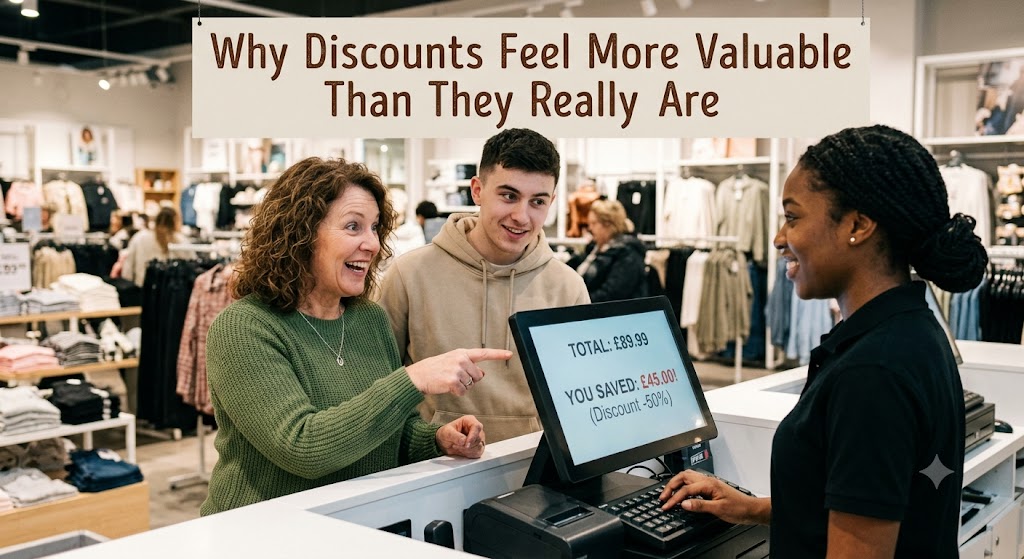
A discount can make an ordinary purchase feel like a financial victory. You walk into a shop intending to spend nothing, see a product marked “30% OFF”, and suddenly feel that buying it would be a smart decision. The original price looks expensive, the discounted price looks attractive, and your brain begins telling you that you are saving money. Sometimes you are. But sometimes the discount is simply making you feel like you are saving money while encouraging you to spend money you never planned to spend in the first place. Why Discounts Feel More Valuable Than They Really Are
This is one of the most interesting psychological effects of shopping. Discounts do not merely change prices. They change how we perceive value. A product that costs ₦50,000 may suddenly feel affordable when it is reduced to ₦35,000, even though ₦35,000 is still ₦35,000 leaving your account. The percentage saved becomes more emotionally powerful than the amount actually spent. You start focusing on the money you supposedly saved instead of the money you actually lost from your available cash.
This is why discounts feel more valuable than they really are.
Imagine walking through a shopping centre and seeing a pair of shoes originally priced at ₦40,000 now selling for ₦25,000. A large sign screams “SAVE ₦15,000”. Your brain immediately notices the ₦15,000 saving. You may even feel excited because it looks like you have discovered an opportunity. But there is a simple question that can completely change the way you look at the purchase. If those shoes had never been discounted and you had not planned to buy them, would you have spent ₦25,000 on them today?
If the answer is no, then you did not save ₦15,000. You spent ₦25,000.
This does not mean discounts are always bad. Discounts can genuinely help people reduce the cost of necessary purchases. A family that needs food, clothing, household items or other essentials can benefit significantly from a well timed price reduction. The problem begins when the existence of a discount becomes the reason for buying something. Why Discounts Feel More Valuable Than They Really Are
This distinction is extremely important because many people confuse getting a good deal with making a good financial decision. They are not always the same thing.
A good deal is about the price of an item compared with its perceived or actual value. A good financial decision is about whether buying the item makes sense for your financial situation. Something can be heavily discounted and still be a terrible purchase.
You could find a television originally priced at ₦500,000 being sold for ₦350,000. The discount is ₦150,000. That sounds impressive. But if you already have a perfectly functional television and buying another one forces you to postpone your rent, delay an important bill or reduce your emergency savings, the discount has not made the purchase financially intelligent. It has simply made an unnecessary expense feel justified.
This is where consumer psychology becomes powerful.
When retailers display an original price beside a discounted price, the original price becomes a reference point in your mind. This is known as anchoring. If you see ₦100,000 crossed out and ₦65,000 displayed beside it, your brain does not evaluate ₦65,000 in isolation. It compares it with the ₦100,000 anchor.
Suddenly ₦65,000 feels cheap.
But what if the product was never worth ₦100,000 to you in the first place? What if you would have considered ₦65,000 expensive if there were no “₦100,000” price sitting beside it?
The anchor has changed your perception.
This happens everywhere. “Was ₦200,000, now ₦120,000.” “Buy one, get one free.” “Limited time offer.” “Flash sale.” “Clearance.” “Only today.” “Save 50%.” These messages are designed to make the purchase feel urgent and financially rewarding.
The language matters because shopping is not purely mathematical. People make financial decisions emotionally and then use logic to justify them.
A person may say, “I bought it because it was 50% off.”
But the deeper truth may be, “I bought it because the discount made me afraid of missing an opportunity.”
That fear is powerful.
It is called the fear of missing out, often shortened to FOMO. When people believe an opportunity will disappear soon, they become more willing to act quickly. A product that seems ordinary today can suddenly feel extremely important when the seller says the offer ends at midnight.
The product has not changed.
Your emotional relationship with the product has changed.
This is why urgency and discounts work so well together. A discount says, “You are getting more than you are paying for.” Urgency says, “You may never get this opportunity again.” Put the two together and the customer can feel almost foolish for walking away. Why Discounts Feel More Valuable Than They Really Are
The result is impulsive spending.
One of the biggest problems with discount shopping is that people calculate the discount instead of calculating the opportunity cost. If you spend ₦50,000 on something because it is discounted, that ₦50,000 cannot simultaneously remain in your bank account, pay another bill, increase your savings or fund another opportunity.
Money has alternatives.
Every naira you spend is a naira you cannot spend somewhere else.
Suppose you have ₦100,000 available and find an item discounted from ₦100,000 to ₦70,000. You might tell yourself that you saved ₦30,000. But if you had planned to use that ₦70,000 for business capital, transport, school expenses or emergency savings, the real cost of the purchase is not simply the discounted price. It is also the opportunity you gave up.
This is why financially disciplined people often ask a different question before buying something.
They do not only ask, “How much am I saving?”
They ask, “What else could this money do?”
That question can completely transform your spending habits.
Another psychological trick behind discounts is the feeling of winning. Humans naturally enjoy the sensation of getting something for less than expected. When you negotiate a price down from ₦80,000 to ₦60,000, you may feel like you defeated the seller. When an online store tells you that you have saved ₦20,000, you may experience a similar feeling.
The purchase becomes a small personal victory.
And once you emotionally classify the purchase as a victory, you are less likely to examine whether you actually needed it.
This explains why people sometimes buy multiple unnecessary items during sales. One discount leads to another. A person goes online looking for one shirt and leaves with shoes, a bag, headphones and accessories because everything is “on sale”.
The individual prices may look attractive.
The total bill tells a different story.
This is why a shopping basket full of discounted products can sometimes cost far more than buying one full priced item you actually needed.
There is also something psychologically fascinating about “free”. Buy one, get one free is one of the most powerful promotional techniques because the word “free” triggers a strong emotional response. People often become less sensitive to the actual value of the purchase when something is presented as free.
But free does not always mean valuable.
If you spend ₦20,000 to receive something worth ₦5,000 for free, you have still spent ₦20,000. The free item did not reduce the amount leaving your pocket unless you genuinely wanted and would otherwise have purchased it.
The same principle applies to free delivery.
A customer may add another ₦10,000 product to an online cart because the store offers free delivery for purchases above ₦50,000. The customer feels clever because delivery is free. But if the extra product was unnecessary, paying for delivery might have been cheaper than qualifying for “free” delivery. Why Discounts Feel More Valuable Than They Really Are
Why Discounts Feel More Valuable Than They Really Are
The word free can make people spend more.
This is not necessarily because people are irrational. It is because the human brain is constantly trying to simplify decisions. Discounts provide an easy shortcut. Instead of calculating long term value, need, alternatives and opportunity cost, your brain sees a bright signal that says “good deal”.
That shortcut can be useful sometimes.
It can also be expensive.
Another reason discounts feel more valuable than they really are is that we often compare prices instead of comparing usefulness. A ₦100,000 product discounted to ₦60,000 looks like a ₦40,000 bargain. But if you only use it twice, it may be poor value. Meanwhile, a ₦20,000 product that you use every day for two years could provide significantly more value.
Price is not the same thing as value.
Value is connected to usefulness, durability, frequency of use, quality and relevance to your needs.
This is particularly important when shopping for clothes, electronics, subscriptions, furniture and other items that can easily accumulate in a household.
A discount does not increase the usefulness of a product.
It only reduces its price.
That distinction sounds obvious, but it is surprisingly easy to forget when confronted with a large percentage sign.
Retailers understand this very well. That is why discounts are often displayed prominently while the actual product benefits receive less attention. The customer is encouraged to think about how much money they are saving rather than whether they should spend the remaining amount.
Consider a simple example. You have ₦30,000. You see a product marked down from ₦30,000 to ₦18,000. You feel like you have saved ₦12,000.
But your bank balance does not increase by ₦12,000.
It decreases by ₦18,000.
This is one of the simplest financial truths that discount psychology can make people forget.
A discount can reduce the amount you spend compared with the original price, but it does not automatically create wealth.
Saving money and not spending money are two different things.
If you were going to buy a necessary item for ₦30,000 and find it for ₦18,000, then yes, you have genuinely reduced your expenditure by ₦12,000. But if you were not going to buy the item at all, the discount has not saved you ₦12,000. It has created an ₦18,000 expense.
This is the difference between planned saving and promotional spending.
Planned saving happens when you purchase something you genuinely need at a lower price than expected and keep the difference.
Promotional spending happens when the promotion itself creates the desire to purchase.
The second one is where many budgets quietly collapse.
Another issue is that consumers sometimes assume a higher original price automatically means a higher quality product. A product advertised as “₦150,000, now ₦75,000” can feel more premium than a similar product permanently priced at ₦75,000. The higher original price creates an impression of greater value.
But price tags are not always perfect measures of quality.
A product can be expensive and still be poor value. A product can be cheap and still be excellent value. A discount can make an expensive product look affordable without changing whether it is actually worth owning.
This is why comparison shopping matters.
Before buying something because of a discount, compare the product with alternatives. Look at quality, warranty, durability, reviews, specifications and long term usefulness. Ask whether another seller offers a similar product at a similar price without pretending that you are receiving an enormous discount.
Sometimes the best bargain is not the product with the biggest percentage reduction.
It is the product that gives you the most useful result for the money you spend.
There is another trap people rarely notice. Discounts can make us feel financially responsible while we are actually increasing our consumption.
Someone might say, “I am not wasting money. I only buy things when they are on sale.”
That sounds disciplined.
But if you keep buying things you do not need simply because they are discounted, the discount becomes the excuse for consumption.
Imagine buying ten unnecessary items at 30% off. You may feel proud of the discounts. But you still spent 70% of the original prices on ten things you did not need. Why Discounts Feel More Valuable Than They Really Are
Sometimes buying nothing is the biggest discount available.
This mindset can be difficult because modern advertising constantly creates the impression that there is always another opportunity. There is always a sale, another promotion, another flash deal, another coupon, another limited offer.
But most opportunities are not as rare as they appear.
A genuine need does not suddenly become more important because a countdown timer appears on a website.
Learning to recognise this can dramatically improve your financial decisions.
One useful strategy is to separate the decision to buy from the decision to take advantage of the discount. First ask whether you want or need the product at its normal price. Then ask whether the discounted price makes the purchase better.
If you would not buy it without the discount, pause.
If you would buy it anyway, compare prices.
If the discount is genuine and the product is useful, then the promotion may actually benefit you.
Another powerful strategy is to wait. Give yourself a cooling off period before making non essential purchases. The emotional intensity created by a discount often decreases when you leave the shopping environment.
What looked like an incredible opportunity at 8pm may look completely unnecessary the following morning.
That is useful information.
Your desire did not disappear because the product became worse. It disappeared because the emotional pressure disappeared.
This is why financially healthy spending is often boring.
There is no adrenaline.
There is no excitement about beating the system.
There is simply a decision based on need, affordability and value.
The goal is not to avoid every discount. The goal is to stop allowing discounts to control your decisions.
There is nothing wrong with enjoying a good bargain. In fact, smart shoppers can save significant amounts of money by buying necessary products during genuine promotions. The problem is allowing the discount to become the main reason for the purchase.
A financially intelligent person does not ask only, “How much am I saving?”
They ask, “Would I still want this if there were no discount?”
They ask, “Was this already in my budget?”
They ask, “Do I have a better use for this money?”
They ask, “How often will I actually use this?”
They ask, “Is this the best value available?”
They ask, “Am I buying this because I need it or because I am afraid of missing the deal?”
Those questions are simple, but they can protect you from thousands of naira in unnecessary spending over time.
The deeper lesson is that discounts are not just about prices. They are about perception.
A discount can make you feel richer while making your bank account poorer.
It can make an unnecessary purchase feel responsible.
It can make spending feel like saving.
It can make urgency feel like opportunity.
And it can make you believe you have won simply because you paid less than the number printed above the new price.
The smartest financial decision is sometimes not finding a bigger discount.
It is refusing to buy something simply because it is discounted.
Money management is not about getting everything cheaply. It is about directing your money towards things that genuinely improve your life, protect your future or create value.
The next time you see “50% OFF”, do not immediately celebrate the 50%.
Look at the 50% you are still going to spend.
Then ask yourself the question that many advertisements hope you never ask:
“If this wasn’t on sale, would I still buy it?”
If the answer is no, the discount may not be saving you money. Why Discounts Feel More Valuable Than They Really Are
It may simply be giving you a cheaper reason to spend it.

EarnSmartOnline.com.ng is dedicated to helping readers make smarter financial decisions through practical guides on online income, personal finance, technology, digital business, and wealth creation. Our goal is to provide reliable, easy-to-understand, and actionable content that empowers individuals to earn smarter, build sustainable income streams and achieve long-term financial success.
Recommended: Start Earning Online
- Ultimate Affiliate Marketing Program — learn affiliate marketing with a done-for-you sales system ($15). Check it out
- The Newbie Affiliate Guide — the beginner-friendly starter guide (~$6.68). Check it out
- Easy Dollar Maker — earn in dollars uploading AI images and videos from your phone ($17). Check it out
Disclosure: These are affiliate links. If you buy through them, I may earn a commission at no extra cost to you.



