
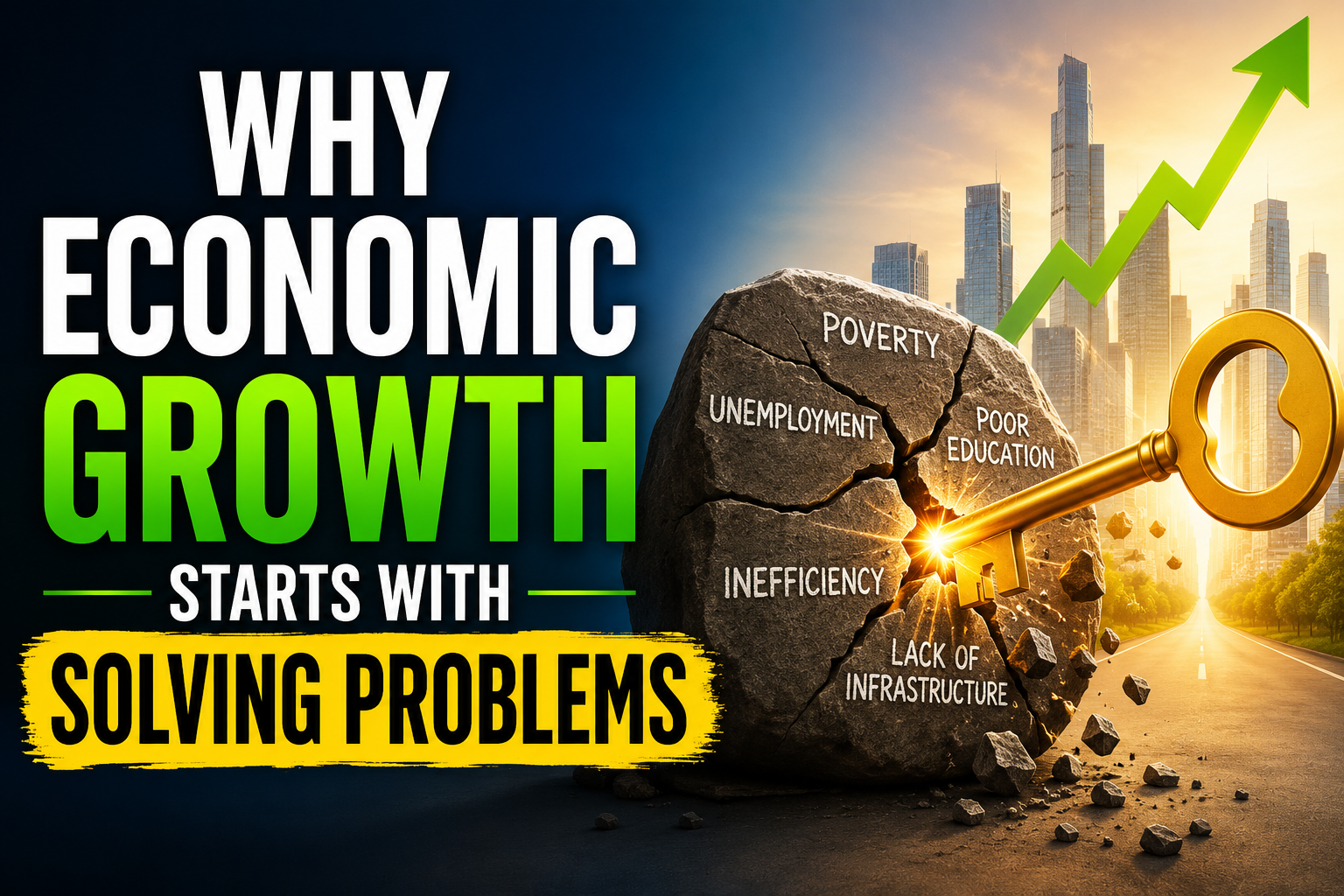
Why Economic Growth Starts With Solving Problems
Economic growth is often discussed as something that happens in charts, policies, or financial reports, but at its core it is a simple human process. Growth begins when problems are solved in a way that improves how people live, work, trade, or survive. Every strong economy, whether at a small business level or across entire nations, is built on one repeating pattern. Someone identifies a problem, creates a solution, and other people are willing to exchange value for that solution. Over time, this exchange multiplies and becomes economic expansion.
The foundation of all economic activity is human need. People need food, shelter, safety, transportation, communication, education, healthcare, and convenience. Whenever any of these needs are not fully met, there is an opportunity waiting to be discovered. Economic growth does not begin with money itself. It begins with discomfort, inefficiency, or limitation in human life. Money only enters the picture when someone organizes a way to reduce that discomfort or improve that limitation.
The reason problem solving drives growth is because value is subjective. Something becomes valuable only when it changes a condition for someone else. If a person is hungry, food has value. If a person is sick, medicine has value. If a person is stranded, transportation has value. The stronger the problem, the more valuable the solution becomes. This is why businesses that address urgent or painful problems tend to grow faster than those that deal with optional or low priority needs.
In every economy, problems exist at different levels. Some are small daily inconveniences, while others are structural and long term inefficiencies. The bigger the problem being solved, the larger the potential for economic impact. For example, improving communication across distances created entire industries from postal services to telecommunications to modern internet platforms. Each stage of improvement did not eliminate the need for solutions. It expanded the economy by creating new layers of demand.
Economic growth also depends on how effectively solutions scale. A solution that only helps one person has limited economic impact. However, a solution that helps millions creates massive growth. This is why technology plays such a central role in modern economies. Technology allows one solution to be replicated and distributed at near zero additional cost. When a single idea can reach millions of people, the economic effect multiplies rapidly.
Another important factor is efficiency. Many problems already have solutions, but those solutions may be slow, expensive, or inconvenient. Economic growth happens when someone finds a better way to solve an existing problem. This improvement does not always require inventing something entirely new. Sometimes it simply involves making something faster, cheaper, easier, or more accessible. Even small improvements in efficiency can lead to large economic shifts when applied across entire populations.
Problem solving also drives competition, which further fuels growth. When multiple people or organizations attempt to solve the same problem, they compete to create better solutions. This competition pushes innovation forward. It forces improvements in quality, price, and delivery. Over time, the end result is a stronger and more efficient economy. Without competition, solutions become stagnant and growth slows down.
At the individual level, understanding problem solving is essential for financial success. Income is not randomly distributed. It is closely tied to how effectively a person solves problems for others. People who solve rare, complex, or high impact problems are usually rewarded more than those who solve common or easily replaceable problems. This is why skill development is so closely connected to economic opportunity. Skills are simply tools for solving problems more effectively.
Many people struggle economically not because they lack effort, but because they focus on problems that are already oversupplied with solutions. When too many people are solving the same simple problems, the value of each individual solution decreases. On the other hand, when someone learns to identify overlooked or emerging problems, they position themselves in areas where demand is higher than supply. This imbalance creates opportunity.
Economic growth also depends on awareness. A problem cannot be solved if it is not recognized. Many of the most important economic breakthroughs in history began with someone noticing inefficiencies that others ignored. This awareness is often the difference between stagnation and progress. People who train themselves to observe problems carefully tend to discover opportunities earlier than others.
Another key element is urgency. Not all problems are treated equally by society. Some problems can be ignored without immediate consequences, while others demand immediate attention. The more urgent a problem is, the more people are willing to pay for its solution. This is why industries related to health, safety, and essential services tend to remain stable even during economic downturns. The urgency of human need ensures continuous demand.
Economic systems also evolve based on how problems are prioritized. As societies grow, basic problems such as survival become less dominant, and more advanced problems emerge. These include problems related to convenience, productivity, mental well being, and time management. This shift creates new industries and opportunities. It also explains why economies become more complex over time. Growth is not just expansion, it is transformation from simple problem solving to advanced problem solving.
It is also important to understand that problem solving is not limited to products or services. It extends to systems, processes, and ideas. Governments solve problems through policies, companies solve problems through operations, and individuals solve problems through personal decisions. Every layer of society participates in the same fundamental process. When these layers align effectively, economic growth becomes more stable and sustainable.
One of the most powerful aspects of problem solving is its compounding effect. A single solution can lead to multiple new problems that also require solutions. For example, the invention of the internet solved communication barriers but created new challenges such as cybersecurity, digital storage, and information overload. Each new challenge became an opportunity for further economic activity. This cycle of solving and creating problems is what drives continuous growth.
Economic growth also depends on how quickly societies adapt to new problems. When change happens slowly, solutions remain relevant for longer periods. When change happens rapidly, there is constant demand for new solutions. In modern economies, rapid technological and social change means that problem solving has become an ongoing requirement rather than a one time activity. This increases both opportunity and competition.
At its deepest level, economic growth is a reflection of human creativity applied to real world challenges. Every time someone chooses to improve a situation rather than accept it, they contribute to economic expansion. This mindset is what separates stagnant environments from thriving ones. Growth is not only about external factors such as capital or infrastructure. It is also about internal willingness to identify and address problems.
In conclusion, economic growth starts with solving problems because problems represent unmet needs, inefficiencies, and opportunities for improvement. When solutions are created, value is generated. When value is exchanged, economies grow. The scale, speed, and effectiveness of problem solving determine the strength of any economy. Whether at the level of individuals, businesses, or entire nations, the principle remains the same. Solve meaningful problems consistently, and growth becomes a natural outcome of that process.

EarnSmartOnline.com.ng is dedicated to helping readers make smarter financial decisions through practical guides on online income, personal finance, technology, digital business, and wealth creation. Our goal is to provide reliable, easy-to-understand, and actionable content that empowers individuals to earn smarter, build sustainable income streams and achieve long-term financial success.
Recommended: Start Earning Online
- Ultimate Affiliate Marketing Program — learn affiliate marketing with a done-for-you sales system ($15). Check it out
- The Newbie Affiliate Guide — the beginner-friendly starter guide (~$6.68). Check it out
- Easy Dollar Maker — earn in dollars uploading AI images and videos from your phone ($17). Check it out
Disclosure: These are affiliate links. If you buy through them, I may earn a commission at no extra cost to you.



