
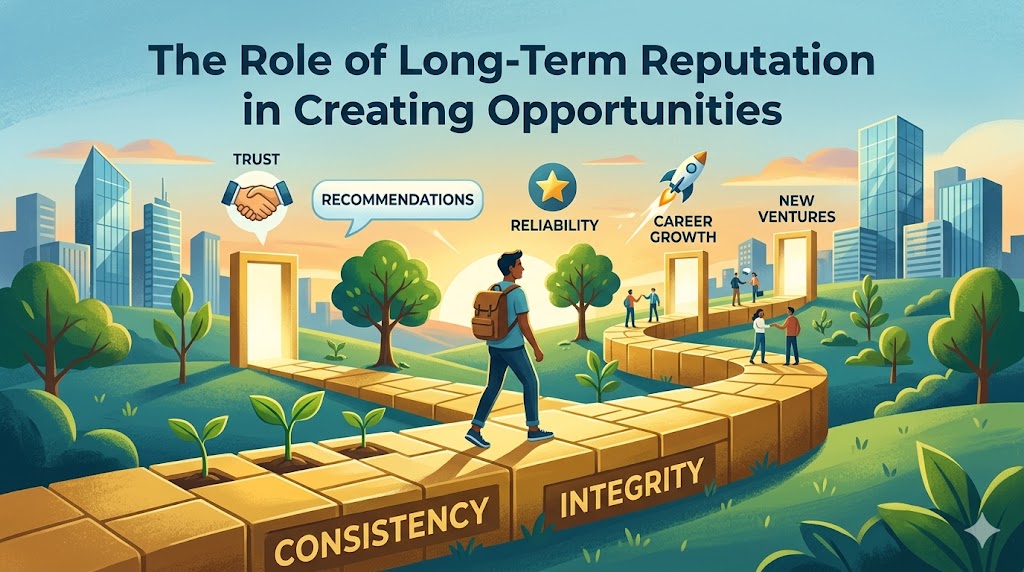
The Role of Long-Term Reputation in Creating Opportunities
In most conversations about success, people focus heavily on skills, talent, money, or even timing, but one of the most quietly powerful forces shaping opportunity is long-term reputation. It is the thing people often ignore because it does not give instant rewards, yet over time it becomes one of the strongest currencies a person can ever build. Reputation is not just about what people think of you in a single moment, it is the accumulated result of how consistently you behave, how reliably you deliver, and how well you handle responsibility when nobody is forcing you to. In many cases, it is the invisible factor that determines whether doors open easily or remain permanently closed.
Long-term reputation works because human beings rely on trust to make decisions. Nobody has unlimited time to investigate every detail about every person they meet, so the brain naturally uses shortcuts. These shortcuts are based on patterns, past experiences, and what others say about you. When your reputation signals consistency, reliability, and honesty, people feel safer engaging with you. That sense of safety is often more valuable than raw ability. In fact, many opportunities are not given to the most talented person, but to the person who is most trusted to not create problems later.
One of the most overlooked aspects of reputation is that it compounds over time. At the beginning, small actions may seem insignificant. Showing up early, keeping promises, delivering work on time, or even how you treat people in low status positions may feel like things nobody notices. But over time, these patterns begin to define how people categorize you mentally. Once a pattern is formed, it becomes difficult to erase, and this is where long-term advantage begins to emerge. People start recommending you without you asking, opportunities begin to appear through indirect channels, and your name starts carrying weight even before you enter a room.
A strong reputation also reduces friction in life. Instead of constantly proving yourself from zero in every new situation, people already arrive with a baseline expectation of trust. This makes collaboration easier, negotiations smoother, and access faster. In contrast, a weak or inconsistent reputation creates the opposite effect. Even when such individuals are capable, they often have to work twice as hard to convince others to take a chance on them. This hidden tax on credibility is one of the reasons some people feel stuck despite having skills.
Another powerful dimension of reputation is how it shapes the quality of opportunities that come your way. Not all opportunities are equal. Some drain energy, some build growth, and some open entirely new levels of access. People with strong reputations tend to attract better opportunities not because they chase them aggressively, but because others are more willing to share them. When someone trusts your judgment and character, they are more likely to involve you in important conversations, high value projects, or strategic decisions. Over time, this creates a shift from chasing opportunities to attracting them.
Reputation also plays a major role in resilience during failure. Everyone makes mistakes, but not everyone is judged the same way when they do. A person with a strong history of reliability is often given the benefit of the doubt, while someone with a weak reputation may find that even small mistakes are used as confirmation of past doubts. This difference affects how quickly people can recover from setbacks. In this sense, reputation acts like a buffer that absorbs shocks and gives people room to recover and improve without being permanently defined by a single event.
In modern digital society, reputation has become even more important because it is no longer limited to personal interactions. Everything leaves traces. What you say, what you post, how you behave in public spaces, and even how you engage with others online can all contribute to your long-term profile. This means reputation is no longer just built in private circles but across broader networks that can scale far beyond immediate geography. A single positive or negative pattern can influence how strangers perceive you long before you ever meet them.
What makes reputation even more powerful is that it often determines access before ability is even tested. In many cases, people are given roles, partnerships, or financial opportunities based on perceived trustworthiness first, and competence second. This is because competence can be verified over time, but trust must exist upfront for any relationship to begin. Without trust, there is no entry point. With trust, even average ability can be developed into excellence because people are willing to give room for growth.
However, reputation is fragile because it is built slowly but can be damaged quickly. One careless action, repeated inconsistency, or failure to respect commitments can undo years of progress. This is why people who understand reputation treat it as an asset that must be protected deliberately. They are careful not only with major decisions but also with small behaviors that seem insignificant in the moment. Over time, these small choices determine whether their reputation becomes a bridge or a barrier.
Another important truth is that reputation is not built by claiming it, but by demonstrating it. Many people try to present themselves as reliable or trustworthy, but real reputation is earned through evidence. It is what others say about you when there is no pressure to be polite. It is the pattern they can predict from your behavior. Because of this, reputation cannot be faked in the long term. It always aligns with consistent action, not intention.
Long-term reputation also influences how much leverage a person has in any situation. Leverage is the ability to influence outcomes without directly controlling all the variables. When people trust you, they are more willing to follow your lead, support your ideas, or give you autonomy. This reduces the need for constant supervision or persuasion. In professional environments, this translates into faster career growth, better partnerships, and more freedom in decision making.
At a deeper level, reputation also shapes identity. Over time, people begin to act in alignment with how they are perceived. If you are known as someone responsible, you tend to behave more responsibly because you do not want to break that expectation. If you are known for inconsistency, it becomes easier to slip into that pattern again. This feedback loop means reputation does not just influence how others see you, it influences how you see yourself and how you behave in future situations.
Ultimately, long-term reputation is not built in dramatic moments but in repeated ordinary actions. It is built in how you respond when no one is watching, how you treat commitments when they become inconvenient, and how consistently you show up over time. While many people chase shortcuts to success, reputation is the one path that cannot be rushed but always pays off when maintained.
In the long run, opportunities tend to move toward people who have proven they can be trusted with them. Skills open the door, but reputation keeps the door open and often opens additional doors that were not originally visible. It determines not just what you can do, but what people are willing to let you do. And in a world where trust is becoming more valuable than ever, long-term reputation is no longer just an advantage, it is a form of invisible infrastructure that supports every other form of success.

EarnSmartOnline.com.ng is dedicated to helping readers make smarter financial decisions through practical guides on online income, personal finance, technology, digital business, and wealth creation. Our goal is to provide reliable, easy-to-understand, and actionable content that empowers individuals to earn smarter, build sustainable income streams and achieve long-term financial success.
Recommended: Start Earning Online
- Ultimate Affiliate Marketing Program — learn affiliate marketing with a done-for-you sales system ($15). Check it out
- The Newbie Affiliate Guide — the beginner-friendly starter guide (~$6.68). Check it out
- Easy Dollar Maker — earn in dollars uploading AI images and videos from your phone ($17). Check it out
Disclosure: These are affiliate links. If you buy through them, I may earn a commission at no extra cost to you.



