
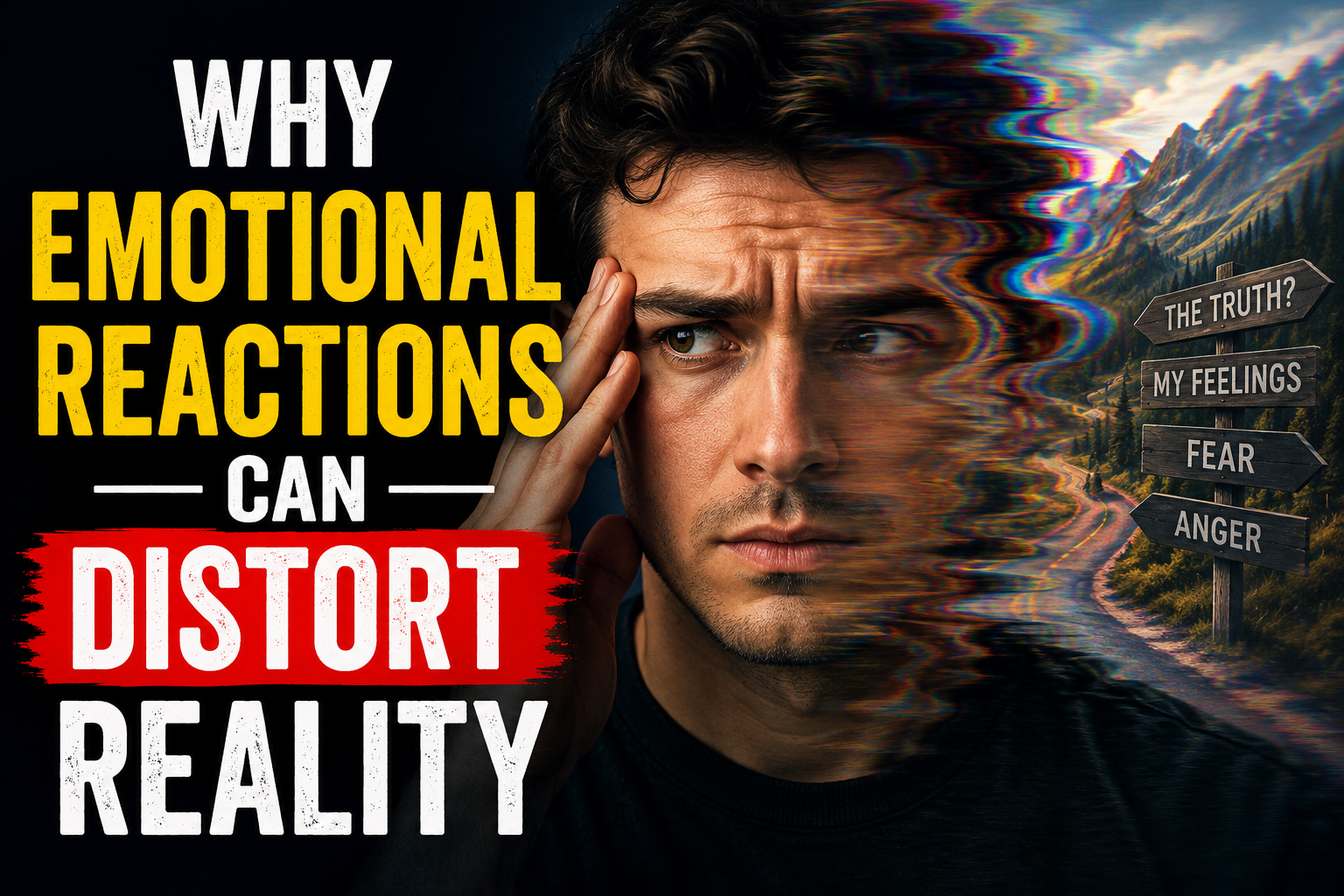
Why Emotional Reactions Can Distort Reality
Emotions are one of the most powerful forces shaping human perception. They influence how we interpret events, how we remember experiences, and how we make decisions in real time. While emotions are essential for survival and connection, they often become a filter that reshapes reality in ways that are not always accurate. When emotions rise, logic tends to step back, and what remains is a version of reality colored by fear, excitement, anger, or sadness. This is why emotional reactions can easily distort reality without us even realizing it.
At the core of this distortion is the way the human brain processes information. The brain is not designed to be a perfect recorder of facts. Instead, it is designed to prioritize survival. This means that when strong emotions are triggered, the brain shifts into a protective mode. In this mode, it focuses more on reacting quickly than on analyzing accurately. For example, when someone feels threatened or disrespected, the emotional part of the brain amplifies the situation, making it feel larger or more urgent than it actually is. This creates a gap between what is real and what is felt.
One of the most common ways emotional reactions distort reality is through exaggeration. A small mistake can feel like a major failure. A delayed response from someone can feel like rejection. A simple disagreement can feel like betrayal. These emotional interpretations often go beyond the actual facts of the situation. The mind builds narratives around the emotion, and those narratives start to feel like truth. Over time, this can lead to misunderstandings, conflicts, and poor decisions that are based more on feelings than on reality.
Another important factor is selective attention. When emotions are strong, people tend to focus only on details that support how they feel. If someone is angry, they will notice everything that confirms their anger while ignoring anything that might soften it. If someone is anxious, they will focus only on potential threats while ignoring signs of safety. This selective attention creates a biased version of reality where only part of the picture is visible. The full context gets lost, and decisions are made based on incomplete information.
Memory is also heavily influenced by emotional reactions. People do not remember events exactly as they happened. Instead, they remember how they felt during those events. This means that emotional intensity can reshape memories over time. A situation that was only mildly negative can be remembered as deeply painful if it was experienced during a strong emotional moment. This distortion of memory affects how people interpret their past and how they expect their future to unfold. It can also reinforce beliefs that are not entirely accurate.
Emotional reactions also distort reality by speeding up judgment. When emotions are high, the mind tends to jump to conclusions without gathering enough evidence. This creates a situation where assumptions replace facts. For example, someone might assume they are being ignored when in reality the other person is simply busy. The emotional brain fills in gaps with worst case scenarios because it prioritizes protection over accuracy. While this can be useful in dangerous situations, it becomes harmful in everyday life where patience and understanding are required.
Another layer of distortion comes from projection. People often project their internal emotional state onto external situations. When someone feels insecure, they may interpret neutral behavior as judgment. When someone feels guilty, they may assume others are disappointed in them. This projection creates a false connection between internal emotions and external reality. Instead of seeing things as they are, people see them through the lens of what they are currently feeling.
Social dynamics also amplify emotional distortion. In group settings, emotions spread quickly from one person to another. This emotional contagion can turn small misunderstandings into large conflicts. When people react emotionally in groups, the collective perception of reality can shift dramatically. A calm situation can suddenly feel tense or hostile simply because emotions have spread through the group. This shows how fragile objective perception can be when emotions are involved.
Stress and fatigue make emotional distortion even worse. When the mind is tired or overwhelmed, its ability to regulate emotions decreases. This leads to stronger reactions and weaker reasoning. Under stress, the brain becomes more reactive and less analytical. Small problems begin to feel overwhelming, and minor challenges feel like major obstacles. This is why people often make poor decisions when they are emotionally drained. The filter of rational thinking becomes weaker, allowing emotions to take full control of perception.
Another important aspect is identity fusion with emotion. Many people unconsciously believe that their emotions define truth. If something feels true, they assume it must be true. This creates a dangerous loop where feelings are treated as facts. In reality, emotions are signals, not facts. They provide information about internal states but do not always reflect external reality. Confusing emotional signals with objective truth leads to distorted interpretations of events.
Emotional reactions also affect communication. When people speak or respond while emotionally charged, their words often carry more intensity than intended. This can escalate situations unnecessarily. A simple conversation can turn into an argument because emotions distort tone, meaning, and intention. Later, when emotions settle, people often realize that the situation was not as serious as it felt in the moment. This gap between emotional intensity and actual reality is one of the main causes of conflict in relationships.
The impact of emotional distortion extends to decision making as well. Decisions made in emotional states tend to prioritize short term relief over long term benefit. For example, anger can lead to impulsive actions, while fear can lead to avoidance of necessary risks. These emotionally driven decisions often feel justified in the moment but can lead to regret later. This is because the emotional mind focuses on immediate comfort rather than long term consequences.
Understanding how emotional reactions distort reality is important because it allows for better self awareness. When people recognize that their perception may be influenced by emotion, they gain the ability to pause and reassess situations more objectively. This does not mean ignoring emotions but rather observing them without letting them fully control interpretation. Emotional awareness creates space between feeling and response, which helps restore clarity.
Developing this awareness requires practice. It involves learning to question immediate interpretations, slowing down reactions, and seeking additional context before forming conclusions. It also involves recognizing patterns in personal emotional triggers. Once someone understands what situations tend to provoke strong emotional responses, they can begin to anticipate and manage them more effectively.
Over time, this leads to more balanced thinking. Instead of reacting instantly to emotional signals, the mind learns to filter them through reasoning. This does not eliminate emotions but integrates them with logic. The result is a more accurate perception of reality, where decisions are based on both feeling and understanding rather than feeling alone.
In conclusion, emotional reactions are not enemies of truth, but they are powerful forces that can easily distort it. They shape perception, influence memory, and affect judgment in ways that are often invisible to the individual experiencing them. By becoming aware of this influence, it becomes possible to separate emotional intensity from objective reality. This separation is not about suppressing emotions but about understanding their role. When emotions are observed rather than obeyed blindly, reality becomes clearer, decisions become wiser, and life becomes more balanced.

EarnSmartOnline.com.ng is dedicated to helping readers make smarter financial decisions through practical guides on online income, personal finance, technology, digital business, and wealth creation. Our goal is to provide reliable, easy-to-understand, and actionable content that empowers individuals to earn smarter, build sustainable income streams and achieve long-term financial success.
Recommended: Start Earning Online
- Ultimate Affiliate Marketing Program — learn affiliate marketing with a done-for-you sales system ($15). Check it out
- The Newbie Affiliate Guide — the beginner-friendly starter guide (~$6.68). Check it out
- Easy Dollar Maker — earn in dollars uploading AI images and videos from your phone ($17). Check it out
Disclosure: These are affiliate links. If you buy through them, I may earn a commission at no extra cost to you.



