
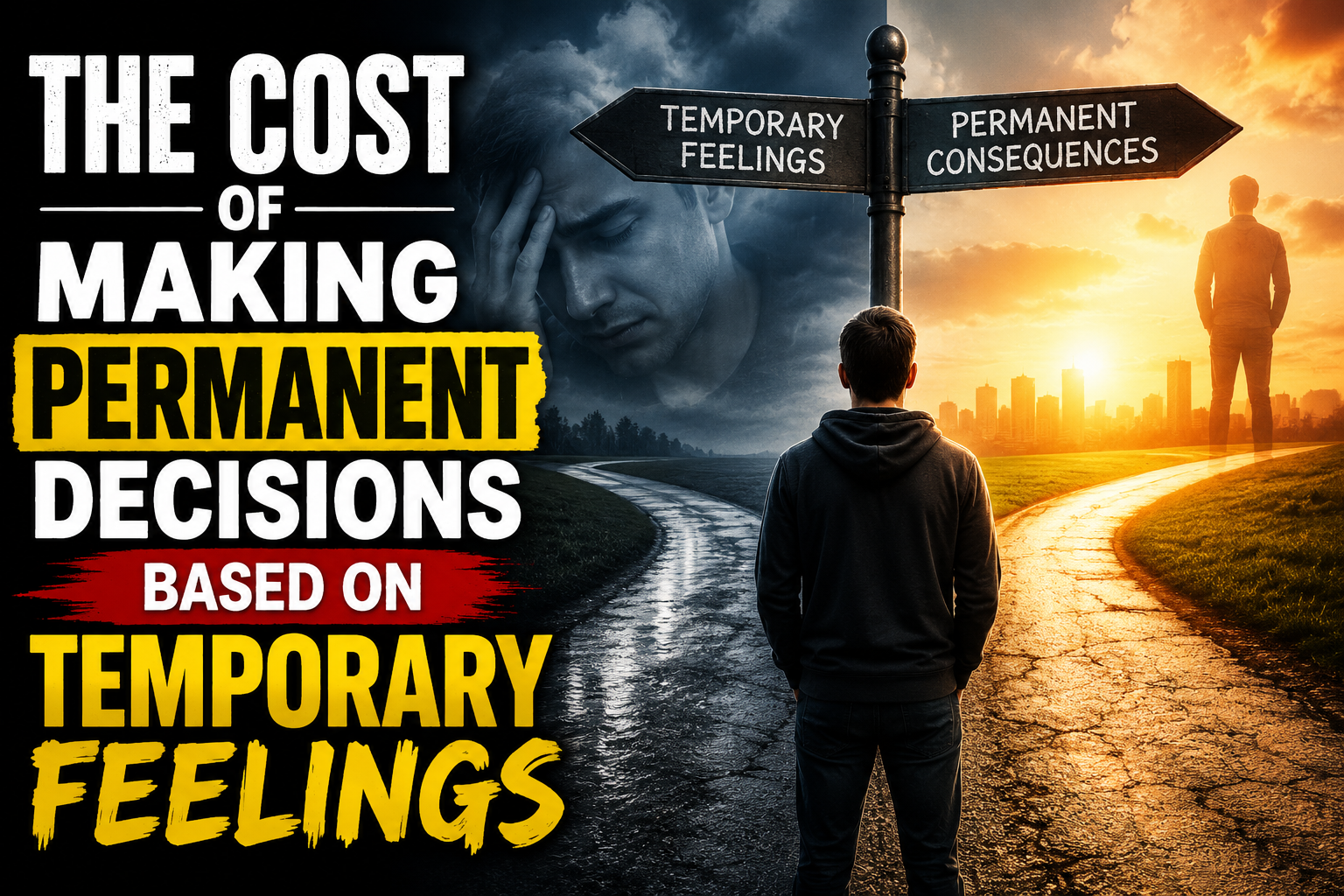
The Cost of Making Permanent Decisions Based on Temporary Feelings
Human emotions are powerful. They shape how we see the world, how we interpret events, and how we respond to situations in real time. But one of the most dangerous mistakes people make in life is allowing emotions that are temporary to influence decisions that are permanent. Feelings are not stable indicators of truth. They are reactions to moments, not maps for life direction. Yet many people build their entire future on decisions made during emotional peaks or emotional lows, only to realize later that the moment passed but the consequences did not. The Cost of Making Permanent Decisions Based on Temporary Feelings.
Temporary feelings often feel permanent while they are happening. When someone is angry, it feels like that anger is justified and final. When someone is sad, it feels like the sadness will never end. When someone is excited, it feels like the excitement is a clear signal of certainty. But emotions are not designed to last. They rise, they peak, and they fade. The problem begins when decisions are locked in during these emotional states. A job is quit in frustration. A relationship is ended in anger. A business is abandoned in fear. Opportunities are rejected out of anxiety. In the moment, these actions feel right. But time often reveals that the emotion that triggered the decision was temporary, while the consequences remain long after the feeling disappears.
One of the most common examples of this pattern appears in relationships. Many relationships that could have grown into something meaningful end not because of incompatibility, but because of emotional reactions during conflict. A single argument can lead to harsh words, and those words can lead to irreversible decisions. Later, when calm returns, clarity also returns. People begin to see the situation differently. They realize that the issue was not as big as it felt in the heat of the moment. But by then, the damage is already done. The relationship is ended, trust is broken, and in some cases, years of potential connection are lost because of a few minutes of emotional intensity.
The same pattern exists in career decisions. A person may feel undervalued at work after a stressful week and decide to resign immediately. In that emotional state, leaving feels like empowerment. It feels like taking control. But once the emotional wave passes, reality sets in. Bills still exist. Opportunities may not appear as quickly as expected. The decision that felt liberating in the moment becomes a source of regret over time. What was supposed to be a short-term emotional relief turns into a long-term structural setback.
Financial decisions are also deeply affected by temporary feelings. People often spend money to regulate emotions. Stress leads to impulsive purchases. Sadness leads to emotional spending. Excitement leads to overcommitment. In each case, the financial decision is not based on logic or long-term planning but on the need to regulate a temporary emotional state. The result is often financial instability that lasts far longer than the emotion that caused it. Money spent in emotional moments does not return when the feeling disappears.
Fear is another powerful driver of permanent decisions. Fear convinces people to avoid risks, even when those risks could lead to growth. A person may fear failure and decide never to start a business. Another may fear rejection and avoid pursuing a meaningful relationship. Another may fear embarrassment and avoid opportunities that require visibility or confidence. Fear feels like protection in the moment, but it often becomes limitation in the long run. What was meant to be a protective emotion becomes a permanent barrier to progress.
Regret is what usually follows these emotionally driven decisions. Regret is unique because it is often clearer than the original emotion that caused the decision. It comes after reflection, after distance, and after emotional calm returns. At that point, people begin to see what they could not see in the moment. They realize that the decision was not made from wisdom but from reaction. But regret cannot easily reverse permanent choices. Time does not reset itself. Some consequences can be repaired, but others cannot be fully undone.
One of the reasons people fall into this trap is the belief that emotions are truth signals. There is a tendency to assume that because something feels strongly true, it must be true. But feelings are influenced by environment, stress, fatigue, expectations, and even physical condition. A person who is tired may feel hopeless. A person who is hungry may feel irritable. A person under pressure may feel overwhelmed. None of these states reflect permanent reality, yet they can heavily influence decisions if not managed carefully.
Another reason is the pressure to act immediately. Modern life often encourages instant responses. Messages demand quick replies. Situations demand fast decisions. Problems demand immediate solutions. In this environment, people rarely give themselves the time needed for emotional stabilization before making important choices. The result is reaction instead of reflection. And reaction is almost always more emotionally driven than strategically sound.
The cost of this pattern is not always immediate. In fact, one of the most dangerous aspects of emotionally driven decisions is delayed consequence. A decision made in seconds can produce effects that unfold over years. A career change made in frustration may lead to financial struggle that lasts a decade. A broken relationship may lead to emotional patterns that affect future connections. A financial mistake made in impulse may take years to recover from. The emotion disappears quickly, but the consequences do not.
There is also a psychological effect that reinforces this behavior. When people act on emotion and experience short-term relief, the brain begins to associate emotional decision-making with comfort. This creates a cycle where future emotions are also acted upon quickly. Over time, this weakens the ability to pause, reflect, and evaluate. The individual becomes more reactive and less deliberate in decision-making, which increases the likelihood of long-term regret.
The alternative to this pattern is not emotional suppression. Emotions are not the enemy. They are part of human intelligence and often carry important signals. The key is not to eliminate emotion but to prevent it from making final decisions without reflection. Emotional awareness allows a person to acknowledge how they feel without immediately acting on it. This creates space between feeling and action. And in that space, better decisions can be made.
One of the most effective ways to reduce emotionally driven mistakes is time delay. Giving time between feeling and decision allows emotions to stabilize. What feels urgent in the moment often becomes less urgent with time. Even a short delay can completely change perspective. Many decisions that feel necessary in the moment lose their intensity after reflection. Time acts as a filter that separates reaction from reason.
Another important approach is perspective expansion. This involves asking how the current decision will look in the future. Will it still make sense next week, next month, or next year. This shift in time perspective helps reduce the influence of temporary emotions. It forces the mind to evaluate long-term consequences instead of short-term relief. Most emotionally driven decisions fail this test when viewed from a future standpoint.
Seeking external perspective can also help. Other people who are not emotionally involved in the situation often see more clearly. They are not affected by the same emotional intensity, so they can offer more balanced judgment. While not every opinion should be followed, outside perspective can act as a stabilizing force when internal emotions are unstable.
Ultimately, the cost of making permanent decisions based on temporary feelings is measured in lost opportunities, broken relationships, financial setbacks, and personal regret. These costs accumulate quietly over time. What begins as a small emotional reaction can grow into a long-term life direction that no longer reflects who the person becomes later.
The goal is not to eliminate emotion but to master the timing of action. Life becomes more stable when decisions are not rushed by feelings that were never meant to last. Emotional waves will always come and go, but not every wave deserves a permanent signature on your future.

EarnSmartOnline.com.ng is dedicated to helping readers make smarter financial decisions through practical guides on online income, personal finance, technology, digital business, and wealth creation. Our goal is to provide reliable, easy-to-understand, and actionable content that empowers individuals to earn smarter, build sustainable income streams and achieve long-term financial success.
Recommended: Start Earning Online
- Ultimate Affiliate Marketing Program — learn affiliate marketing with a done-for-you sales system ($15). Check it out
- The Newbie Affiliate Guide — the beginner-friendly starter guide (~$6.68). Check it out
- Easy Dollar Maker — earn in dollars uploading AI images and videos from your phone ($17). Check it out
Disclosure: These are affiliate links. If you buy through them, I may earn a commission at no extra cost to you.



