
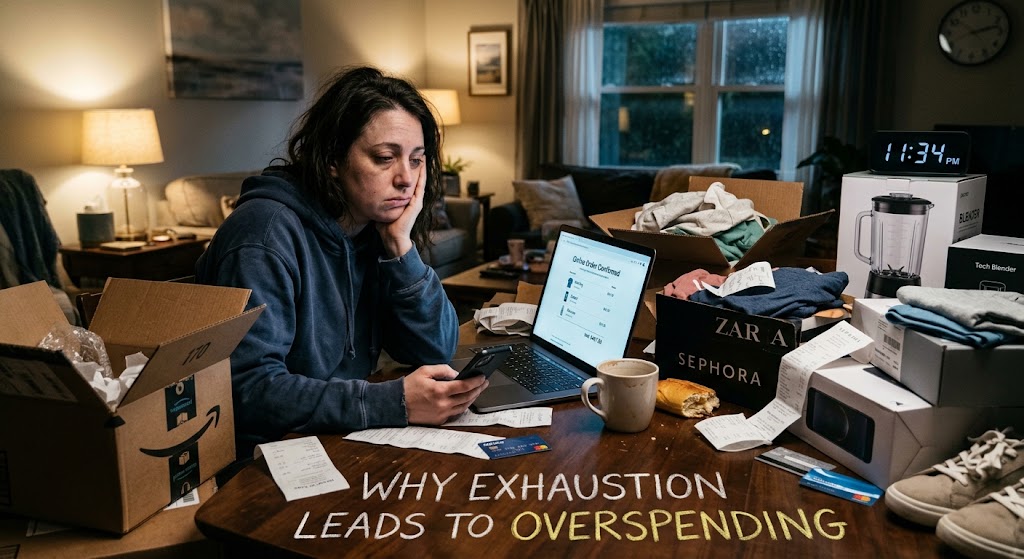
Why Exhaustion Leads to Overspending
Why Exhaustion Leads to Overspending is a question that deserves far more attention than it receives. Most people understand that being tired can affect their mood, concentration and productivity, but fewer people realise that exhaustion can also affect the way they handle money. You may think you are making an ordinary purchase after a stressful day, only to discover later that you spent far more than you intended. You may order food instead of cooking, buy something online because you feel you deserve a reward, take an expensive ride because you do not have the energy to use public transport, or subscribe to another service simply because cancelling it feels like too much work. These decisions may appear unrelated, but they can all be connected to exhaustion.
Why Exhaustion Leads to Overspending becomes easier to understand when you recognise that money decisions require mental energy. Every financial decision involves some level of judgement. You have to compare prices, consider alternatives, think about future consequences, control impulses and decide whether something is genuinely necessary. When you are rested, these decisions can feel manageable. When you are physically or mentally exhausted, however, even simple choices can feel unnecessarily difficult.
Exhaustion does not automatically make someone financially irresponsible. A hardworking, disciplined and financially conscious person can still overspend when they are exhausted. The problem is that tiredness can weaken the mental processes that normally help you pause and evaluate a decision. When your mental energy is low, immediate comfort can become more attractive than long term financial goals.
This is one of the biggest reasons Why Exhaustion Leads to Overspending. Your brain naturally looks for ways to reduce effort. After a long day, you may not want to compare ten restaurants, check prices across different websites, prepare a meal, review your bank balance or think deeply about whether you actually need something. You simply want the easiest solution available.
Imagine coming home after working for ten hours. You are hungry, frustrated and mentally drained. There is food in your kitchen, but preparing it requires effort. You open a food delivery app and see your favourite meal. The meal costs significantly more than cooking at home, but at that moment, the extra money may feel less important than the convenience. You place the order.
The purchase may not be financially disastrous on its own. The problem occurs when the same pattern happens repeatedly. A small convenience purchase today becomes another tomorrow, followed by online shopping, ride hailing, impulse purchases and unnecessary subscriptions. Eventually, the person wonders where their money went.
This is why exhaustion can quietly become an expensive habit.
Another reason Why Exhaustion Leads to Overspending is emotional spending. Exhaustion is not always physical. You can be emotionally exhausted from work, family responsibilities, financial pressure, relationship problems, social obligations or constant exposure to information. When emotional energy is depleted, people often search for something that provides immediate pleasure.
Shopping can provide that temporary emotional lift. Buying something new can create excitement. Ordering a favourite meal can provide comfort. Booking an expensive outing can create something to look forward to. Even scrolling through an online shop can provide a brief distraction from stress.
The problem is that emotional relief and financial wisdom are not always the same thing.
You may know that you should save money, but when you are exhausted, the desire to feel better immediately can overpower the desire to achieve a financial goal months from now. The future becomes abstract while the immediate reward feels real.
This creates a dangerous psychological trade off. Instead of asking, “Will this purchase help me achieve what I want financially?” you may unconsciously ask, “What can make me feel better right now?”
That small change in the question can completely change your spending behaviour.
Exhaustion can also increase decision fatigue. Modern life requires people to make hundreds of decisions every day. What should I eat? What should I wear? Which task should I complete first? Should I respond to this message? Should I attend this meeting? Should I take this route? Should I buy this product? Should I save this money?
By the end of the day, your ability to make thoughtful choices can feel significantly reduced. This is where spending becomes particularly vulnerable.
Instead of comparing options, you may choose the first acceptable option. Instead of waiting for a better price, you may buy immediately. Instead of questioning whether you need something, you may simply convince yourself that it is affordable.
This does not necessarily mean your financial knowledge disappeared. It means you may not have enough mental energy to apply that knowledge.
Convenience is another major factor in Why Exhaustion Leads to Overspending. Convenience has a price, and tired people are often more willing to pay it.
Consider transportation. When you are energetic, you may compare different routes and choose the cheaper option. After a stressful day, you might automatically choose the most convenient ride even if it costs considerably more.
The same principle applies to food, shopping, entertainment and household services. You may pay extra for delivery rather than collect something yourself. You may buy a more expensive product because it is immediately available. You may pay someone to perform a task you would normally do yourself.
There is nothing inherently wrong with paying for convenience. In fact, convenience can be valuable. The problem is failing to recognise when convenience spending has become an automatic response to exhaustion.
Exhaustion can also make promotional tactics more powerful. Retailers understand that people respond to urgency, scarcity and emotional triggers. Messages such as “limited time offer”, “only a few left” and “sale ends tonight” encourage immediate decisions.
When you are rested, you may question whether the offer is genuinely valuable. When you are exhausted, you may simply want to stop thinking about it.
You might tell yourself, “I will regret missing this deal.”
Ironically, you may end up regretting buying something you never needed.
Online shopping makes this even easier. You do not have to travel to a shop, speak to anyone or physically hand over cash. You can make a purchase within seconds while lying in bed at midnight.
This is one reason late night shopping can become dangerous for people who are exhausted. Your resistance is already weakened, and the purchasing process has been designed to require very little effort.
Another important factor is the desire for self reward. People who work extremely hard sometimes develop the belief that they deserve to spend because they are tired.
After surviving a difficult week, you may think, “I deserve this.”
There is nothing wrong with rewarding yourself. The danger begins when every difficult day becomes a justification for spending.
If you repeatedly reward exhaustion with spending, you can unintentionally create a cycle. You work hard, become exhausted, spend money to feel better, experience financial pressure, work harder to compensate, become exhausted again and spend again.
The financial consequences can eventually become more stressful than the original exhaustion.
Understanding Why Exhaustion Leads to Overspending therefore requires looking beyond the purchase itself. The real issue is often what the purchase represents.
Sometimes you are not buying the product. You are buying convenience.
Sometimes you are not buying the meal. You are buying relief.
Sometimes you are not buying the clothes. You are buying excitement.
Sometimes you are not buying the holiday. You are buying escape.
Sometimes you are not buying the expensive coffee. You are buying a five minute feeling that your difficult day is finally under control.
Recognising this distinction can completely change your financial behaviour.
One of the simplest ways to protect yourself is to create financial rules before you become exhausted. This is important because tired you may make different decisions from rested you.
For example, you can decide that non essential purchases above a certain amount must wait 24 hours. You can create a weekly convenience budget. You can limit food delivery to specific days. You can remove saved payment details from shopping websites. You can also unsubscribe from promotional emails that encourage unnecessary purchases.
These systems reduce the number of decisions you need to make when your mental energy is low.
Automation can also help. If you automatically transfer money into savings after receiving income, you reduce the possibility of spending everything before saving. If bills are automated, you reduce the risk of forgetting them during stressful periods. If you have separate accounts for different purposes, you can make it harder for exhaustion driven spending to consume money meant for important goals.
Another useful strategy is to identify your personal exhaustion triggers.
Do you spend more after a stressful workday?
Do you shop online late at night?
Do you order expensive food when you are too tired to cook?
Do you take expensive transportation after working late?
Do you buy things after arguments or disappointing experiences?
Do you spend more immediately after receiving your salary?
Your answers can reveal patterns that a traditional budget may not show.
A budget tells you where your money should go. Awareness tells you why it keeps going somewhere else.
This is why tracking spending is so powerful. Do not only record the amount you spend. Record the circumstances surrounding the purchase. Write down whether you were tired, stressed, hungry, bored, angry or celebrating.
After several weeks, patterns may become obvious.
You might discover that your biggest unnecessary expenses happen between 9 pm and midnight. You might realise that your spending increases dramatically after difficult days at work. You might notice that you rarely overspend when you have slept well.
Once you understand the pattern, you can design a solution around it.
For someone who spends excessively after work, the answer might be preparing meals in advance. For someone who shops online late at night, the answer might be deleting shopping apps from their phone. For someone who uses expensive transportation when exhausted, the solution might be creating a transport budget specifically for difficult days.
The goal is not to eliminate every convenience from your life. The goal is to stop exhaustion from making financial decisions on your behalf.
Sleep and recovery also matter more to personal finance than many people realise. People often treat rest as something that should happen only after everything else is finished. But if exhaustion consistently damages your judgement, productivity and spending behaviour, recovery becomes part of financial management.
A person who refuses to rest because they are trying to work harder may eventually lose money through poor decisions, reduced productivity and unnecessary spending.
Rest is not laziness.
Sometimes rest is financial discipline.
This does not mean everyone who overspends is simply tired. Overspending can have many causes, including poor budgeting, social pressure, emotional difficulties, financial insecurity, impulsive behaviour and lifestyle inflation. Exhaustion is one possible contributor, but understanding it can provide an important missing piece of the puzzle.
There is also an important lesson here for people trying to improve their financial lives. You should not build a financial system that requires perfect discipline every single day.
That system will eventually fail.
Life gets busy. You get tired. Work becomes stressful. Family responsibilities increase. Unexpected problems appear. If your entire financial strategy depends on making perfect decisions while exhausted, you are relying on willpower at exactly the moment when willpower may be weakest.
A stronger approach is to build systems that protect you from your worst moments.
Set spending limits. Automate savings. Plan meals. Create emergency funds. Remove unnecessary shopping triggers. Establish waiting periods for large purchases. Keep your financial goals visible. Decide your rules while you are calm so that you do not have to negotiate with yourself when you are exhausted.
The deeper lesson behind Why Exhaustion Leads to Overspending is that financial behaviour is not purely mathematical. Personal finance is also psychological.
Knowing that you should save money does not automatically mean you will save it. Knowing that a purchase is unnecessary does not always stop you from buying it. Knowing that your future self needs the money does not always defeat the desire for immediate comfort.
Your emotional and physical state can influence your financial decisions.
That is why becoming financially successful is not simply about earning more money. It is also about understanding the conditions under which you make financial mistakes.
You need to know yourself.
If you consistently spend when you are tired, do not simply promise yourself that you will “try harder” next time. Build a system that makes overspending harder.
If you always order expensive food when exhausted, prepare simple meals ahead of time.
If you shop online when stressed, remove the apps or payment details that make impulse buying effortless.
If you spend excessively after payday, automate your savings before discretionary spending begins.
If you repeatedly justify purchases because you “deserve something nice”, create a specific reward budget so that enjoyment remains part of your financial plan without destroying it.
The objective is balance, not punishment.
Money is supposed to serve your life, and spending money on comfort, enjoyment and convenience is not automatically irresponsible. The issue is whether those purchases align with your priorities or are simply reactions to temporary exhaustion.
Once you understand Why Exhaustion Leads to Overspending, you can begin separating genuine needs from emotional reactions. You can start asking yourself better questions before spending.
Do I actually need this?
Would I buy this if I were rested?
Am I buying this because it is valuable or because I am exhausted?
Am I paying for something because it genuinely improves my life or because I cannot be bothered to think about alternatives?
Will I still be happy with this purchase tomorrow?
Could I achieve the same result for less money?
These questions do not require complicated financial knowledge. They simply create a pause between emotion and action.
That pause can save you a surprising amount of money.
Ultimately, Why Exhaustion Leads to Overspending is not a story about weak people or irresponsible consumers. It is a reminder that humans have limits. When your body and mind are depleted, your priorities can temporarily shift towards immediate comfort and reduced effort.
The good news is that awareness gives you an advantage.
You cannot eliminate every stressful day. You cannot always avoid being tired. You cannot control every emotional situation that influences your spending. But you can prepare for those moments.
You can make your financial decisions when you are calm and rested. You can automate important actions. You can create boundaries around convenience spending. You can recognise emotional triggers. You can give yourself affordable ways to recover without turning every difficult day into a shopping opportunity.
The next time you find yourself spending money after an exhausting day, do not immediately ask, “Why am I so bad with money?”
Ask a better question.
“Am I actually making a financial decision, or am I simply trying to feel better?”
That question can expose the real reason behind many seemingly random purchases.
Sometimes the solution to overspending is not another budgeting app, another financial book or another lecture about discipline.
Sometimes the first step is simply getting enough rest to make a better decision.

EarnSmartOnline.com.ng is dedicated to helping readers make smarter financial decisions through practical guides on online income, personal finance, technology, digital business, and wealth creation. Our goal is to provide reliable, easy-to-understand, and actionable content that empowers individuals to earn smarter, build sustainable income streams and achieve long-term financial success.
Recommended: Start Earning Online
- Ultimate Affiliate Marketing Program — learn affiliate marketing with a done-for-you sales system ($15). Check it out
- The Newbie Affiliate Guide — the beginner-friendly starter guide (~$6.68). Check it out
- Easy Dollar Maker — earn in dollars uploading AI images and videos from your phone ($17). Check it out
Disclosure: These are affiliate links. If you buy through them, I may earn a commission at no extra cost to you.



