
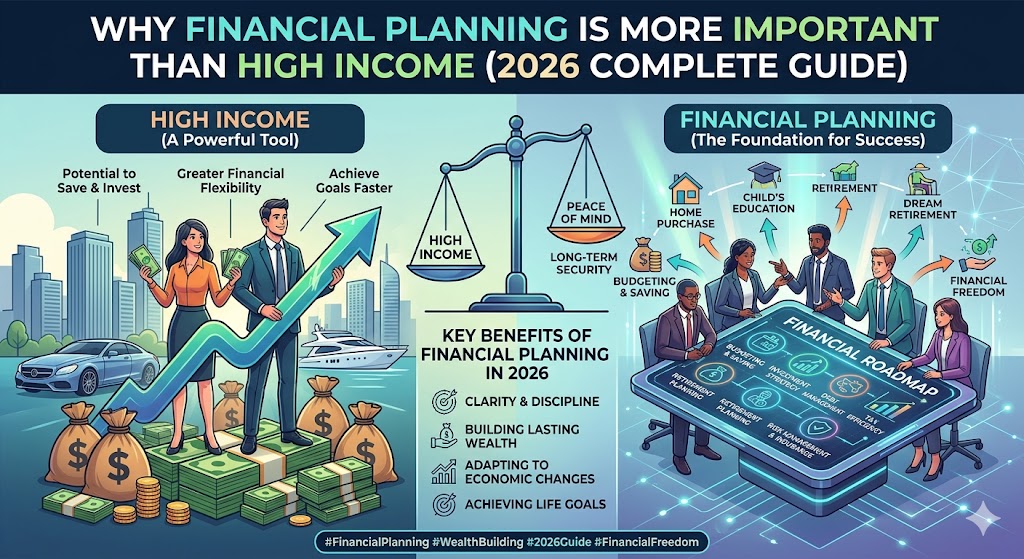

Why Financial Planning Is More Important Than High Income (2026 Complete Guide)
Financial success is often misunderstood. Many people believe that earning a high income automatically guarantees wealth, comfort, and financial freedom. However, real-life experience shows something very different.
In reality, financial stability is not determined by how much you earn, but by how well you manage what you earn. This is where financial planning becomes more important than income itself.
A person earning a modest salary with proper planning can outperform someone earning a high salary with poor financial discipline. This article explains why financial planning matters more than high income and how you can apply it to build long-term financial stability.
Understanding the Difference Between Income and Financial Planning
Before comparing both concepts, it is important to understand what they mean.
Income refers to the money you earn from work, business, investments, or any other source.
Financial planning refers to how you:
Budget your money
Save consistently
Invest for the future
Control your spending
Prepare for emergencies
Income is what comes in. Financial planning is what you do with it.
This difference is the foundation of financial success.
Why High Income Alone Is Not Enough
Many people assume that increasing income solves financial problems. While higher income can improve lifestyle, it does not automatically create wealth.
Without proper financial planning, higher income often leads to higher spending. This is known as lifestyle inflation.
For example:
A person earning ₦150,000 may rent a modest apartment and manage expenses carefully
The same person earning ₦500,000 may immediately upgrade to expensive rent, cars, and lifestyle choices
In both cases, the result may still be living paycheck to paycheck.
This shows that income alone does not guarantee financial freedom.
The Problem of Lifestyle Inflation
Lifestyle inflation happens when spending increases as income increases. It is one of the biggest reasons many high earners remain financially unstable.
Common examples include:
Moving to more expensive housing immediately after a salary increase
Buying expensive gadgets and luxury items
Eating out more frequently
Increasing unnecessary subscriptions and lifestyle costs
Over time, expenses grow to match income, leaving little or nothing to save.
Without financial planning, higher income simply creates higher consumption, not wealth.
Financial Planning Gives Every Naira a Purpose
One of the biggest advantages of financial planning is control.
Instead of spending money randomly, financial planning allows you to assign roles to your income, such as:
Savings
Investments
Bills and expenses
Emergency funds
Personal development
When money is structured, it becomes easier to track and manage.
For example, if you earn ₦300,000 monthly:
50% can go to expenses
20% to savings
20% to investments
10% to emergencies or personal development
This structure ensures that every naira has a purpose.
Without planning, money disappears without accountability.
Wealth Is Built Through Allocation, Not Just Earnings
Two people can earn the same income but end up in completely different financial positions after a few years.
Person A:
Earns high income
Spends freely
Saves very little or nothing
Has no investments
Person B:
Earns moderate income
Follows a strict budget
Saves and invests consistently
Builds assets over time
After 5–10 years:
Person A remains financially dependent on income
Person B has investments, savings and passive income sources
This proves that wealth is created through how money is allocated, not how much is earned.
Financial Planning Protects You From Financial Shocks
Life is unpredictable. Unexpected events can disrupt even the highest income earners.
Common financial shocks include:
Job loss
Medical emergencies
Business failure
Economic downturns
Family responsibilities
High income does not protect anyone from these challenges.
However, financial planning provides protection through:
Emergency funds
Insurance coverage
Diversified income sources
Savings buffers
With proper planning, financial shocks become manageable instead of devastating.
Financial Planning Helps You Build Multiple Income Streams
Relying on a single income source is risky.
Financial planning encourages you to:
Save part of your income consistently
Invest in income-generating assets
Learn new skills that create side income
Start small online or offline businesses
Over time, this leads to multiple income streams.
For example:
Salary from job
Profit from small business
Returns from investments
Online income from freelancing or blogging
This diversification increases financial stability and reduces dependence on one source.
Discipline Is More Powerful Than Income
Financial discipline is one of the strongest predictors of long-term financial success.
A person earning less but saving consistently will outperform someone earning more but spending carelessly.
This is because:
Discipline builds consistency
Consistency builds savings
Savings build investments
Investments build wealth
Income alone does not follow this chain. Discipline does.
Financial Planning Gives You Direction
Without financial planning, money decisions become emotional and random:
Impulse purchases
Unplanned loans
No savings goals
Lack of investment direction
With financial planning, everything becomes structured:
You know how much to spend
You know how much to save
You know when to invest
You have clear financial goals
This structure turns money into a tool for growth instead of stress.
Real-Life Example
Consider two individuals:
High Income Earner (No Planning)
Earns ₦600,000 monthly
Spends ₦580,000 monthly
Saves almost nothing
No investments
Moderate Income Earner (With Planning)
Earns ₦250,000 monthly
Saves ₦50,000 monthly
Invests ₦50,000 monthly
Builds financial assets over time
After several years:
The high income earner still depends on salary
The moderate income earner has passive income sources and savings growth
This clearly shows that planning beats income.
How to Start Financial Planning Today
If you want to improve your financial life, here are simple steps:
1. Track your income and expenses
Know exactly where your money goes.
2. Create a monthly budget
Assign percentages to spending, saving and investing.
3. Build an emergency fund
Aim for 3–6 months of expenses.
4. Start investing early
Even small amounts matter over time.
5. Avoid lifestyle inflation
Don’t increase spending every time income increases.
High income can improve your lifestyle, but it does not guarantee financial freedom. Financial planning is what transforms income into wealth.
Without planning, money disappears quickly no matter how much you earn. With planning, even a small income can grow into long-term financial stability.
The real secret of financial success is simple:
Income helps you survive, but financial planning helps you build wealth.
If you want to achieve financial independence, start focusing less on how much you earn and more on how you manage what you earn.

EarnSmartOnline.com.ng is dedicated to helping readers make smarter financial decisions through practical guides on online income, personal finance, technology, digital business, and wealth creation. Our goal is to provide reliable, easy-to-understand, and actionable content that empowers individuals to earn smarter, build sustainable income streams and achieve long-term financial success.
Recommended: Start Earning Online
- Ultimate Affiliate Marketing Program — learn affiliate marketing with a done-for-you sales system ($15). Check it out
- The Newbie Affiliate Guide — the beginner-friendly starter guide (~$6.68). Check it out
- Easy Dollar Maker — earn in dollars uploading AI images and videos from your phone ($17). Check it out
Disclosure: These are affiliate links. If you buy through them, I may earn a commission at no extra cost to you.



